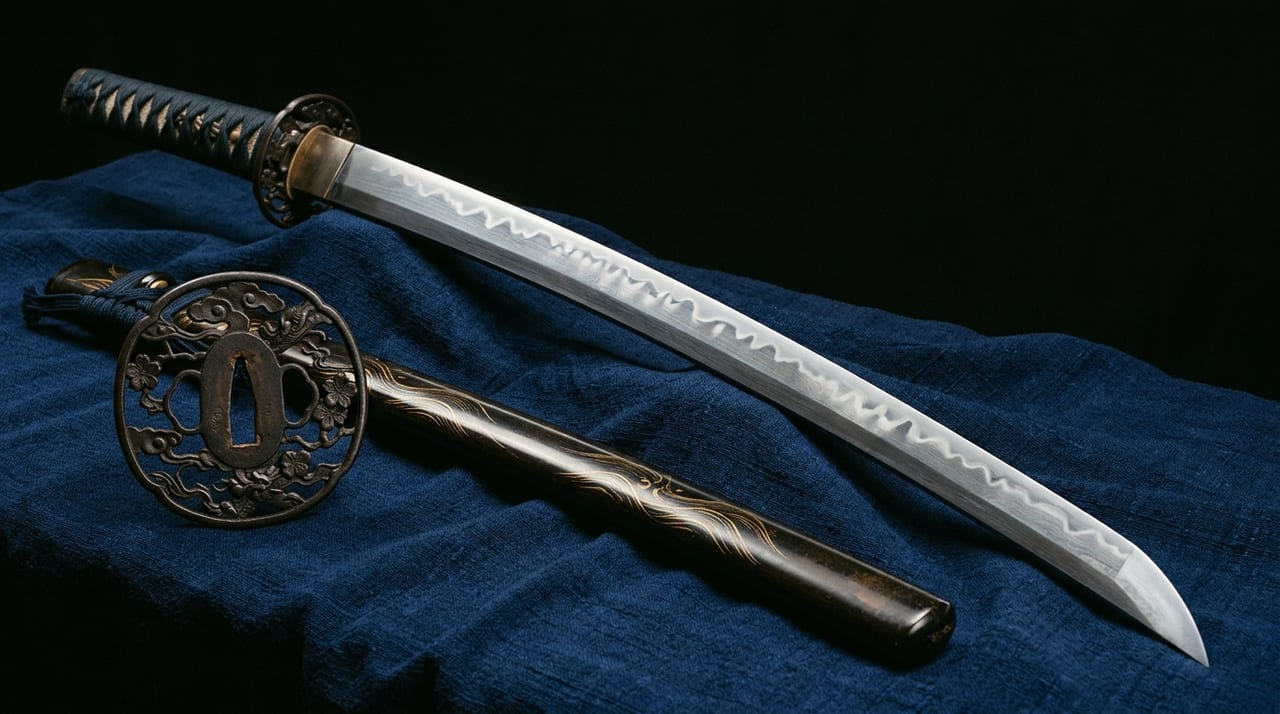
 * Image is for illustrative purposes only.
Tantō Signed Yukimitsu
短刀 銘 行光
Also known as: Signed tantō by Sōshū Yukimitsu; heirloom of the Kaga Maeda clan
Description
A National Treasure Tantō Bridging the Sōshū Tradition
The maker, Yukimitsu, was a smith of Sagami Province (present-day Kanagawa Prefecture), commonly known as Tōzaburō. He is variously recorded as the son or the pupil of Shintōgo Kunimitsu, founder of the Sōshū tradition, and is further said to have been the father or adoptive father of Masamune. He therefore stands at the midpoint of the lineage along which the Sōshū tradition was brought to completion, and his work is decisive evidence for how that tradition took form.
This tantō has a cutting edge of 26.2 cm and dates to the 14th century, in the Kamakura period. It clearly displays a transitional style, moving from the straight, linear suguha inherited from his master Kunimitsu toward the dynamic, undulating midare-ba of Masamune. The jigane is finely forged, and the temper line shows the activity characteristic of the Sōshū tradition.
The Rarity of Signed Works
Although Yukimitsu's reputation stands high, securely signed surviving works are very few. This blade and a tantō in the collection of the Imperial Household Agency are together regarded as his representative works, which makes the present signed example exceptionally valuable. Several unsigned blades are attributed to Yukimitsu, but because signed benchmarks are so limited, this tantō forms the cornerstone of scholarship on the smith.
Provenance and Designation
The blade was formerly held by the Maeda clan of Kaga, the "million-koku" domain, and counts among the celebrated swords transmitted in that house. It is now in the collection of the Tokyo National Museum and is designated a National Treasure in the crafts category — an indispensable piece for tracing the formation of the Sōshū tradition and the lineage leading to Masamune.
Legends & Stories
Yukimitsu is recorded as the son or pupil of Shintōgo Kunimitsu, and as the father or adoptive father of Masamune — a figure said to link by blood the founder and the perfecter of the Sōshū tradition. Because so few signed works survive, however, the truth of the man himself remains obscure.