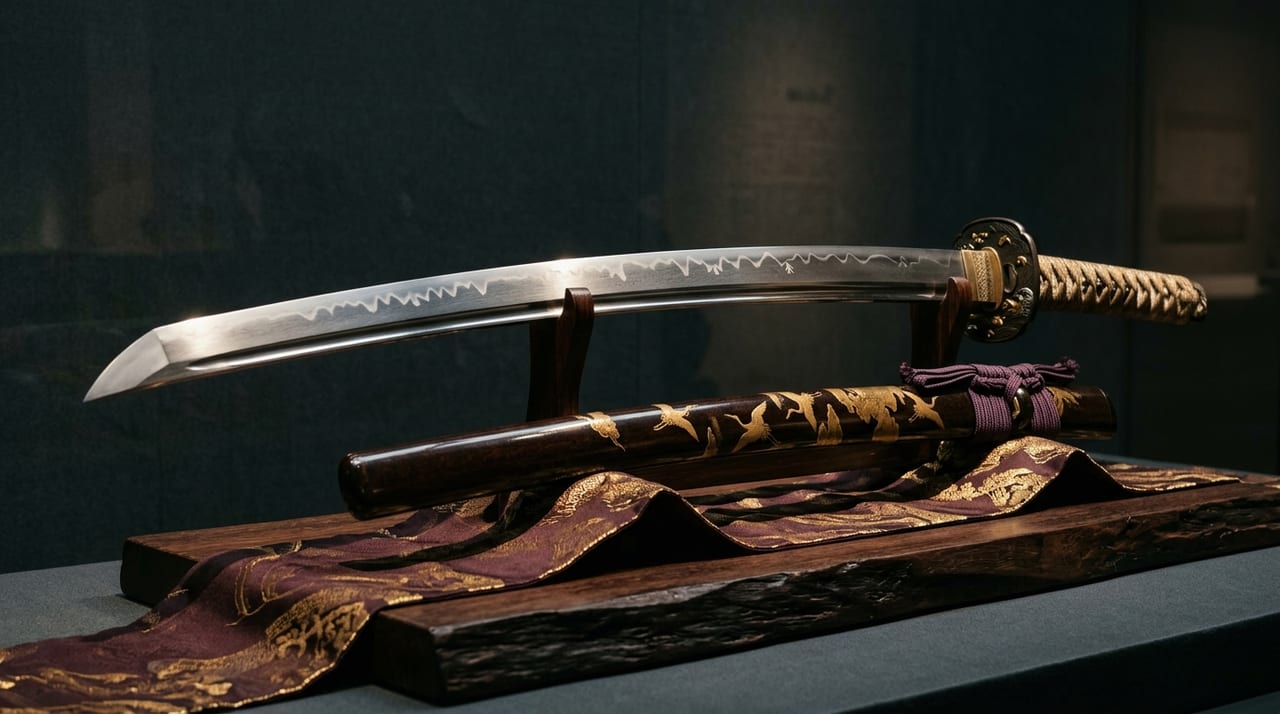
 * Image is for illustrative purposes only.
Tachi by Bizen Osafune Kagehide
備前長船景秀の太刀
Also known as: Tachi by Kagehide (Bizen Osafune, Elite Smith of the Nanbokuchō Period)
Description
Bizen Osafune Kagehide was a swordsmith active during the Kamakura period, based at Osafune in Bizen Province (modern Okayama Prefecture), and stands among the elite smiths of the Bizen sword tradition, counted in the lineage of Mitsutada, the founder of the Osafune school. While displaying the bold and imposing construction characteristic of Kamakura-era Bizen work, his technique is exemplified by the masterwork Kurombo-kiri Kagehide (designated as Jūyō Bunka-zai/Important Cultural Property), transmitted through the Date family collection. His tachi display a wide body, thick spine, and large kissaki. The jigane exhibits the uniformly packed ko-itame grain characteristic of Bizen work, with ji-nie and ji-kei creating steel of pleasing depth. The hamon is primarily kata-ochi gunome chōji (one-sided-falling wavy clove pattern), abundant in ashi (activity lines descending toward the edge) and yō (floating formations of nie), an energetic pattern displaying the splendid mastery that upholds the Bizen tradition. Tachi bearing Kagehide's signature are housed at the Bizen Osafune Japanese Sword Museum and institutions across the country, with many designated as Jūyō Tōken. Born and trained at Osafune—Japan's greatest sword-producing region—Kagehide's technique embodies the inherent strength of Bizen swordsmanship.
Legends & Stories
A tradition surrounding Kagehide tells of a Southern Court general holding out at Mount Yoshino who commissioned him to 'forge a spirit blade to break the great armies of the Northern Court.' Kagehide is said to have gathered sacred iron sand from Bizen's rivers and, conducting thirty-three days of ritual prayer within his forge, completed a tachi for presentation. The general who wore that blade is said never to have suffered defeat in battle thereafter, and the sword was passed down through generations of Southern Court loyalists as a blade embodying the spiritual power of the Bizen tradition. Another legend recounts that a disciple who witnessed Kagehide working in his final years declared, 'The master's technique is inhabited by the deity of Bizen,' a phrase that has been repeated ever since, cementing Kagehide's place as a symbol of the Osafune tradition passed on to the next generation.
Related Famous Swords
短刀 銘備州長船住長重
National TreasureTantō Signed Bishū Osafune-jū Nagashige
Nagashige (Bizen Osafune, Chōgi school)
藤島友重の太刀
Important Cultural Property and Important Sword (Multiple Designations)Fujishima Tomoshige's Tachi
Fujishima Tomoshige
分部志津
Important Cultural PropertyWakebe Shizu
Shizu Kaneuji (Shizu Saburō Kaneuji)
山城信国
Important Cultural Property (several works)Yamashiro Nobukuni
Nobukuni