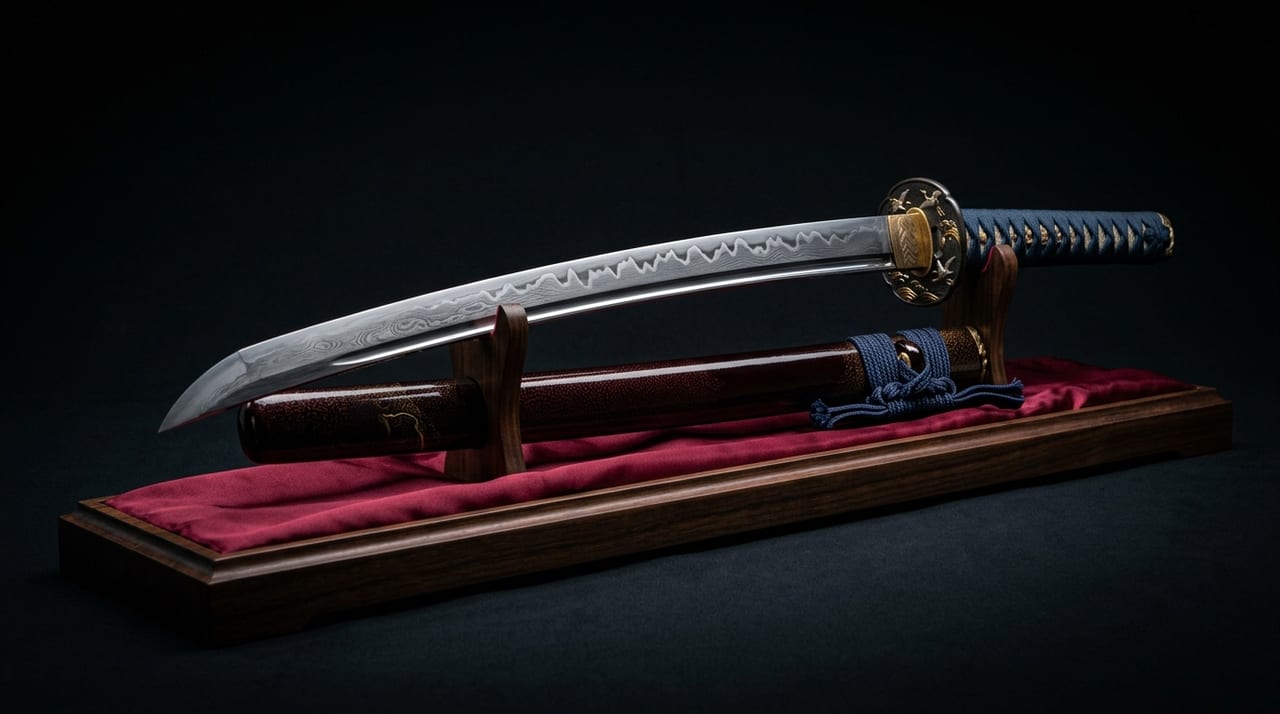
 * Image is for illustrative purposes only.
Nanki Shigekuni
南紀重国
Also known as: Sword-Smith of the Kishu Tokugawa; Master of Wakayama; Shigekuni-Masamune
Description
Nanki Shigekuni was the master swordsmith under the patronage of Tokugawa Yorinobu, founder of the Kishu (Kii Province, modern Wakayama) branch of the Tokugawa — one of the three senior Tokugawa branches (Gosanke). Working in the early Edo period, Shigekuni distinguished himself from contemporaries by consciously emulating the Soshu-den (Kamakura) style of Masamune and Sadamune: powerful ōnitae hamon, flowing ōitame-nagare hada with thick ji-nie, and bold, turbulent activity rather than the decorative styles fashionable among many Edo-era smiths. His status as a retained swordsmith (okakae tōkō) gave him ideal conditions — secure income, finest materials — to produce work of the highest level. Multiple Important Cultural Properties and Important Swords survive. His work represents the Edo-era sword world's serious engagement with the lost glories of Kamakura technique.
Legends & Stories
Tokugawa Yorinobu as Patron
Tokugawa Yorinobu (1602–1671) was born as the tenth son of Ieyasu and became the founder of the Kishu branch of the Gosanke. Beyond being merely a daimyo, Yorinobu held a special interest in blades and martial arts, and was a lord who actively recruited retained swordsmiths and martial-arts masters to his domain, aiming to establish "the highest standard of samurai culture" within it. Behind Yorinobu's decision to retain Shigekuni lay both his pure passion for blades—the desire to possess "the finest swords at hand"—and a political intention to establish "cultural authority befitting the Tokugawa Gosanke." For Shigekuni, the position of retained swordsmith to the Gosanke meant both the highest honor as a craftsman and economic security; in this ideal environment, Shigekuni devoted himself fully to exceeding "the highest standard of the age." The relationship between Yorinobu and Shigekuni became a prototype of "the ideal patron-craftsman relationship" in Japanese sword history, treasured by later generations.
Sword Culture and Samurai Status During the Shinto Period
As the Edo period began (1603) and peace became established, the role of the Japanese sword transformed rapidly from "a weapon of actual combat" to "a symbol expressing samurai status and authority." Within this transformation, the "aesthetic quality" of blades came to be valued over practical function, and swordsmiths entered a competition of aesthetic pursuit—"more beautiful, more refined." Nankoku Shigekuni responded to these new demands of sword culture with his own distinctive approach: a revival of the Soshu-den tradition. Rather than competing in decorative novelty, he chose to face directly the aesthetics of the medieval masters (Masamune and Sadamune) who had received the highest historical evaluation. This "return to the classical" was not mere imitation but an expression of craftsman's integrity—learning from the greatest masters—and it is the reason why Shigekuni's works possess not only "bold, vigorous hamon" but also a depth of "dialogue with history."
Shigekuni and the Status of "Tokugawa Swords"
Since Tokugawa Ieyasu, the Tokugawa shogun and the Gosanke branches functioned as the highest patrons of sword culture in Japan, and retaining the finest swordsmiths formed part of Tokugawa authority. By becoming a retained swordsmith of the Kishu Tokugawa, Shigekuni established an evaluation of "Shigekuni's swords = swords bearing Tokugawa status." His works transcended being the masterpieces of an individual to achieve the status of "the highest expression of Tokugawa culture." This bond with the Tokugawa greatly enhanced Shigekuni's reputation while simultaneously giving him a strong motivation to "do the finest work worthy of the Tokugawa." In Edo-period sword culture, "the works of a retained swordsmith" were not mere commodities but "the face of the house"; the quality of such blades was directly connected to the cultural level of the domain. Shigekuni's masterpieces became preserved to this day as among the finest evidence that the Kishu Tokugawa could take pride in being "a seat of culture."
The Sword-Making Situation Around the Osaka Summer Campaign (1615)
The era in which Shigekuni was active coincided with a time when the Toyotomi fell in the Osaka Summer Campaign (1615) and the Tokugawa peace was becoming completely established. This historical context of "after the last war" fundamentally changed the meaning of the swordsmiths' work. Even after the war ended, daimyo continued to commission swords, but the purpose shifted from "preparation for some future war" to "the transmission of samurai culture and the expression of authority." The fact that Shigekuni's swords were created in the era immediately following the Osaka Summer Campaign means that they are products of "the finest sword culture of the post-war age." Even after practical necessity for combat vanished, the samurai spirit of "possessing the finest sword" was maintained, and a culture pursuing "the sword as art" bloomed in ever purer form—Shigekuni's works embody this reality.
A Gift for Modern Viewers
When one sees Nankoku Shigekuni's blades in a modern sword exhibition, their vigorous hamon resounds with new depth as "a craftsman of the Edo period's salute to the Kamakura master." The revolutionary technique of Masamune, seven centuries past, was attempted to be "revived" by an Edo-period swordsmith four centuries earlier, and even in the present day this attempt remains a subject of evaluation—this depth of temporal dimension is one of the greatest charms of Japanese sword culture. The viewer who can discern within the intense jigane and wildly surging hamon of Shigekuni's blades both his respect for the Soshu tradition and the aesthetic sensibility of his own age experiences most deeply the essential attraction of Japanese sword culture: "dialogue with history." In the modern era, Shigekuni's works maintain an unwavering evaluation as "the pinnacle of the Shinto period," an evaluation that deepens with time. The artistry of Shigekuni, which bloomed under the patronage of the Kishu Tokugawa, embodies the heights of the Japanese sword in the final golden age of samurai culture; his name will continue to shine with glory in the history of Edo-period sword-making. The fusion of authority and refinement that his blades possess is nothing but a reflection of the spirit nurtured by Wakayama's majestic nature of mountains and sea. The swords that Shigekuni forged in Wakayama Castle are works of art in which Tokugawa authority and samurai aesthetics are marvelously fused, shining with eternal light in Japanese craft history as the ideal arrival point of sword culture in the age of peace.