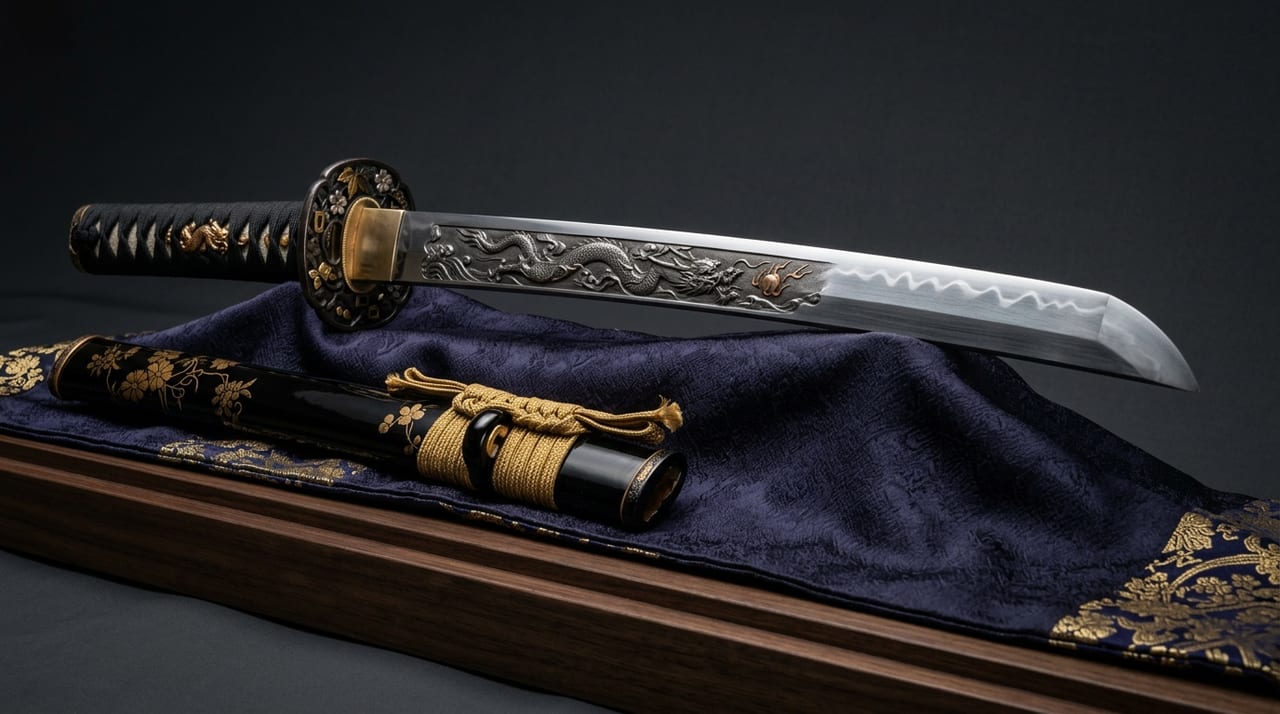
 * Image is for illustrative purposes only.
Katana by Kurihara Nobuhide
栗原信秀の刀
Also known as: Uchigatana by Kurihara Nobuhide (Shinshintō Master Carver of Edo)
Description
Kurihara Nobuhide (1815–1880) was a leading swordsmith of the shinshintō (new-new-sword) period, active from the late Edo era into the Meiji period, celebrated above all as a master of blade carving (horimono). Born in Tsukikata Village, Nishi-Kanbara District, Echigo Province (present-day Niigata City, Niigata Prefecture), he later came to Edo, where he refined his forging skills under the guidance of Minamoto no Kiyomaro, himself a disciple of Suishinshi Masahide. Nobuhide's swords display a finely packed, uniform ko-itame jigane and a versatile command of hamon forms including gunome, chōji, and hitatsura. Yet his greatest distinguishing feature lies in his carving technique: the intricate and powerful carvings of dragons, Kurikara-Fudō, Sanskrit characters, and peony arabesques engraved on his blades were judged unsurpassed by any contemporary. He produced many presentation swords for the Tokugawa shogunate and daimyo lords, meeting the demand for refined weapons among the warrior culture throughout the turbulent final decades of the shogunate. After the Meiji Restoration, despite the headwinds of the sword-prohibition edict, he continued working and received commissions from new-government officials and businesspeople alike. Multiple surviving works hold the Jūyō Tōken designation, and blades with horimono command particularly high prices. As a swordsmith embodying the legitimate line of Edo shinshintō from Suishinshi Masahide through Minamoto no Kiyomaro, Nobuhide is an indispensable figure in the history of modern Japanese swordsmanship.
Legends & Stories
One legend surrounding Kurihara Nobuhide tells that his teacher Minamoto no Kiyomaro taught him: 'A sword is a vessel for the soul; horimono makes that soul visible.' The night Nobuhide completed his first dragon carving, the forge fire is said to have died out on its own while the blade alone continued to glow. Another story holds that when sonnō-jōi activists came seeking his blades during the turbulent final years of the shogunate, Nobuhide declared: 'This sword is not for cutting men—it is for cutting a path through the principles of heaven and earth,' and charged twice the price. It was also believed that the protection of the Fudō Myōō carved on his blades shielded their bearers, and warriors who returned unharmed from battle were said to attribute their survival to 'Nobuhide's sword.'