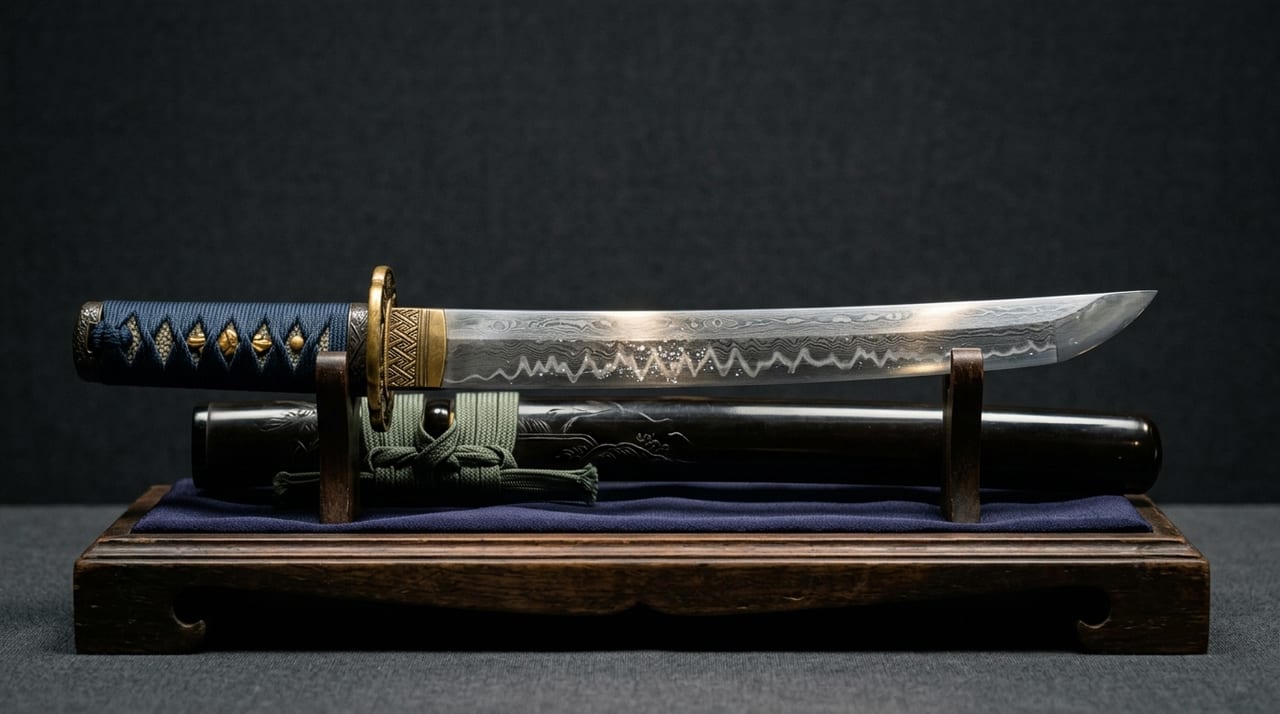
 * Image is for illustrative purposes only.
Ikoma Mitsutada
生駒光忠
Also known as: Ikoma Mitsutada — National Treasure katana by Osafune Mitsutada, Eisei Bunko
Description
Overview of Ikoma Mitsutada
Ikoma Mitsutada is a katana attributed to Bizen Osafune Mitsutada, a master smith active in Osafune, Bizen Province (present-day Osafune-chō, Setouchi City, Okayama Prefecture) in the mid-Kamakura period. Its formal name is “Katana, with gold-inlaid inscription Mitsutada, Kōtoku kao, held by Ikoma Sanuki no kami.” It was designated a National Treasure on February 2, Shōwa 30 (1955). It is currently held by the Eisei Bunko in Bunkyō-ku, Tokyo. Mitsutada is regarded as the de facto founder of the Bizen Osafune school. As a representative smith of Kamakura-period Bizen who perfected the magnificent chōji-midare, his works were especially prized by Oda Nobunaga and successive powerful figures.
Name Origin and Provenance
The sword takes its name from the Ikoma family of Sanuki, a daimyō house. The tang bears the owner's gold-inlaid inscription “Ikoma Sanuki no kami shoji.” The owner is said to have been Ikoma Chikamasa, who served Toyotomi Hideyoshi and governed Sanuki, or his son Kazumasa. The blade has been shortened by ō-suriage and has lost its signature. However, Hon'ami Kōtoku appraised it as the work of Mitsutada, and that appraisal was cut into the nakago as a gold-inlaid inscription. Based on Kōtoku's handwriting, this inlay is thought to have been applied around the late Keichō era (1610s).
In the late Meiji period, Hosokawa Moritatsu, later the sixteenth head of the Hosokawa family, purchased this sword while still in his teens. Moritatsu later built a vast art collection and founded the Eisei Bunko. Ikoma Mitsutada is said to have been found after a long search for a Mitsutada that could rival the one held by Kiyota Masanao, a former retainer, and Moritatsu is said to have bought it with pocket money borrowed from his mother. It remained a sword that Moritatsu boasted about for years afterward.
Style and Highlights
The blade is broad in width (mihaba) and presents an imposing bearing (taihai). The jigane is a tightly packed ko-itame hada with ji-nie, and the distinctive Bizen midare-utsuri stands out clearly. The hamon is mainly chōji-midare, Mitsutada's hallmark, and shows a gorgeous, varied temper with kawazuko chōji and jūka chōji mixed in. Many ashi and yō appear within the hamon, and the nioiguchi is bright and clear. The bōshi (the hamon at the tip) is ko-nie deki and nearly fully hardened. These features convey that Mitsutada established the splendid style of mid-Kamakura Bizen. Although the blade is unsigned, its quality is worthy of National Treasure designation.
Evaluation
Mitsutada's signed works are, of course, limited in number, so a blade of this quality with an ō-suriage, unsigned tang is extremely rare. Ikoma Mitsutada also has a distinguished provenance, having passed through the hands of two daimyō houses, the Ikoma and the Hosokawa. It is highly regarded as one of the representative works that vividly demonstrate the splendid style of Osafune Mitsutada.
Legends & Stories
Hosokawa Moritatsu repeatedly asked Kiyota Masanao, a former retainer and sword enthusiast who owned a Mitsutada, to sell it to him, but was refused with the words, “Ika ni o-tono-sama demo, kono katana dake wa sashiage kaneru.” (“Even for you, my lord, I cannot give up this sword.”) So he searched for a Mitsutada that would surpass Kiyota's, and after a long search came upon this sword. Still in his teens, Moritatsu borrowed pocket money from his mother and bought it. Later, the sword scholar Satō Kanzan was often boasted to by Moritatsu with the words, “Dō da, Kiyota no Mitsutada ni makemai ga?” (“Well? It is no worse than Kiyota's Mitsutada, is it?”)