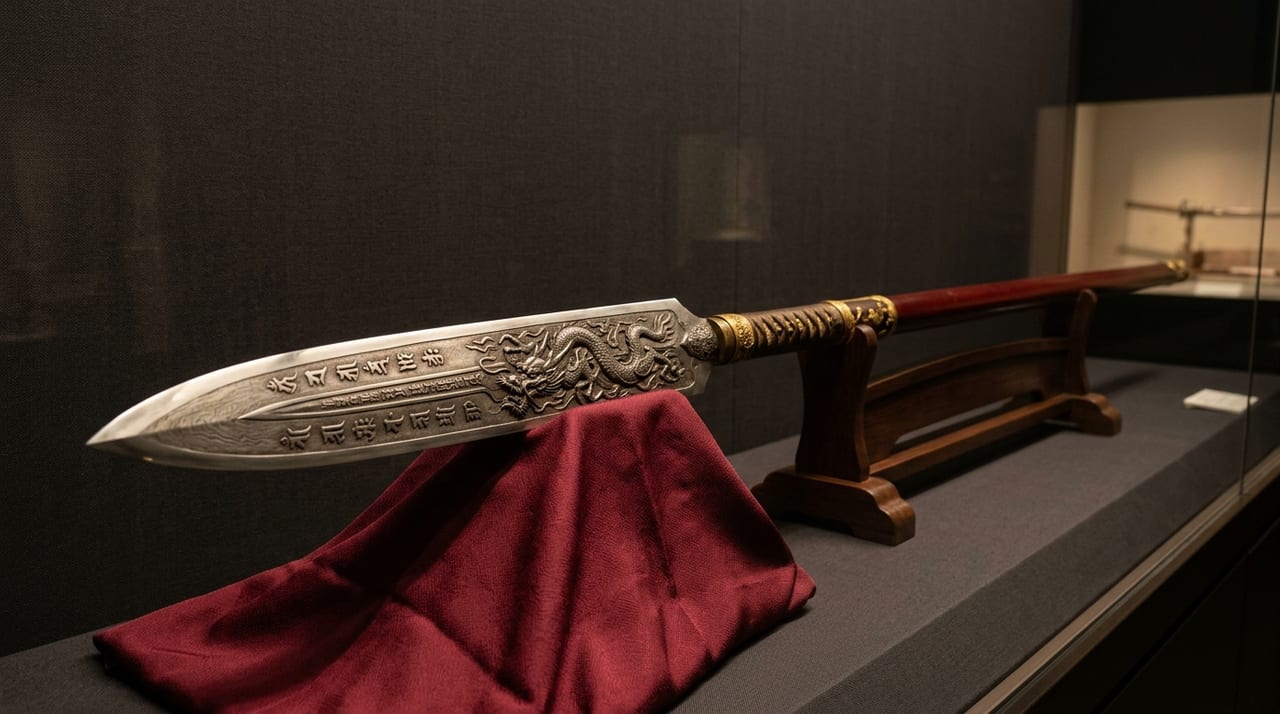
 * Image is for illustrative purposes only.
Fukushima Mitsutada
福島光忠
Also known as: The Osafune Mitsutada of Fukushima Masanori / a lost meibutsu
Description
A signed tachi by the founder of the Osafune school
The Fukushima Mitsutada is a tachi forged by Mitsutada, the master smith of the mid-Kamakura period who founded the Osafune school in Bizen Province. Its blade length is 2 shaku 3 sun 7 bu (about 71.8 cm). It is signed, and it is recorded as having grooves carved on both faces. Mitsutada is also known as a favourite of Oda Nobunaga, and his works stand out for their splendid chōji-midare hamon. This blade is listed in the Kyōhō Meibutsu Chō, compiled by the Hon'ami family at the order of the eighth shogun, Tokugawa Yoshimune, and is valued at 30 pieces of gold (some manuscripts say 130).
Origin of the name and transmission
The name derives from its possession by Fukushima Masanori, a Azuchi-Momoyama period warrior known as one of the Seven Spears of Shizugatake. How Masanori came to acquire this blade is unclear. After Masanori was stripped of his domain in 1619 for repairing Hiroshima Castle without permission, he died in Takaino, Shinano Province, in 1624. His son Masatoshi then presented the sword, as a relic of his father, to the third shogun, Tokugawa Iemitsu. In 1627, Iemitsu bestowed it on Tokugawa Yorifusa, the first lord of the Mito domain, and thereafter it was passed down through the Matsudaira family of the Shishido domain in Hitachi Province, founded by a son of Yorifusa. When the Kyōhō Meibutsu Chō was compiled, it was recorded as being held by the Matsudaira family, lords of Shishido.
A lost masterpiece
After it passed into the Matsudaira family of the Shishido domain, its whereabouts are unknown, and it remains a famous blade whose location is still unknown to this day. Some researchers point out that the existing National Treasure Mitsutada bearing the Kōtoku inlaid inscription may be this very sword, but this has not been confirmed. Passing from the ruler of the realm to a great daimyo house and then to the Tokugawa Three Houses, this blade vanished without a trace, making it a representative example of a famous sword that survives only in written records.
Mitsutada as a swordsmith
Mitsutada established the Osafune line in Bizen during the mid-Kamakura period. His son Nagamitsu and grandson Kagemitsu continued it, laying the foundation of the Osafune school. He excelled at wide, flamboyant chōji-midare, and his style is ranked alongside the contemporary Fukuoka Ichimonji school. It is said that Oda Nobunaga favoured Mitsutada's works and collected more than thirty blades. Famous meibutsu include the Shokudaikiri Mitsutada, the Jikkyū Mitsutada and the Ikoma Mitsutada. The Fukushima Mitsutada belongs to this group of signed works. Although it has been lost, its appearance, dimensions and appraised value have been handed down to the present through the record in the Kyōhō Meibutsu Chō.
Legends & Stories
The brave general of Shizugatake and a famous sword
Fukushima Masanori served Toyotomi Hideyoshi from childhood and built a record of military exploits, including being the first to thrust a spear at the Battle of Shizugatake, the Odawara campaign, and the invasion of Korea. He was a fierce general. The famous Mitsutada that Masanori held adds the dimension of a daimyo who appreciated fine swords to his image as a warrior devoted solely to martial prowess. Among the arms Masanori received from Hideyoshi, the spear "Nihongō," one of the Three Great Spears of Japan, is well known; it is said that Nihongō was won by Mori Tomonobu in a drinking contest.
A bequest presented to the shogunate
It is symbolic that this famous sword was presented to the shogunal house as a relic of Masanori, who lost his domain through the 1619 attainder and died in obscurity at Takaino in Shinano. As daimyo who had been favoured by the Toyotomi were absorbed into the Tokugawa order, famous swords also flowed to the side of the victors. Ironically, the sword that had been carefully handed down from the Mito Tokugawa of the Three Houses to their collateral line vanished from the records without anyone noticing.