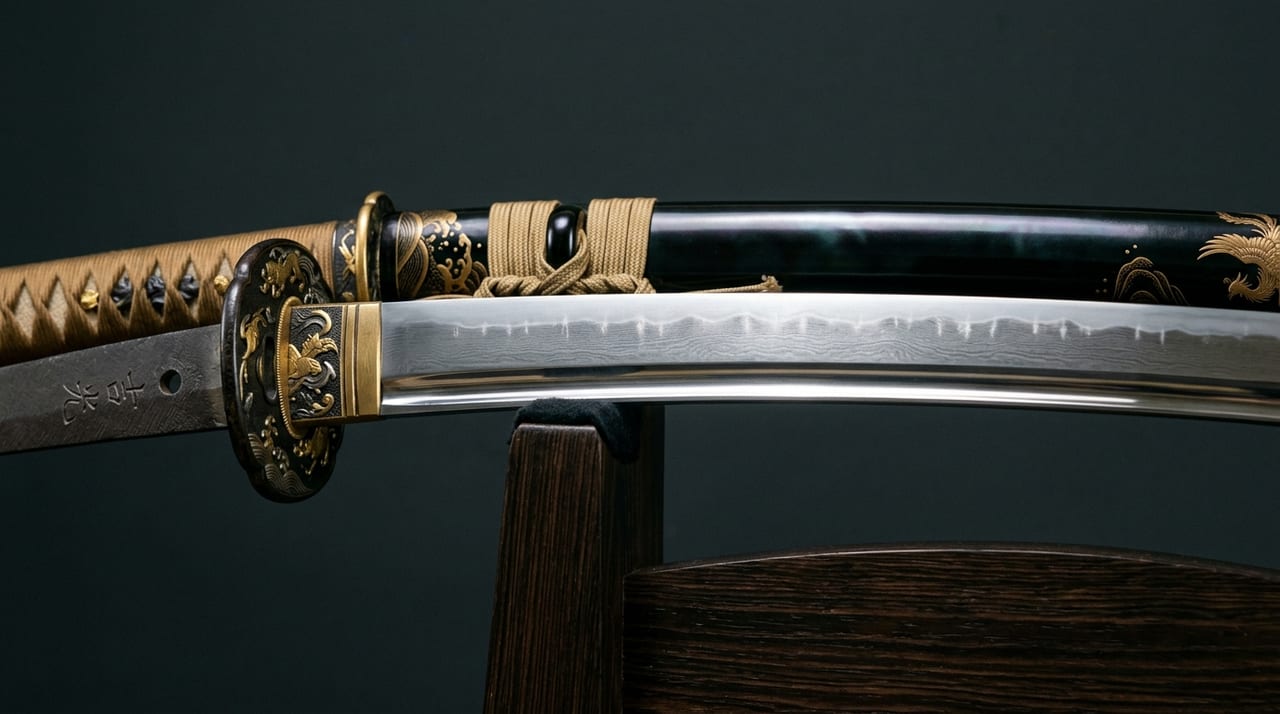
 * Image is for illustrative purposes only.
Tachi by Awataguchi Yoshimitsu
粟田口吉光の太刀
Also known as: Tachi by Tōshirō Yoshimitsu (Supreme Swordsmith of Kamakura Period)
Description
Awataguchi Yoshimitsu (Tōshirō) was the preeminent swordsmith of the late Kamakura period, based in Awataguchi, Yamashiro Province (modern Kyoto Prefecture), and is most often celebrated as 'Japan's greatest maker of tantō.' Yet Yoshimitsu's mastery was not confined to short blades—his tachi works, though exceedingly rare, carry exceptional value precisely because of their scarcity. The characteristics of an Awataguchi Yoshimitsu tachi reflect a transitional technical depth: rooted in the ancient Awataguchi tradition yet incorporating influences from the emerging Sōshū tradition. The jigane shows a fine, densely packed ko-itame grain richly covered with ji-nie, with some areas of flowing itame. The hamon is based on a ko-nie deki suguha, interspersed with subtle ko-midare and ko-gunome, and the blade is alive with fine activities (hataraki) throughout the tempered zone. The bōshi (tip temper) returns in a small round, and some surviving pieces retain a clear two-character 'Yoshimitsu' signature on the tang. Because so few tachi by Yoshimitsu survive, each piece is carefully preserved as a National Treasure or Important Cultural Property, and all continue to be held in the highest regard as pinnacles of Japanese swordsmithing. Unlike the celebrated Tōshirō tantō group, Yoshimitsu's tachi illuminate a distinct technical dimension of his art and serve as crucial references in sword scholarship.
Legends & Stories
Yoshimitsu is surrounded by numerous legends of divine protection. Concerning his tachi, one tradition holds that Emperor Go-Daigo chose a Yoshimitsu tachi as his personal sword (okoshimono) when raising his army to overthrow the shogunate. Believed that 'an enemy struck by Yoshimitsu's edge will surely be slain,' his swords were passed down among the loyal retainers of the Southern Court and are said to have served as one of the spiritual pillars supporting the Kenmu Restoration. Another anecdote holds that later swordsmiths who took up a Yoshimitsu tachi felt as though 'their master's hands were guiding their own,' a phrase still quoted today as testament that Yoshimitsu's technique had reached the realm of the divine.
Related Famous Swords
太刀 銘 国行(当麻)
National TreasureTachi Signed Kuniyuki (Taima)
Kuniyuki (founder of the Taima school)
伏見貞宗
National TreasureFushimi Sadamune
Sadamune (Sōshū Sadamune)
太刀 銘 大和則長作
Important Cultural PropertyTachi Signed Yamato Norinaga saku
Norinaga (Yamato Shikkake school)
沃懸地酢漿平文兵庫鎖太刀
National TreasureIkakeji Katabami Hyōmon Hyōgogusari Tachi
Unknown (unsigned)