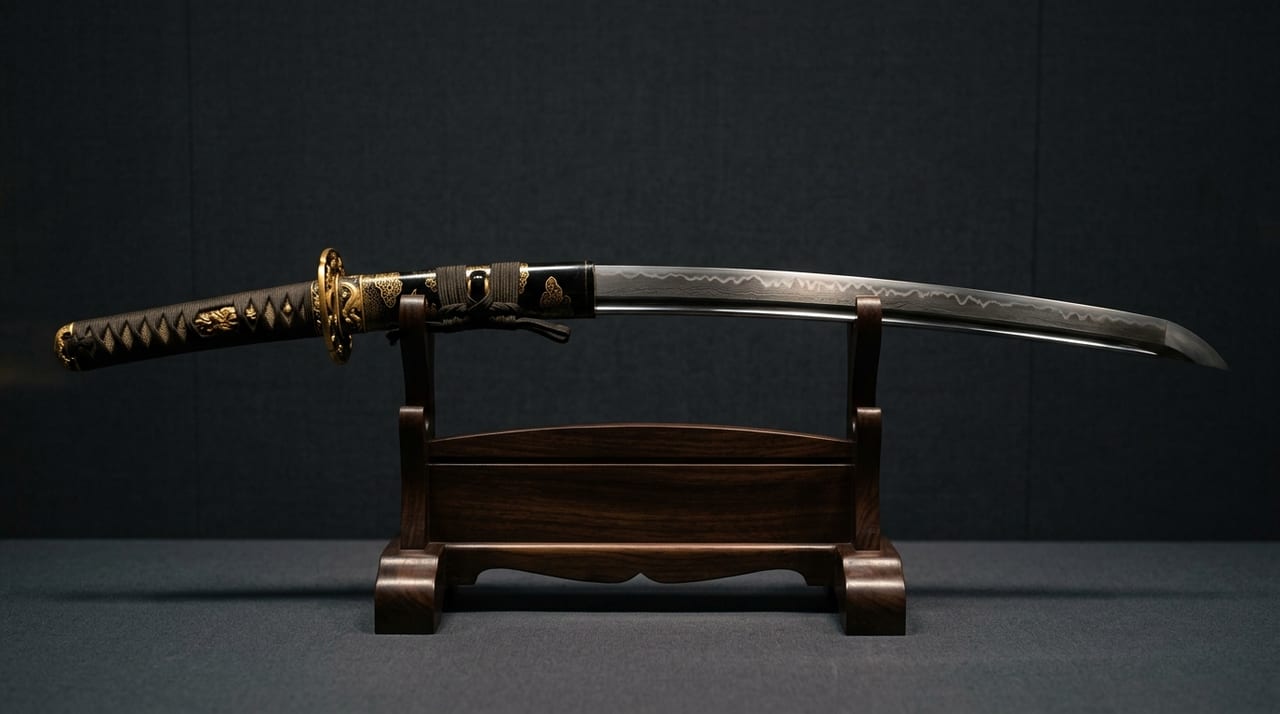
 * Image is for illustrative purposes only.
Aizen Kunitoshi
愛染国俊
Also known as: Aizen Kunitoshi — Tantō by Niji Kunitoshi, Former Maeda Clan Treasure
Description
Aizen Kunitoshi is a short sword forged by Kunitoshi, a swordsmith of the Rai school in Yamashiro Province during the late Kamakura period. It is a work of "Two-character Kunitoshi," defined by a signature reading only "Kunitoshi" in two characters. Among signed short swords of Two-character Kunitoshi, it is said to be the sole surviving example, and is highly valued for this rarity.
Origin of the Name and Carvings
The name derives from the carvings applied to the tang. Above the "Kunitoshi" signature on the tang, Aizen Myōō—a wisdom king of Esoteric Buddhism—is carved in fine relief, and the sword is called "Aizen Kunitoshi" after this deity. The blade bears a plain sword motif on the front surface and straight and hip grooves on the back surface. The presence of a Buddhist deity image carved on the tang suggests a devotional character, making the carvings a particularly noteworthy feature.
Style
Taking as its foundation the clear base steel characteristic of the Rai school, the blade exhibits a finely-packed small wood-grain surface pattern with a hardened edge. The Rai school is a distinguished lineage of the Yamashiro tradition, characterized by the precision and refinement of its steel; this work likewise demonstrates an elegant and refined execution worthy of that lineage. Despite its short length, the harmony between the carvings and the edge is striking, and this masterpiece directly conveys the skill of Rai no Kunitoshi.
Provenance
This work is known to have been transmitted through the Kaga Maeda family. In Jōhō 1 (1644), when Lady Ōhime, the young Inuchiyo's mother, who was an adopted daughter of Tokugawa Iemitsu, made her first visit to Edo Castle, the young Inuchiyo—later the fourth daimyo of Kaga, Maeda Tsunanori—is said to have been given this sword. Thereafter it was passed down through successive generations of the Maeda family in Kanazawa.
Designation and Current Holding
In Shōwa 8 (1933), it was recognized as an Important Art Object under the name of Marquis Maeda Toshinari. In Shōwa 10 (1935), it was designated a National Treasure under the former National Treasures Preservation Law. Under the Cultural Properties Protection Law enacted in Shōwa 25 (1950), it is now designated an Important Cultural Property as "Tantō with signature Kunitoshi (Meibotsu: Aizen Kunitoshi)." After leaving the Maeda family collection, it became privately held, and is currently owned by a corporate entity in Ibaraki City, Osaka Prefecture.
Legends & Stories
There is a long-standing theory of two smiths behind the name Kunitoshi of the Yamashiro Rai school. Because the workmanship differs between the smith who signed in only the two characters "Kunitoshi" (Niji Kunitoshi) and the one who signed in three characters as "Rai Kunitoshi," the prevailing view holds them to be different men. The surviving works of Niji Kunitoshi are chiefly tachi, and this blade is said to be his only tantō, which makes it exceptionally rare.
The name "Aizen" derives from the carvings rendered on the blade: the Esoteric Buddhist wisdom king Aizen Myōō on the front and a Kurikara dragon on the back. Aizen Myōō, a deity symbolizing the identity of earthly desire and enlightenment, was widely revered as an object of faith not only among warriors. The subject matter of the carvings shows that this blade carried a devotional and artistic character beyond that of a mere weapon.
The sword was handed down in the Maeda family, lords of the million-koku Kaga domain, and was carefully guarded as one of the family's treasures. The Maeda were renowned for assembling a great collection of fine swords, and Aizen Kunitoshi was among the representative blades of that collection.
It was designated an old National Treasure under the National Treasure Preservation Law in 1935 (Shōwa 10) and became an Important Cultural Property after the postwar enactment of the Cultural Properties Protection Law. It later left the Maeda family and is now held by a corporation in Ibaraki, Osaka. Combining the clear style of the Rai school with exquisite carvings, it has inscribed its name in sword history as the only known tantō by Niji Kunitoshi.