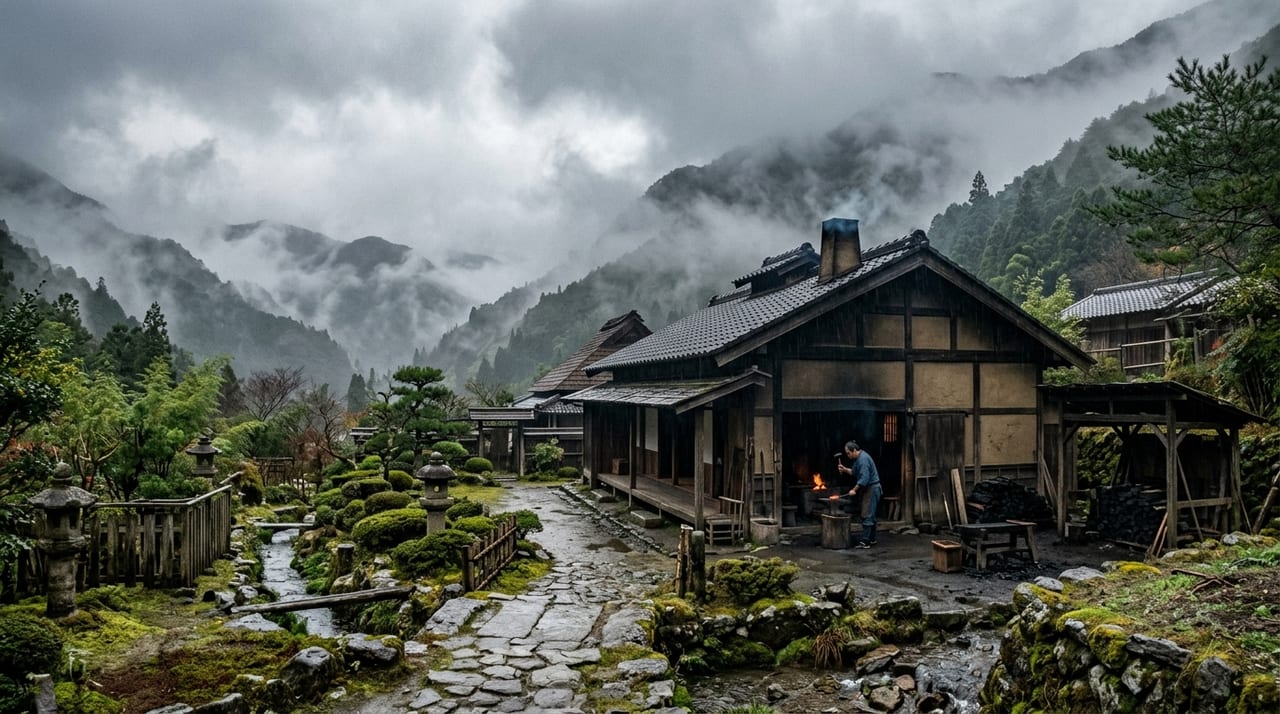
 * Image is for illustrative purposes only.
Tosa Tradition
土佐伝
The swordsmithing tradition of Tosa Province (present-day Kōchi Prefecture), celebrated for its robustly practical blades and its profound connection to the loyalist movement of the Bakumatsu era through the Tosa Loyalist Party.
Description
The Tosa tradition is a sword-forging heritage rooted in Tosa Province (present-day Kōchi Prefecture) on southern Shikoku, which underwent unique development as mainland and Kinai techniques filtered in during the Kamakura and Muromachi periods. Tosa's mountainous terrain and scarce farmland meant that throughout the Sengoku period, the populace continuously demanded practical weaponry. Consequently, Tosa smiths relentlessly pursued functionality over ornamentation, establishing a distinctive style characterized by bold, deeply curved bodies (sugata) and tough, resilient forging.
Under the governance of the Yamauchi clan in the Tosa domain, sword culture was preserved in distinctive form. The Yamauchi were outer lords (tozama daimyo) who took their position after the Battle of Sekigahara, with deep tensions persisting between them and the former Chōsokabe retainers. This structural tension cultivated independence and martial spirit among Tosa's warriors, manifesting as fierce attachment to swords. From the mid-Edo period onward, multiple smith families thrived in Tosa, developing the region's distinctive jihada and hamon while influenced by Bizen-den and Sagami-den traditions.
During the Bakumatsu era, Tosa assumed a crucial role at a turning point in Japanese history. Activists of the Tosa Loyalist Party (Tosa Kinnōtō), led by Takechi Hanpeita, championed the overthrow of the Shogunate under the banner of revering the emperor and expelling the barbarians; many carried Tosa blades while pursuing political activism and assassination campaigns. That Tosa-born activists, foremost among them Sakamoto Ryōma, rushed forth bearing swords inscribed Tosa blades as emblems of the age in history.
Among Tosa's notable smiths stands Hidari Yukihide, active in the Bakumatsu period. Born in Chikuzen, he became a Tosa domain smith; starting from the Bizen tradition, he incorporated Sagami-den, and his work earned him the nickname "Tosa Masamune." Additionally, Nankai Tarō Chōson, a Tosa native who was active mainly in Kyoto, returned home in 1858 (Ansei 5) and forged swords in Tosa; Takechi Hanpeita is known to have owned one of his blades. Following the Sword Abolition Edict of 1876, Tosa's swordsmithing culture declined rapidly, yet today research and preservation activities continue among sword enthusiasts throughout Kōchi Prefecture.
Characteristics of This Era
- Long blades with shallow curvature and a bold, powerful sugata
- Tough, layered jihada — itame or flowing masame grain emphasizing resilience over visual elegance
- Suguha and notare-based hamon — straightforward temper lines suited to cutting performance
- Functional koshirae over decorative — durability and ease of use prioritized
- Bakumatsu loyalist connection — swords of Tosa Kinnōtō activists including Sakamoto Ryōma