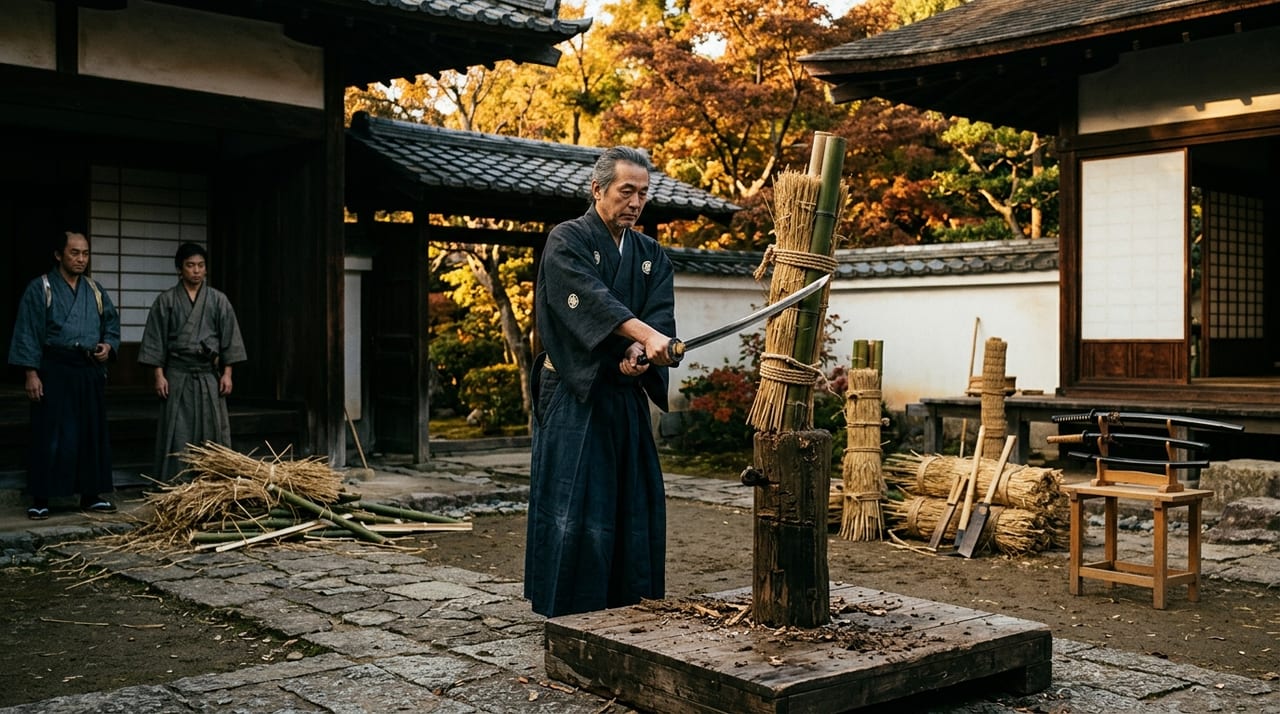
 * Image is for illustrative purposes only.
Tameshigiri — The Culture of Sword Testing
試し斬り・試刀の文化
During the early-to-mid Edo period, sword testing (tameshigiri) was institutionalized as a formal practice performed on executed criminals' bodies by licensed testers, most famously the Yamada Asaemon lineage, who held exclusive shogunate-sanctioned authority over sword appraisal through cutting tests.
Description
Origins and Significance of Tameshigiri
For a Japanese sword to be an excellent weapon, it required not only beauty and craftsmanship, but also "cutting ability" (kireasaji)—the actual capacity to sever objects. This empirical method of evaluating swords was called "tameshigiri" (sword testing) or "shitō" (sword testing). Though the practice of tameshigiri existed from ancient times, it was systematized as an institution during the early Edo period (17th century), becoming an officially sanctioned sword evaluation method conducted by specialized expert practitioners.
Materials and Methods of Sword Testing
Tameshigiri employed two main types of materials. One method used the bodies of criminals executed at execution grounds, placed on an earthen execution platform (dodan). During the Edo period, it was an established convention that bodies of those executed at bakufu and domain execution grounds could be used for sword testing, and tameshigiri masters would visit the grounds to demonstrate their swords' cutting ability. The other method employed "straw bundles" (warataba) or "green bamboo" (aodake), which later became more widespread.
Results of tameshigiri were recorded as "tameshi-mei" (test inscriptions carved on the tang). Notations such as "two-body severance" (nidō otoshi) or "three-body severance" (sandō otoshi)—indicating how many bodies (or bundles) could be severed in a single stroke—were engraved on the tang, functioning as a quality certificate for the sword.
The Yamada Asaemon Lineage and the Sword Testing System
The representative experts of Edo-period tameshigiri were the "Yamada Asaemon" lineage. The founder, Yamada Asaemon Sadatake (1657–1716), served as otameshi goyō, the official sword-testing post. In Genbun 1 (1736), his son Yoshitoki was granted permission to succeed to this role, after which the Yamada family came to monopolize the otameshi goyō. The Yamada family, also called "Asaemon the Beheader," continued the sword testing profession for eight generations until the early Meiji period.
The Yamada family were not merely sword testing practitioners but also excelled at sword appraisal and connoisseurship, authoring numerous sword evaluation treatises. The fifth-generation Yamada Asaemon Yoshimutsu (1767–1823) was particularly learned and left multiple sword works, including the "Kaihō Kenjaku" and "Kokon Kaji Bikō."
Types of Tameshi-mei and Sword Value
Tameshi-mei directly determined a sword's market value. Swords with records of cutting through multiple torsos, such as "futatsu-dō" (two-body) and "mittsu-dō" (three-body), were particularly highly valued.
However, problems arose with later-period forgery and re-carving of tameshi-mei. From the mid-Edo period onward, authentication of tameshi-mei inscriptions became an important concern for sword appraisers such as the Honami family.
Tameshigiri after the Meiji Era
With the Dajōkan proclamation of Meiji 3 (1870) prohibiting sword testing on executed criminals, sword testing using actual bodies came to an end. In modern times, tameshigiri using bamboo bundles, tatami mats, and wet straw continues to be performed as a demonstration of iaido and battōdo, and as a means of verifying a sword's cutting ability, being preserved as one form of traditional sword culture.
Characteristics of This Era
- Tameshi-mei (test inscriptions) carved on the tang recording cutting performance
- Shogunate-sanctioned monopoly by the Yamada Asaemon lineage
- Gradual shift from human subjects to straw and bamboo targets
- Direct link between cutting test results and market value
- Authenticity concerns around forged tameshi-mei requiring expert appraisal