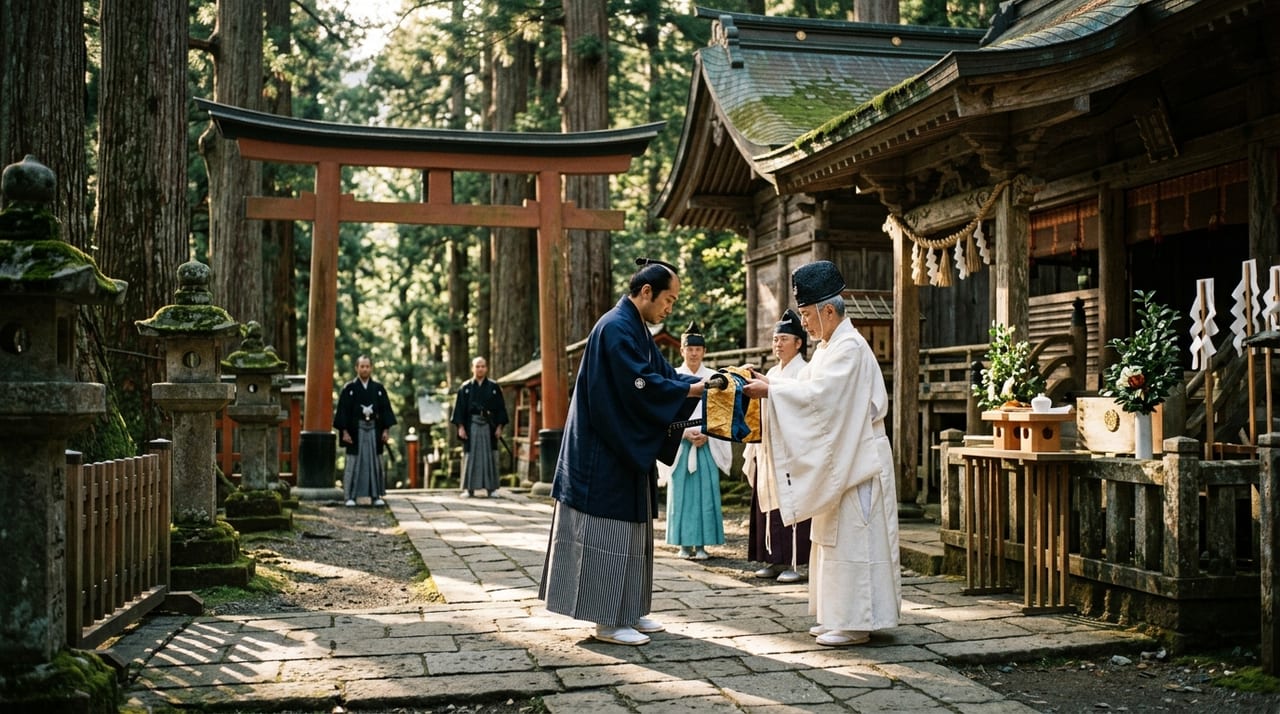
 * Image is for illustrative purposes only.
Swords and Ritual — The Art of Wearing a Sword and Votive Blades
刀剣と儀礼——帯刀の作法と奉納刀
The Japanese sword was far more than a weapon—it was a cultural object laden with ritual and religious meaning. This entry comprehensively explores the multifaceted roles swords played in Japanese rites of passage, social order, and religious practice: the etiquette of wearing a sword, shrine donations, shogunal audience protocol, and coming-of-age ceremonies.
Description
Social Significance of Wearing a Sword and Its Etiquette
In the Edo period, the right to wear a sword (taitō-ken) was a symbol of shibun (warrior status). Wearing swords was in principle prohibited for anyone outside the warrior class, under the shi-nō-kō-shō status system. Wearing the daishō nihon-zashi (a long and a short sword) was the formal status marker of warriors. The etiquette of wearing a sword, including how the blade was worn, the direction of the scabbard, and the way the koikuchi was opened, formed the core of buke reihō (warrior etiquette). The etiquette for wearing swords at formal occasions such as audiences, castle visits, and tea gatherings was strictly prescribed by family-transmitted etiquette manuals (such as Ogasawara-ryū reihō). The sword functioned as a symbol that made the status order visible.
History and Forms of Votive Swords
The custom of dedicating swords to shrines and temples dates back to ancient times. Swords were dedicated for many purposes, including festival offerings, prayers for victory in battle, recovery from illness, and national peace, and large numbers of dedicated swords accumulated in shrine treasure houses. The forms of dedicated swords ranged from practical blades to kazari-tachi, swords made purely for dedication. At Ise Jingū in particular, the onshōzoku shinpō, including the Sugari no Ontachi, were remade at every shikinen sengū, and this formed the core of national ritual. Many dedicated swords survive in the treasure halls of major shrines such as Kasuga Taisha, Kashima Jingū, and Sumiyoshi Taisha.
Genpuku and Swords
Genpuku is the rite of passage by which a warrior boy came of age. In the Edo period, the genpuku of the eldest son of a senior daimyō was held in the presence of the shōgun, and he received a sword together with a sakazuki. Receiving a sword from one's lord was also an important ritual for confirming the master-retainer bond. Genpuku swords were often kept for life as mamori-gatana, showing the cultural significance of swords as closely tied to an individual's life.
Weddings and Swords
In warrior weddings, swords played an important ritual role. The custom of bringing a tantō (mamori-gatana) as part of the bride's trousseau spread not only among warriors but also among commoners. This gave rise to the habit of women carrying a tantō as a mamori-gatana for self-protection and magical protection. The exchange of swords as wedding congratulatory gifts between daimyō, and between warrior families, was also widely practiced.
Funerals and Swords
In warrior funerary rites, swords were treated as important grave goods and heirlooms. Practices included the fukusō-tō, in which a warrior's beloved sword was placed in the coffin at his death, and the inheritance by family members and successors of the sword of a lord who died in battle. Swords thus were involved in the whole of a warrior's life, including his death.
Audience with the Shōgun and the 'O-memie' Ceremony
In the Edo period, the o-memie ceremony, in which daimyō and hatamoto had an audience with the shōgun, was one of the highest forms of sword ritual. The handling of swords during audiences, such as checking swords at the entrance (genkan) and carrying a koshigatana, was strictly prescribed. It developed as a ritual that gathered the essence of warrior etiquette. In particular, the etiquette of Edo Castle visits (tojō) during sankin kōtai most clearly showed the political relationship between shogunal authority and sword-wearing culture, and it was an institutional practice.
Continuity of Sword Rituals in the Present Day
After the Haitōrei (1876), the daily practice of wearing swords was lost. However, sword rituals in national ceremonies, such as the tachi-mochi of sumo yokozuna and the gyoken at the Emperor's enthronement ceremony (Sokui Tairei), survive today. So does the spirit of 'begin and end with rei' in the sword rituals of iaidō, kendō, and koryū bujutsu.
Characteristics of This Era
- Sword-wearing as visible social marker: The daishō (paired long and short sword) was the most direct visible badge of samurai status in Edo-period society; the presence, number, and quality of swords worn announced the wearer's social rank.
- Accumulation of votive swords in shrine treasuries: Major shrine treasure halls hold votive swords spanning from the Kofun period to the present, forming part of Japan's largest publicly accessible sword collections.
- Sword involvement across all rites of passage: The presence of swords in all major life transitions—genpuku, weddings, funerals—arose from the foundational belief that swords were spiritual beings that guarded a person throughout life.
- The concept of mamori-gatana: Separate from combat swords, guardian blades (mamori-gatana) for protection and apotropaic purposes positioned the sword as a religious talisman; placing one beside a birthing woman or a sick person was a widespread custom.
- Significance of hairyō-tō (lord-bestowed swords): A sword given by a lord to a retainer was one of the highest expressions of the master-retainer bond; the hairyō-tō was treated with special reverence as an embodiment of the lord's will and person.
- Specialization of ceremonial fittings: Fittings designed exclusively for ceremony and votive offering (kazari-tachi koshirae, sokutai-tachi koshirae) developed distinct from practical sword mounts, evolving as fine-art objects combining the best of metalwork, lacquer, and textiles.
- Continuity to the present: even after the Haitōrei, sword rituals have continued in yokozuna dohyō-iri, the Emperor's enthronement ceremony (Tairei), and martial arts ceremonies. This shows that the cultural significance of swords continues to live on in modern society.