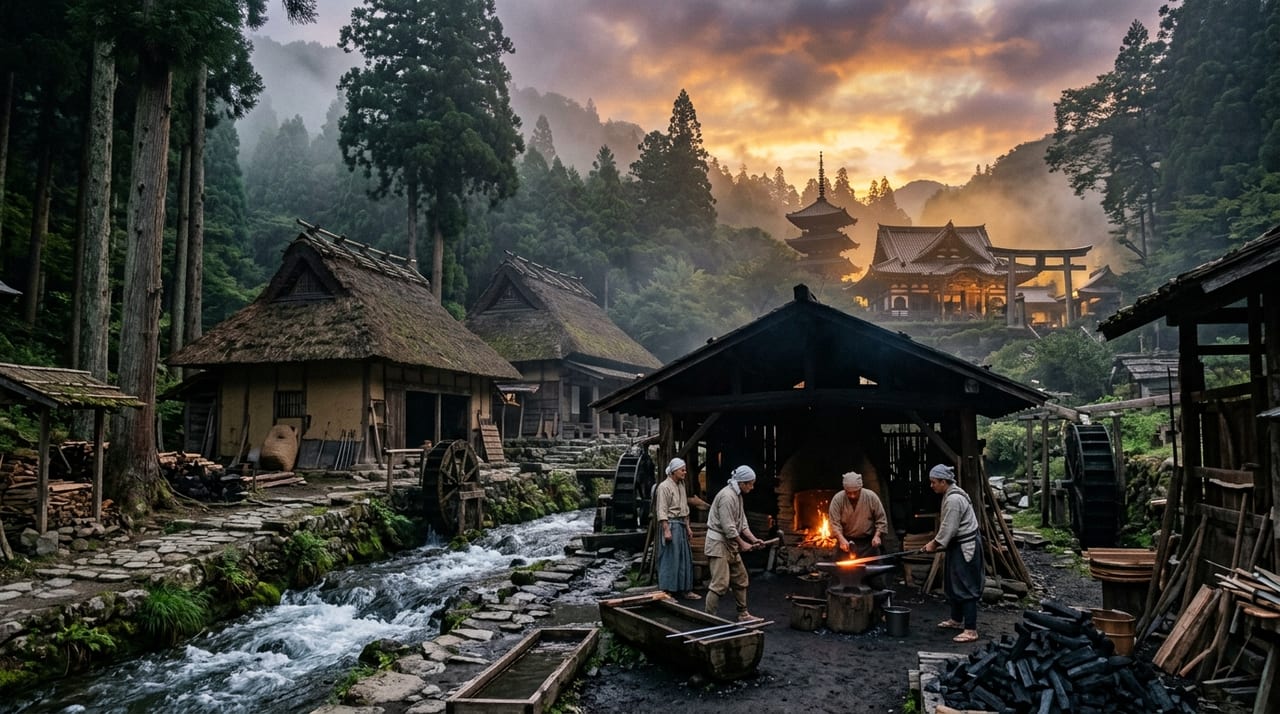
 * Image is for illustrative purposes only.
Sōden-Bizen and the Cross-Tradition Technical Synthesis
相伝備前と五伝の技術融合
The late Kamakura and Nanbokuchō period witnessed an unprecedented cross-pollination of Japan's five sword traditions, driven primarily by the dispersal of Masamune's ten great disciples (Jittetsu) from Kamakura to provinces across Japan. The hybrid styles they created — Sōden-Bizen, Sōden-Mino, and related mixed traditions — produced some of the most technically complex and aesthetically admired blades in Japanese sword history, establishing the archetypes that later revival movements would spend centuries attempting to recover.
Description
Masamune's Technical Revolution
The hamon technique established by Masamune, the perfecter of the Sōshū-den, in the late Kamakura period (roughly the 1290s to the 1330s) was one of the greatest technical revolutions in the history of the Japanese sword. Against nioi-deki, the technique used by the earlier Bizen smiths, in which nioi (clusters of mist-like fine particles) form the edge of the hamon, Masamune perfected nie-deki. In nie-deki, the large nie grains work across the entire hamon so roughly and richly that the individual particles can be distinguished. The rich scenery of the Sōshū-den, in which nie particles produce complex effects within the hamon such as kinsuji, sunagashi, chikei and yubashiri, opened a revolutionary new dimension in the aesthetics of the Japanese sword that had existed before.
Dispersal of the Masamune Jittetsu and Transmission of the Technique
Masamune's revolutionary technique was transmitted throughout the country by ten senior disciples known as the Masamune Jittetsu. There are various theories about the members of the Jittetsu, but the following smiths are cited as representative: Yoshihiro (Gō Yoshihiro) of Etchū (present-day Toyama Prefecture), Chōgi of Bizen Osafune, who was active in the Nanboku-chō period, Shizu Saburō Kaneuji of Mino, Samonji of Kyūshū, and Hasebe Kunishige of Yamashiro. These smiths are considered the core members. Each of them fused the traditional techniques of their home region or new place of settlement with the nie technique of the Sōshū-den, and created an entirely new 'blended style' (sōden).
Achievement of Sōden Bizen
As the foremost example of 'Sōden Bizen' by the Bizen smiths among the Masamune Jittetsu, Osafune Kanemitsu can be cited. Kanemitsu forged a majestic 'nie-nioi-deki no ō-midare' in which he added the nie of the Sōshū-den to the chōji-midare of nioi-deki in the Bizen tradition, and skillfully fused the elegance of classical Bizen blades with the vigor of the Sōshū-den. Kanemitsu left a wide range of works, from ōdachi to tanto, and his tachi were treasured for a long time by later generations as masterpieces representing the last golden age of Bizen blades.
Establishment of Sōden Mino
Shizu Saburō Kaneuji was a smith who transplanted the techniques of the Sōshū-den to Mino Province (present-day Gifu Prefecture), and as one of the Masamune Jittetsu he renewed the technical foundation of Mino blades. Kaneuji's works show strong nie of the Sōshū-den working on the distinctive Mino 'ō-itame' surface, in which itame and masame are mixed, and they demonstrate a high standard approaching the majesty of Masamune. The Mino smiths who inherited Kaneuji's technique later established a mass-production system as the 'Seki kaji' and achieved industrial development by single-handedly meeting the demand for swords in the Sengoku period. However, Kaneuji's works possess an artistic standard completely different from the Mino blades of the later mass-production period, and they receive unique recognition as the highest peak of 'Sōden Mino'.
The Mystery of Gō Yoshihiro
Among the Masamune Jittetsu, the smith most shrouded in mystery is Yoshihiro (Gō Yoshihiro) of Etchū (present-day Toyama Prefecture). As the ancient saying 'No one has ever seen a Gō or a ghost' indicates, no signed works by Yoshihiro survive, yet many unsigned works have received kiwame attributing them to Yoshihiro, and the authentication of their authenticity is one of the most difficult challenges in sword appraisal. Works regarded as Yoshihiro's include a scene in which complex ji-hada movement intertwines with a wild nie hamon that is said to surpass even the majesty of Masamune, and he is given the highest rating as one of the Tenka Sansaku. The existence of a Tenka Sansaku smith with no (or extremely few) signed works heightens to the utmost both the difficulty of authentication and the rarity of Yoshihiro's works, in cases where his works are said to survive.
Later Influence and the Challenge of Reproduction
The 'Sōden style' works created by the smiths of this period became the ideal that the smiths of the later Shintō and Shinshintō periods pursued forever as the objects of their 'utsushi' (copies). The fact that Taikei Naotane devoted his life to reproducing chōji-midare, and that Yamaura Saneo and Suishinshi Masahide aimed to reproduce the Sōshū-den, was inspired by this group of masterpieces from the late Kamakura to the Nanboku-chō period. The idea that 'forging copies of famous swords is the supreme task of a smith' continues to this day, and it shows that the works of this period have continued to serve as the 'standard' of Japanese sword culture.
Characteristics of This Era
- Transmission of the Sōshū-den throughout the country by the Masamune Jittetsu: an unprecedented event in which the technical revolution of a single genius rewrote all five traditions through ten disciples. It is the greatest historical example of how the master-disciple transmission system spread a technical innovation nationwide
- Achievement of Sōden Bizen (nie-nioi-deki midare hamon): a complex beauty without precedent, in which the richness of Bizen nioi and the wildness of Sōshū nie are fused. The state reached by Osafune Kanemitsu and Chōgi became an eternal goal for later smiths
- Establishment of Sōden Mino (Shizu Kaneuji): the Sōshū-den fused with the ō-itame surface of Mino, renewing the technical foundation of later Mino-den and Seki kaji. The technical fusion of this period can be seen as a remote cause of the industrial development of the sword during the Sengoku period
- The mystery of Gō Yoshihiro: a Tenka Sansaku smith with almost no signed works. Authentication of extant works is at the highest level of difficulty, and the saying 'No one has ever seen a Gō or a ghost' expresses the worship of his extraordinary technique and the mystery that continues to this day
- The historical significance of works from this period becoming the objects of 'utsushi' in later revival movements: the creation of the ideal that the famous smiths of the Shinto and Shinshinto periods continued to take as their model. It is the most important achievement in Japanese sword culture, namely 'the establishment of a standard'
- The appearance of hitatsura (hardening spreading across the entire surface of the blade): the bold technique represented by Hasebe Kunishige, in which hardening spreads across the whole blade, could not have arisen without the nationwide transmission of the Sōshū-den. It is the most extreme technical experiment produced by crossing traditional boundaries