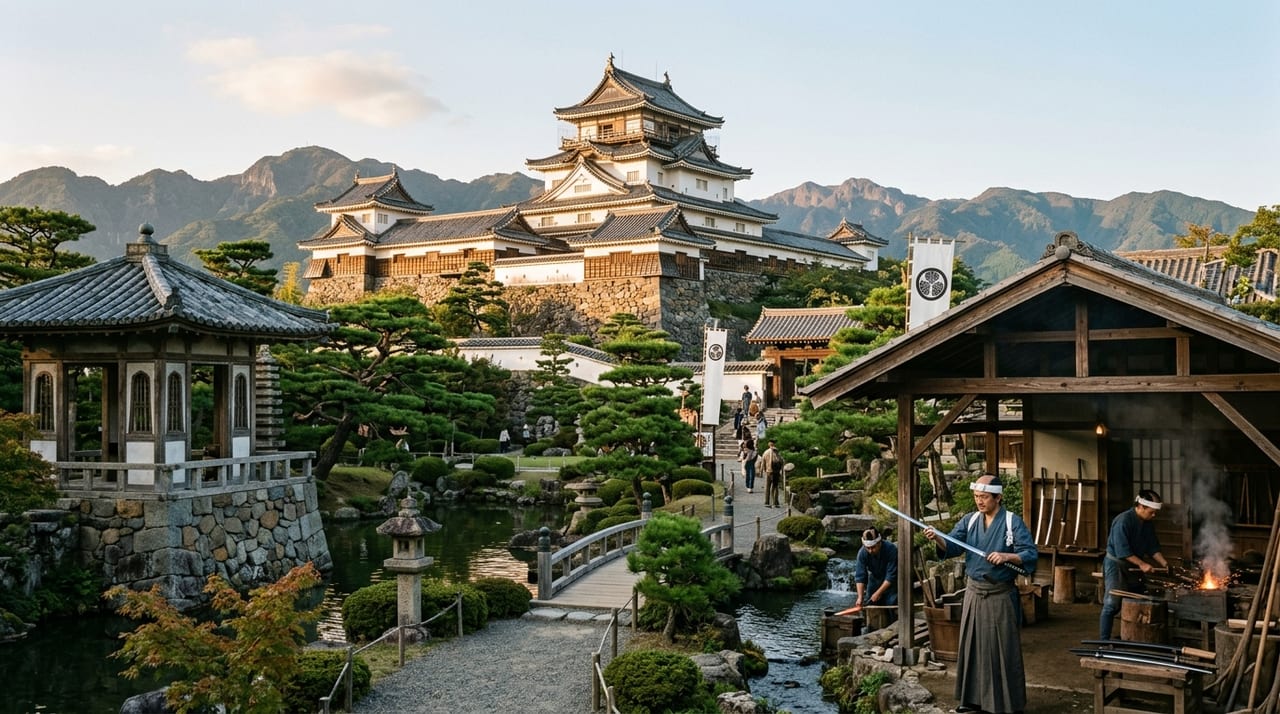
 * Image is for illustrative purposes only.
Kishu-Tokugawa Sword Culture
紀州徳川家の刀剣文化
The Kishū Tokugawa family (Wakayama Domain), one of the Gosanke, maintained retained swordsmiths led by Nanki Shigekuni and passed down a line of swordsmiths descended from the Tegai school of the Yamato tradition until the late Edo period.
Description
The Kishū Tokugawa Family as One of the Gosanke
The Kishū Tokugawa family, whose first head was Tokugawa Yorinobu (1602–1671), the tenth son of Tokugawa Ieyasu, was the most important shinpan (collateral branch) of the Tokugawa shogunal house, forming the Gosanke together with Owari and Mito. The Kishū Domain, a major domain with a kokudaka of 550,000 koku that governed Kii Province (present-day Wakayama Prefecture), developed its own sword culture, backed by its economic strength and cultural prestige. For the heads of the Gosanke, who held the right of succession to the shogunate, swords were symbols of authority, and collecting and possessing blades of the highest quality was directly tied to the domain's prestige.
Swordsmiths of Kishū
The Kishū Domain protected swordsmiths as o-kakae kaji (retained smiths; swordsmiths employed exclusively by the domain). Among them, the most renowned was Nanki Shigekuni. The first Shigekuni, said to be a descendant of the Tegai school of the Yamato tradition, was summoned by Tokugawa Ieyasu at Sunpu and later moved to Kishū, following Tokugawa Yorinobu. From then on, the Shigekuni family served as retained smiths of the Kishū Domain for eleven generations until the late Edo period.
The first Shigekuni is said to have been most active around the Genna era, and many swords made in Kishū bear the inscription "Oite Nanki Shigekuni kore o tsukuru."
Tokugawa Yoshimune and Swords
In the mid-Edo period, Tokugawa Yoshimune (1684–1751) assumed office as the eighth shogun from the Kishū Tokugawa family. While carrying out the Kyōhō Reforms, Yoshimune also took an interest in swords. He ordered the Hon'ami family to compile the Kyōhō Meibutsuchō, summoned the fourth Nanki Shigekuni to Edo to make swords at Hama Goten, and permitted him to carve the single-hollyhock-leaf crest on the tang (nakago).
Swords Associated with the Kishū Tokugawa Family
A sword by Horikawa Kunihiro, said to have been a favorite blade of Katō Kiyomasa, is said to have been handed down to the Kishū Tokugawa family as part of the trousseau of Kiyomasa's daughter (now in the collection of the Mitsui Memorial Museum). Today, the Wakayama Prefectural Museum and other institutions hold swords associated with Kishū, including blades by Nanki Shigekuni.
Kishū and Swords in the Late Edo Period
In the late Edo period, Tokugawa Yoshitomi, lord of the Kishū Domain, contested Hitotsubashi Yoshinobu in the shogunal succession dispute. Backed by the Nanki faction, he became the fourteenth shogun, Tokugawa Iemochi, in Ansei 5 (1858). The Nanki Shigekuni family continued until this late Edo period.
Characteristics of This Era
- Swords made by retained swordsmiths of the Kishū Domain, led by Nanki Shigekuni
- The lineage of Nanki Shigekuni, descended from the Tegai school of the Yamato tradition (eleven generations until the late Edo period)
- Compilation of the Kyōhō Meibutsuchō and summoning of swordsmiths under Tokugawa Yoshimune
- Patronage of swordsmiths as retained smiths (o-kakae kaji)