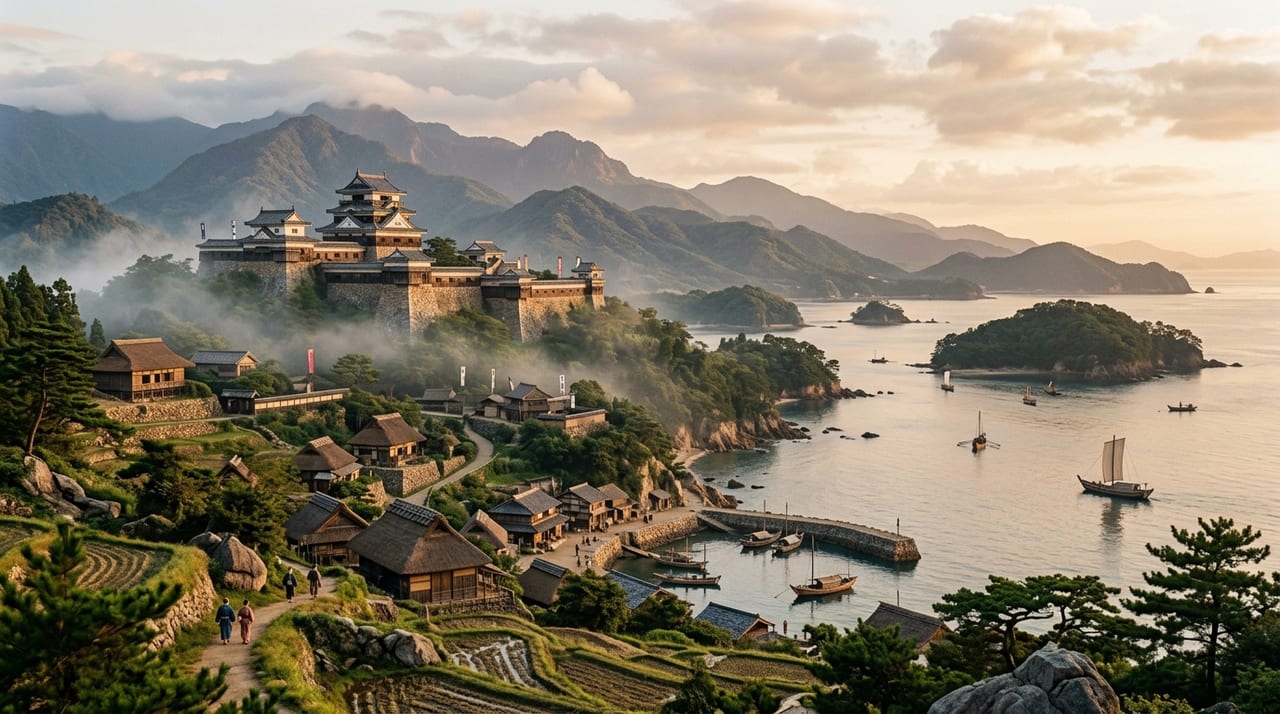
 * Image is for illustrative purposes only.
Iyo Tradition — The Foremost Sword-Making Region of Shikoku
伊予伝——四国最大の刀剣産地
Iyo Tradition (Iyo-den) is the collective name for the largest sword-producing region in Shikoku, centered on present-day Ehime Prefecture (formerly Iyo Province). Shikoku formed a distinct sword culture sphere independent of the Five Home-Province Traditions (Yamashiro, Bizen, Soshu, Yamato, Mino), and Iyo Province was especially the center of Shikoku sword culture, housing so many smiths that it was called Iyo-sento-kaji (Iyo's thousand sword smiths). Iyo smiths cultivated a distinctive style drawing on the unique properties of Iyo sand iron and local iron-production technology while receiving the technical influence of Bizen and Yamashiro through the Seto Inland Sea traffic routes. The jigane ranges widely from itame to masame grain, and the hamon is mostly of a clean type based on suguha and ko-midare. Iyo swords, developed under the patronage of regional daimyo such as the Kono and Nishisono clans and within the active trade network of the Seto Inland Sea, also played an important role in supplying swords under the Chosokabe clan's unification of Shikoku and the Toyotomi regime.
Description
Geographical and Historical Foundation of the Iyo Tradition
Iyo Province (present-day Ehime Prefecture) is located in the northwestern part of Shikoku, facing the Seto Inland Sea, and possesses a mild climate and the rich sand iron-producing zones of western Japan (particularly the Toyo and Chuyo regions). These geographical conditions positioned Iyo advantageously both in terms of access to quality raw materials (sand iron) essential for sword production and in the distribution of technology and products through Seto Inland Sea traffic.
The history of sword production in Iyo is thought to extend back to the late Heian period, but the oldest smiths confirmed by documentary sources are mostly from the early to mid-Kamakura period. The Iyo swordsmithing community is said to have taken full shape after the mid-Kamakura period (13th century), when the Kono clan rose as a powerful warrior group in Iyo Province. The Kono clan subsequently became the constable (shugo) of Iyo Province, providing stable demand for Iyo smiths.
The Seto Inland Sea was at this time Japan's largest inland waterway, and the swordsmithing techniques of Bizen Province (present-day Okayama Prefecture) were readily transmitted to Iyo through the Inland Sea. Indeed, many Iyo smiths received the technical influence of the Bizen tradition, and many works with Bizen-like characteristics in both jigane and hamon were produced in Iyo. At the same time, the addition of the unique characteristics of Iyo sand iron created regional individuality distinct from pure Bizen tradition.
The Nanbokucho period (14th century) was one of the peak periods of Iyo swords. The turmoil of the Northern and Southern Courts extended to Shikoku, with Iyo warrior bands fighting intensely on both sides. This period of conflict generated large demand for swords, and many Iyo smiths were actively producing. Smiths of the late Nanbokucho period, called Sue-Iyo (Late Iyo), often have signatures of multiple characters rather than single characters, indicating advancing regional documentation of smith information.
During the Sengoku period (15th-16th centuries), the Iyo sword industry developed within the complex political situation of the three competing powers: the Nishisono clan, the Kurushima Murakami navy, and the Kono clan. In particular, the Kurushima Murakami navy, based at Kurushima and known as a maritime force controlling the Seto Inland Sea, was a stable client for Iyo smiths. Even during the period when Chosokabe Motochika nearly unified Shikoku (before the 1585 suppression by Toyotomi forces), Iyo smiths played an important role as weapons suppliers supporting the military power of Shikoku's unification.
Technical Characteristics and Style
Diversity of Jigane: Iyo tradition jigane varies by school, but overall a mixed itame and masame grain, or a masame-influenced itame is commonly seen. This is attributed to the characteristics of Iyo sand iron, creating an intermediate aesthetic distinct from the fine itame of Bizen and the true masame of Yamato. The jinie is fine and rich, with utsuri appearing in some examples.
Hamon Characteristics: Iyo tradition hamon ranges widely from suguha to ko-midare and ko-gunome, but overall tends toward a clean, taut impression. More restrained than the luxuriant choji-midare of the Bizen tradition, it tends closer to the orderly hamon of the Yamashiro tradition. In the later period (Sengoku through early Edo), works with gunome or large-midare prioritizing practicality also increase.
Sword Form (Sugata): Tachi by Iyo smiths from the Heian through Kamakura period are mainly of the koshizori form following contemporary fashion. In the Nanbokucho period, o-dachi and nodachi were also produced. From the Sengoku period onward, the transition to uchigatana and wakizashi progressed, with works of practical dimensions and construction increasing. Generally, Iyo swords often reflect a utilitarian aesthetic that avoids excessive decoration.
Signature Style: Iyo smith signatures are diverse, with those bearing the province name such as Iyo-ju~ (Iyo resident) or Iyo-no-kuni~ (Province of Iyo) common, as well as those bearing place names (Ozu, Imabari, Uwajima, etc.). From the Sengoku period onward, signatures explicitly indicating the smith's location and active region increase, serving as an important information source for understanding the distribution of smiths throughout Iyo.
Principal Smiths and Surviving Works
Fujiwara Kiyonori (mid-Kamakura period): One of the oldest representative smiths of Iyo. Confirmed surviving works are rare, but the name appears in later connoisseur records. The style is characterized by masame-influenced jigane unique to Iyo while receiving the technical influence of the Bizen tradition. The documentary value in proving the existence of Iyo smiths in the Kamakura period is also high.
Iyo-no-kuni Yukimitsu (late Kamakura period): A representative Iyo smith of the late Kamakura through Nanbokucho era. Highly regarded for hamon with gentle variation on a suguha basis and uniform jigane, with works embodying the clean beauty of the Iyo tradition. Frequently cited by later researchers as the typical example of the Iyo tradition.
Iyo-no-kuni Tsugu (Nanbokucho through Muromachi period): An Iyo smith of the Nanbokucho through early Muromachi period. Known for producing combat swords to meet the heavy demand of the turbulent period, with characteristics also reflecting technical exchange with contemporary Kyushu and Chugoku region smiths. Positioned as a representative smith of the Sue-Iyo period of Iyo swords.
Iyo-ju Munenobu (Sengoku period): A Sengoku-period Iyo smith said to be connected with commissions from the Kurushima Murakami navy. The practical hamon centered on gunome-midare and the easily portable uchigatana in usuzukuri or hirazukuri construction reflect the demand for naval combat swords. Left works representative of the sword culture of Shikoku's Sengoku period.
Position within Shikoku Sword Culture
Shikoku has been a relatively underexamined region in Japanese sword research, but recent scholarly advances have led to a reassessment of the Iyo tradition's distinctiveness and historical importance. Particularly noteworthy is the observation that Iyo sword culture, taking advantage of its geographical advantage as a node of Seto Inland Sea traffic, selectively absorbed the technical influences of both the Bizen and Yamashiro traditions to form a distinctively synthetic style.
While the Tosa tradition (Kochi Prefecture) possesses the distinctiveness of southern Shikoku connected with the later ichiryo-gusoku warrior culture, the Iyo tradition embodies the internationality of northern Shikoku incorporated into the Seto Inland Sea cultural sphere. This contrast demonstrates the internal diversity of Shikoku sword culture, suggesting the need to discuss the respective individualities of Iyo and Tosa traditions separately rather than lumping them together as simply Shikoku swords.
The relationship with the Kurushima Murakami navy also reveals a special aspect of Iyo swords. The demand for lightweight, easily portable uchigatana and wakizashi suitable for sea combat was qualitatively different from the sword demand of other regions centered on land warfare, and it is possible that Iyo smiths achieved early technical specialization for the special use of maritime combat.
Influence on Later Periods and Contemporary Significance
The technical legacy of the Iyo tradition was inherited by the official smiths of the Edo-period Ehime domains (Matsuyama, Ozu, Uwajima, etc.). The Uwajima domain maintained a distinctive sword culture, and some of that tradition has been inherited as the contemporary Ehime sword culture even after the Meiji Restoration.
In contemporary sword research, comprehensive database compilation of Iyo tradition smiths is advancing, with systematic investigation of scattered surviving works from various locations. Museums and art museums within the prefecture, including the Ehime Prefectural Museum of History and Culture, are actively collecting, preserving, and displaying Iyo tradition swords, contributing to the academic re-evaluation of Shikoku sword culture.
The distinctiveness of the Iyo tradition suggests that the Five Traditions framework for Japanese swords may in fact be concealing the diverse individuality of regional smiths. The detailed study of regional traditions, in order to draw a richer overall picture of Japanese sword culture, has become one of the important tasks of contemporary sword scholarship.
Characteristics of This Era
- Center of Shikoku Sword Culture — Iyo Province was the largest sword-producing region in Shikoku, housing so many smiths it was called Iyo-sento-kaji. Located at a key point in Seto Inland Sea traffic, it selectively absorbed the technical influences of the Bizen and Yamashiro traditions while establishing a distinctively synthetic style
- Distinctive Jigane with Masame-Influenced Itame — The masame-influenced itame grain, deriving from the unique mineral composition of Iyo sand iron, creates a distinctive aesthetic between the fine itame of Bizen and the true masame of Yamato. Rich in jinie with utsuri appearing in some examples, it is valued as the material beauty unique to Iyo
- Clean, Taut Hamon — Avoiding Bizen's luxuriant choji-midare, a clean hamon based on suguha, ko-midare, and ko-gunome constitutes the basic Iyo style. Reflecting the aesthetic of practicalism excluding excessive decoration characteristic of Shikoku warriors, it possesses an elegance contrasting with the Tosa tradition of southern Shikoku
- Special Relationship with the Kurushima Murakami Navy — The special demand of supplying swords to the naval force dominating the Seto Inland Sea promoted early development of lightweight, portable uchigatana and wakizashi technology. Technical specialization for the special environment of sea combat shows a trajectory of development unique to Iyo not found in swordsmithing communities in other regions
- Historical Patronage by the Kono, Nishisono, and Chosokabe Clans — Sword patronage policies by successive rulers of Iyo supported the long continuation of the sword industry from the late Heian through early Edo periods. In particular, during the Chosokabe clan's unification of Shikoku, the tradition functioned as a weapons supply base for all of Shikoku, maximizing the distribution range of Iyo swords
- Regional Distinctiveness Outside the Five Traditions — The Iyo tradition possesses a technical lineage that does not fit within the Five Traditions framework, representing an important example of the diversity of Japanese sword culture. Advancing regional smith research in recent years has led to reassessment, with independent cultural value exceeding simple hierarchical evaluation as regional swords increasingly being recognized