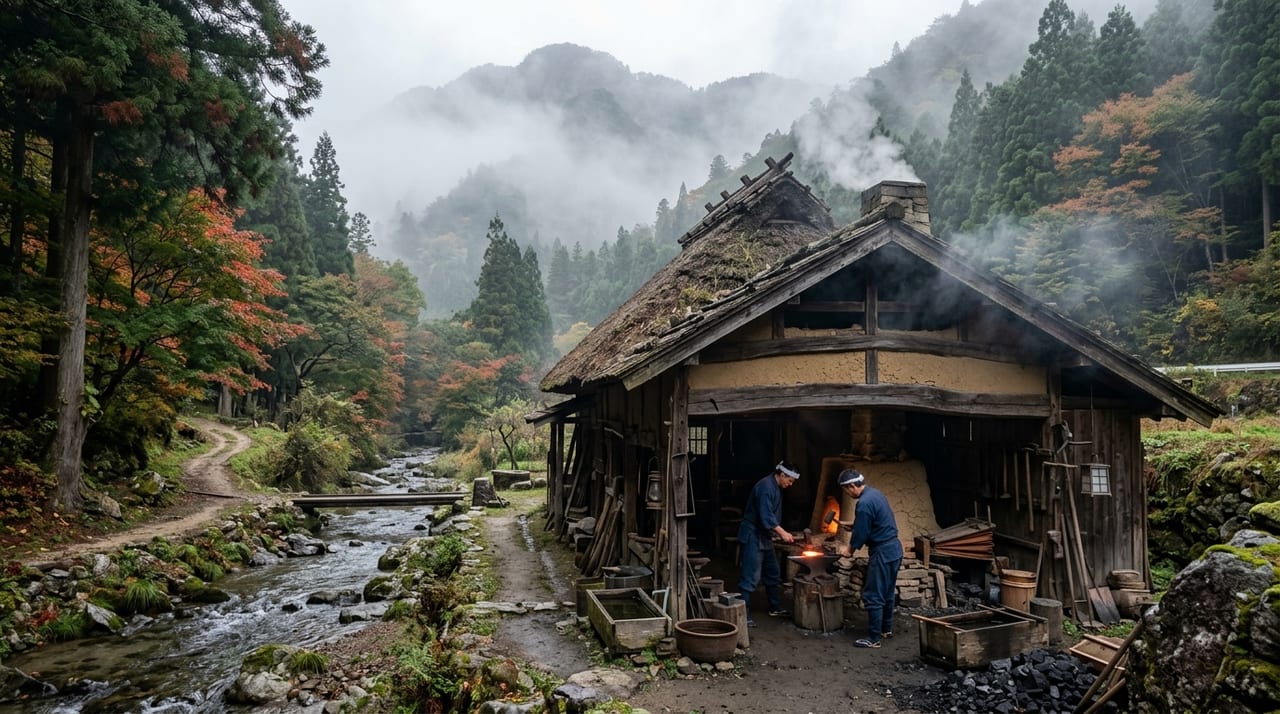
 * Image is for illustrative purposes only.
Hōreki-Meiwa Period — The Refinement of Shintō and the Flourishing of Sword Scholarship
宝暦明和期——新刀の洗練と刀剣研究の隆盛
The Hōreki and Meiwa eras (1751–1772) represent a period of highly refined sword culture during the stable peace of the mid-Edo period. As the practical martial importance of swords waned, interest in swords as art objects and connoisseur's items intensified, and the Hon'ami family's culture of appraisal and polishing reached full maturity. Smiths in Ōsaka and Edo competed in creating refined ji-hada and artistic hamon, building up the technical achievements that would bridge the way to the Shinshintō period.
Description
The Maturation of Sword Culture in the Age of Peace
The Hōreki and Meiwa eras (1751–1772) fall in the mid-Edo period, when Tokugawa rule was thoroughly stabilized and the sankin-kōtai system of alternate attendance was firmly established. In the period just before Tanuma Okitsugu rose to prominence as senior councillor, the development of the commercial economy and the maturation of urban culture provided the backdrop for swords to transcend their role as practical weapons and establish themselves as prestigious art objects expressing the dignity of the warrior class.
The defining characteristic of sword culture in this era was the sophistication of the "mekiki" (connoisseurship and appraisal) culture. Sword appraisal centered on the Hon'ami family had taken on the character of a systematic discipline following the completion of the Kyōhō Meibutsu-chō commissioned by Tokugawa Yoshimune (r. 1716–1745). Standards of appraisal became more refined, and comprehensive methods for evaluating ji-hada, hamon, nakago, and inscription together became widely practiced.
The Competition and Artistic Pursuit of Ōsaka and Edo Smiths
The smiths of the Hōreki-Meiwa period pursued their own artistic goals while taking the masterworks of the kotō and shintō traditions as models. In Ōsaka, smithing groups carrying on the "Ōsaka Shintō" lineage were active, and the refined hamon techniques descending from Echizen no Kami Sukehiro were further polished. The smiths of Naniwa in particular were known for hamon combining deep nioi-laden chōji-midare with elegant notare, earning high praise among the warrior class.
In Edo, descendants of smiths who had relocated from Mino and Shinshū served as purveyors to the shogunate, while a growing spirit of "ko-hō kenkyū" (ancient-method research) into classical Bizen and Sōshū blades took hold. Smiths refined the art of utsushi (copying masterworks), aiming to reproduce the hamon and ji-hada of classical masterpieces as a means of preserving and advancing their techniques.
The Deepening of Polishing and Research Culture
The culture of sword polishing and scholarly study deepened particularly during this period. The polishing techniques established by Hon'ami Kōchū and Kōshin were carried forward, and methods for bringing out the full beauty of kotō ji-hada through suriage (shortening) and revealing the landscape of hamon through polishing were refined. The elevated standards of polishers in this era laid the groundwork for the sword connoisseurship culture of the subsequent Shinshintō period.
Publication of books and illustrated catalogs on sword subjects also flourished in the Hōreki-Meiwa period, spreading sword knowledge and education to both warriors and townspeople. The publication of sword illustrated catalogs and appraisal texts enabled some wealthy merchants and townspeople to enter the sword-collecting world, broadening the base of demand.
The Bridge to the Shinshintō Period
The techniques and knowledge accumulated by the smiths and scholars of the Hōreki-Meiwa period became the direct foundation for the "Shinshintō movement" proposed by Suishinshi Masahide and others in the subsequent Tenmei-Kansei period (1781–1801). The Shinshintō movement's call for a return to ancient methods was only possible because of the deepening of ancient-method research during the Hōreki-Meiwa era, making this period indispensable to any discussion of the modernization of the Japanese sword.
Characteristics of This Era
- Era when swords were fully established as art objects and connoisseur's items
- Systematization of appraisal culture centered on the Hon'ami family
- Refinement of Ōsaka Shintō's sophisticated hamon techniques
- Flourishing of ancient-method research and the art of copying classical masterworks
- Widespread publication of sword illustrated catalogs and appraisal texts