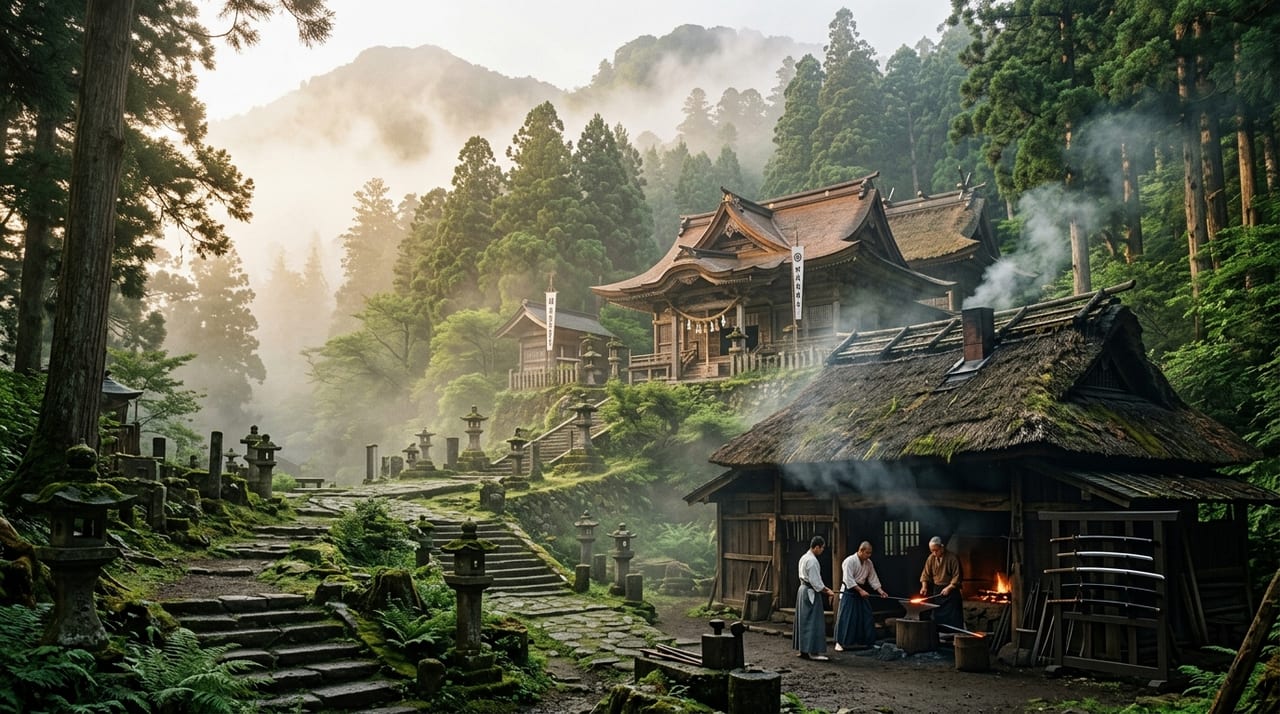
 * Image is for illustrative purposes only.
Gassan Tradition
月山伝
A distinctive sword-making tradition born beneath Gassan, the sacred mountain of Dewa Province (present-day Yamagata Prefecture). Its greatest hallmark is the wave-patterned forged steel texture known as ayasugi-hada. The tradition died out once in the Edo period, but a lineage that moved to Osaka in the late Bakumatsu period revived it and carried it to the present day. The modern Gassan Sadakazu, appointed a Teishitsu Gigeiin (Imperial Household Artist), is celebrated as the pinnacle of modern Japanese swords.
Description
Gassan as Sacred Ground and the Birth of Sword Forging
The Three Mountains of Dewa (Gassan, Haguro-san, and Yudonosan) have long served as sacred sites of Shugendo (mountain ascetic Buddhism), drawing pilgrims from across the nation and forming a unique religious and cultural sphere where mountain faith, Buddhism, and Shinto are fused together. Gassan, as the principal peak, stands at the spiritual center of Dewa Province (present-day Yamagata Prefecture), and the religious authority centered on Gassan Shrine exerted profound influence over local society.
The tradition of sword forging from the base of this sacred mountain is said to have been born in the late Heian period, but confirmed surviving examples are known from the Kamakura period onward. Abundant sources of high-quality iron sand are scattered throughout the Gassan region, and the wealth of iron resources combined with the spiritual needs of Shugendo practitioners formed the foundation of sword production. The Gassan smiths, seeking to imbue the blade with the spirituality of mountain faith, developed entirely original techniques distinct from all other traditions. Their greatest achievement was "ayasugi-hada."
Ayasugi-hada—The Representative Forging Texture of the Gassan Tradition
Ayasugi-hada is the representative forging texture of the Gassan tradition. While ordinary forging textures (itame, masame, mokume, etc.) arise from the directional fiber structure of iron, ayasugi-hada is produced through an extremely challenging technique in which special folding methods are applied during forging, creating wave-patterned and streamlined wood-grain-like patterns resembling cedar bark.
The wave-patterned designs that appear on the steel surface possess a natural sculptural beauty suggestive of rough ocean waves, undulating mountain ridges, or cedar bark, and display a dreamlike expression as the light reflection changes with the viewing angle. Producing this texture uniformly and beautifully through forging is considered technically extremely difficult.
Ayasugi-hada exhibits multiple expression types, such as "ayasugi flow appearing within ko-itame" or "wave patterns arising within masame," and individual smiths display considerable stylistic variation. In authentication and appraisal, ayasugi that flows uniformly throughout the entire steel surface receives the highest evaluation, while those appearing only partially are considered inferior.
Ko-Gassan to Modern Gassan—A School History
Works from the Ko-Gassan period date to the Kamakura–Muromachi era, and few survive. The blade pattern is predominantly straight-edged (suguha), with distinctive characteristics in the appearance of the hardening line and texture that differ clearly from other traditions such as Yamato, Bizen, and Yamashiro.
Gassan smithing lapsed for a time after the Edo period began, but in the late Edo period Gassan Sadakichi, a member of the lineage, moved from Dewa to Osaka, marking a new phase of development. The Gassan lineage, settling in Naniwa (Osaka), deepened its technique while being integrated with the sword culture of the Kansai region, reaching remarkable heights from the late Edo period through the Meiji era. The pinnacle of this period was Gassan Sadakazu (first generation, 1836–1918).
While inheriting the ancient traditions of Dewa's Gassan school, Sadakazu honed his skills in Osaka's technical environment, and during the Meiji era achieved such renown that his work was presented for imperial viewing as a modern tenkandō (imperial-viewed blade). For his achievements, he was appointed in Meiji 39 (1906) as a Court Artist (Teishitsu Gigeiin—the imperial highest recognition of artists, equivalent to present-day "Living National Treasure" status), officially recognized as the pinnacle of modern Japanese swordsmithing.
Sadakazu's works achieved unprecedented mastery in the perfection of ayasugi-hada, and his blade patterns demonstrate remarkably diverse expressiveness ranging from elegant clove-flower randomness (choji-midare) to orderly straight edges. Gassan Sadakatsu (1869–1943) inherited his father's techniques and was active from the Taisho through early Showa era. His son, the second Gassan Sadakazu (1907–1995), succeeded him. In modern times, Gassan Sadatoshi, the third son of the second-generation Gassan Sadakazu, and his eldest son Gassan Sadanobu continue the lineage, and the Gassan tradition's ayasugi-hada lives on in the present day.
The Aesthetic Qualities and Appreciation of Gassan Works
When appreciating works of the Gassan tradition, what first strikes the eye is naturally the striking presence of ayasugi-hada. The wave patterns flowing across the steel surface provide a unique visual experience impossible to obtain in any other sword. The optical changes in which the flow of the texture emerges or vanishes depending on the angle of light represent the supreme aesthetic pleasure of viewing a Gassan blade.
While blade patterns vary by era and smith, harmony with the ayasugi-hada of the steel surface is always prioritized. The first Sadakazu's clove-flower randomness is elegant and magnificent, leaving masterpieces in which the rough waves of the steel and the vitality of the blade pattern unite to create overwhelming presence. By contrast, Ko-Gassan's straight edge possesses a clear and spiritual atmosphere, with a mystical beauty as if the very essence of Shugendo spirituality were distilled into it.
The Gassan Tradition in Modern Times
The modern Gassan tradition is carried on by Gassan Sadatoshi, a Nara Prefecture-designated Intangible Cultural Property holder, and others, and represents the cutting edge of traditional sword-forging craftsmanship. The preservation of the challenging ayasugi-hada technique demands extraordinary training and talent, and the practicing Gassan lineage comprises only a handful of active smiths. Modern Gassan blades are highly valued by collectors both domestically and internationally, and due to their limited production numbers and high artistic merit, they command premium status in the collecting market.
Characteristics of This Era
- Ayasugi-hada—distinctive wave-patterned, streamlined forging texture. A representative steel-surface expression of the Gassan tradition. Born from special folding techniques during forging, its appearance changes dramatically with the angle of light.
- Inherited tradition—after Ko-Gassan of the Kamakura to Muromachi periods, the tradition lapsed once in the Edo period. A lineage that moved to Osaka in the late Bakumatsu period revived it and carried it to the present day, retaining ayasugi-hada as its shared technical identity.
- Diverse blade pattern expressions—ranging from Ko-Gassan's straight edges to Sadakazu's magnificent clove-flower randomness, offering varied hamon across eras and smiths. What unites them is an aesthetic sensibility of steel-and-blade unity pursuing harmony with ayasugi-hada.
- Honor of the Imperial Household Artist appointment—in Meiji 39 (1906), the first Gassan Sadakazu was appointed a Teishitsu Gigeiin (Imperial Household Artist) together with Miyamoto Kanenori, earning the highest official modern recognition as a swordsmith.