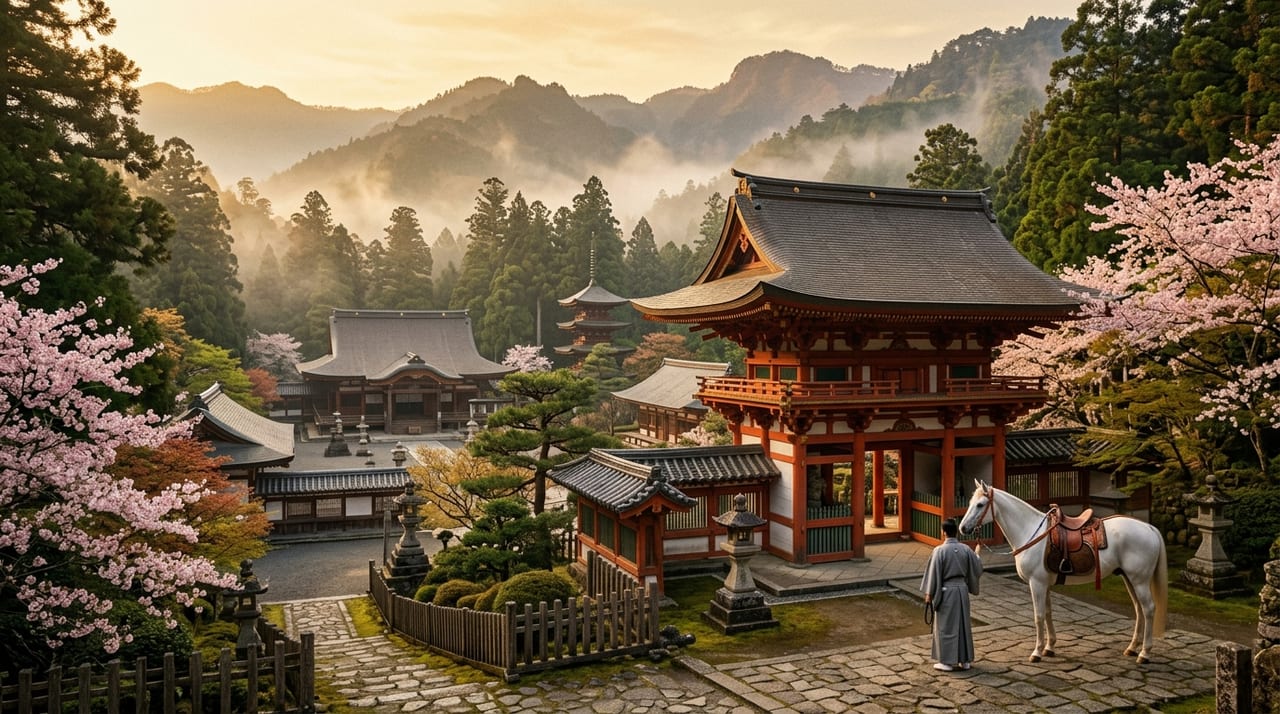
 * Image is for illustrative purposes only.
Fujiwara Regency
藤原摂関期
During the height of Fujiwara regency culture, the historic transition from straight to curved blades occurred, giving birth to the proto-Japanese sword. Early curved tachi reflected the elegance of Heian court culture.
Description
Transition from Chokutō to Wantō
The Fujiwara regency period (late ninth to late eleventh century) was the era in which the most fundamental transformation in the history of the Japanese sword took place. Since the Nara period, the mainstream swords had been straight blades (chokutō) imported from the continent, but from the tenth century onward, swords with curved blades called wantō began to appear. Behind this change lay a shift in the fighting methods of Heian warriors. As mounted combat became dominant, it came to be recognized that a curve in the blade made the downward cutting stroke from horseback more effective. Moreover, as the technique of nukiuchi, drawing the sword swiftly from the scabbard, developed, it also became clear that a curved blade handled better on horseback.
Sekkan Nobility and Swords
During the period when Fujiwara no Michinaga and his son Yorimichi held power, swords were more than mere weapons. The decorative swords (kazari-tachi) used in court ceremonies were symbols of status and authority, and luxurious koshirae were made, fitted with fine metal fittings, lacquered scabbards, and silk braided cords. Famous blades produced as gifts for vassals became an important impetus for improving the skills of swordsmiths. Smiths gathered in Sanjō, Gojō and other districts of Kyoto, refining sophisticated styles that met the demands of the nobility. Although the name of the smith Sanjō Munechika has been handed down from this era, very few of his works survive, and many aspects of his practice remain shrouded in mystery.
Characteristics of Early Wantō
Few swords from this period survive, but their characteristics are clearly distinct from those of the later Kamakura period. The blades are somewhat slender, with a pronounced koshi-zori, a strong curve near the hilt. The kissaki (point) is small, with a delicate form known as ko-kissaki. The jigane shows itame-hada and ō-itame-hada, and the hamon consists mostly of suguha and small midare. The yakiba is narrow, and the nie is fine and tightly set, giving a serene beauty that contrasts with the bold hamon of later periods. These features are said to reflect the aristocratic aesthetic of miyabi, or refined elegance.
The Rise of Warrior Monks and Samurai
In the late Sekkan period, great temples and shrines that held estates across the provinces organized warrior monks (sōhei) for self-defense. Major temples such as Enryakuji, Kōfukuji and Onjōji fielded thousands of sōhei armed with swords and naginata. Demand for swords during this period spread not only among the aristocracy but also among these temple and shrine powers. Smiths in Yamato Province (Nara) had especially close ties with the temples and shrines, and the seeds of the later Yamato-den five schools can be seen in this era. The smith groups that would become the source of Yamato-den refined a sturdy style that met the practical needs of the sōhei, producing straightforward swords that differed from the elegance of Yamashiro.
Independence of Eastern Warriors
In the Kantō and Tōhoku regions, far from the reach of the Fujiwara, independent warrior bands were beginning to form. The Taira no Masakado Rebellion (939) and the Fujiwara no Sumitomo Rebellion are events that symbolize the social unrest and rise of warriors in this age. Eastern warriors fought mainly in mounted close combat and needed swords suited to actual battle. In Bizen Province (Okayama), local smiths were working diligently, and the foundations of what would later become Japan's largest sword-producing region began to take shape in this period. Meanwhile, in Kyushu, metalworking techniques flowed in through trade with the continent and the Korean Peninsula, and Kyushu smiths built up their own distinctive techniques.
Surviving Works and the Significance of Collecting
Few swords from this period survive, and most are designated National Treasures or Important Cultural Properties. Mikazuki Munechika, attributed to Sanjō Munechika and held by the Tokyo National Museum, is one of the Tenka Goken, the Five Swords of the Realm, and represents the highest achievement of this era, yet signed examples are extremely rare. Many works are classified by period characteristics as Ko-Aoe or Ko-Hōki, but identifying the maker is difficult at the current level of research. For collectors, swords of this period offer the finest opportunity to touch the origins of the Japanese sword, and a single blade can carry such scholarly value that it greatly advances the understanding of sword history.
Characteristics of This Era
- The blade is slender, with pronounced koshi-zori. It has ko-kissaki, and its elegant form stands out compared with the later Kamakura period. It is sculptural beauty that embodies the Heian aristocracy's aesthetic of miyabi.
- The jigane is mainly itame-hada and ō-itame-hada. It is not yet as refined technically as in the Kamakura period, but it has a simple beauty. The nie is fine and tight, in contrast to the bold style of later periods.
- The hamon centers on suguha and ko-midare, with a narrow yakiba. The yakidashi near the hamachi is unbroken, presenting a serene and refined appearance.
- The koshirae of kazari-tachi (ornamental tachi) involve elaborate metalwork and served as symbols of rank and authority. They were produced as integrated works of art that combined the sword with metalwork and lacquerwork.
- Surviving examples are extremely rare, and signed (zaimei) examples are rarer still. Their discovery or circulation would be a major event in the sword world, and they are the highest-value historical source material.