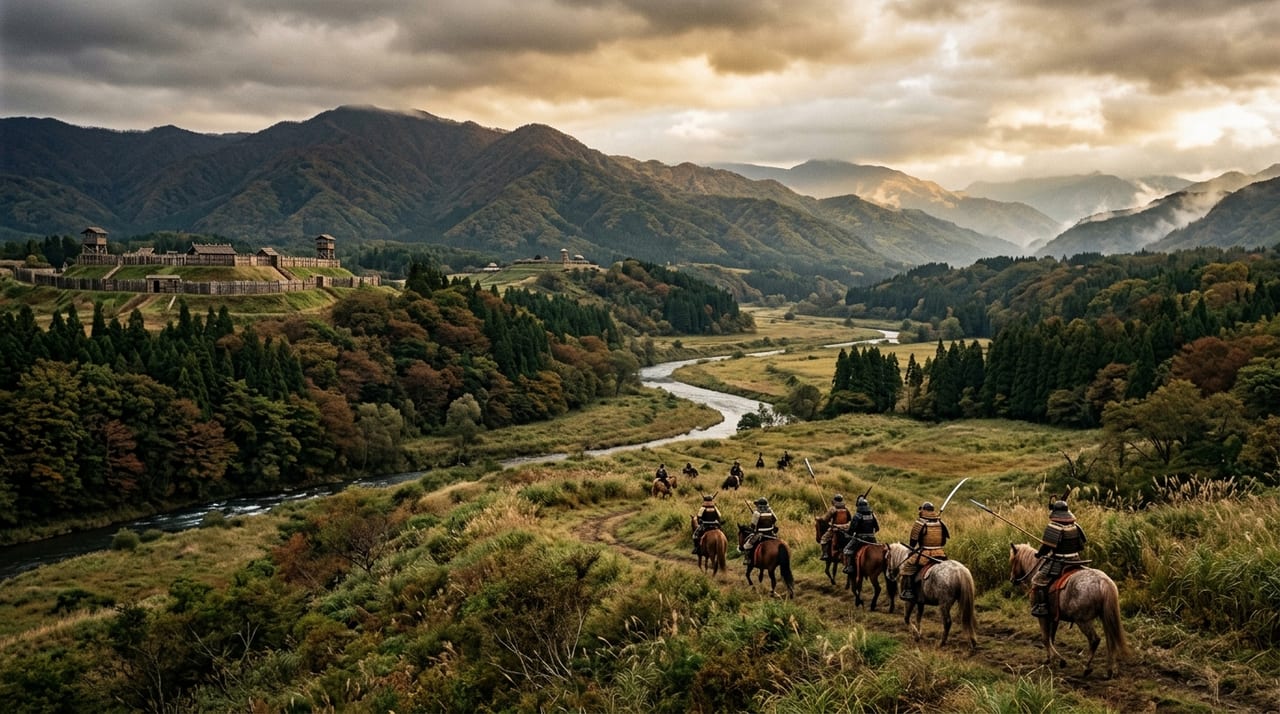
 * Image is for illustrative purposes only.
Emishi Campaigns and Frontier Swords
蝦夷征討と辺境の刀剣
The era of Emishi campaigns led by Sakanoue no Tamuramaro drove advances in blade technology along Japan's northeastern frontier, forming a crucial military and cultural backdrop for the transition from straight to curved swords.
Description
Background to the Emishi Campaigns
From the late Nara to the early Heian period, the Yamato polity waged a prolonged war against the Emishi who lived in the Tōhoku region. Sakanoue no Tamuramaro, appointed Sei-i Taishōgun in the 16th year of Enryaku (797), built jōsaku palisade fortresses at Isawa (present-day Ōshū, Iwate Prefecture) and Shiwa (around present-day Morioka), laying the foundation for the management of Tōhoku. This military activity played a major role in spreading sword production and iron culture to Tōhoku.
The Transition from Straight to Curved Swords
The period of the Emishi campaigns coincides with one of the most important technical turning points in the history of Japanese swords. It was a transitional phase in which the chokutō (straight-bodied long swords and daggers), which had been mainstream in the Nara period, gradually changed into forms with curvature during the early Heian period. The convenience of drawing and cutting from horseback is thought to have prompted the adoption of curved blade shapes, and it is also said that combat experience with horses on Tōhoku's vast plains accelerated this development.
Iron Production on the Frontier
Tōhoku has long been known as a rich source of iron sand (satetsu), and local smithing techniques there developed their own distinctive traditions. Emishi warriors also used high-quality iron implements, and Yamato swordsmiths brought their techniques in, driven by the need for local supply and repair. The military administration centered on Isawa-jō and Tagajō required a stable supply of iron goods, including swords, armor, and farm tools, and this led to the formation of a smithing industry base in Tōhoku.
Votive Swords and the Fusion of Shinto and Buddhism
Tamuramaro is said to have dedicated his personal sword “Sohaya” and a companion sword to Kiyomizu-dera in Harima (Katō, Hyōgo Prefecture), and the three long swords are designated Important Cultural Properties. This tradition well illustrates the custom among warriors of offering swords to shrines and temples as thanks for victory or as prayers for success in battle. Swords that proved effective against the Emishi came to carry the meaning of a sacred sword, strengthening the link between swords and spiritual power.
The Emergence of Tōhoku's Sword Culture
From the 9th century, after the campaigns had run their course, Ōshū (Tōhoku) became known in Heian aristocratic society as a source of horses and iron. In Tōhoku, where the Abe clan of Oku-rokugun and later the Kiyohara and Fujiwara clans (the Ōshū Fujiwara) held sway, a distinctive martial culture took root. Through the Former Nine Years' War and the Later Three Years' War of the 11th century, it developed into the golden culture of the Ōshū Fujiwara. The starting point of this long history lies in the era of the Emishi campaigns.
Tamuramaro and Sword Legends
Sword legends associated with Tamuramaro survive in many regions. The story of the famed sword “Sohaya-no-Tsurugi,” held by Tamura Shōgun and appearing in the Tamura tales and others, is also well known. Tamuramaro's deeds were later absorbed into Noh chants and setsuwa literature, and they were deeply inscribed in Japanese culture as a heroic tale of the Emishi campaigns and of swords.
Characteristics of This Era
- Transitional style from chokutō to curved swords: a very slight curvature first began to appear in chokutō, and this form survives in 9th-century tachi. Adaptation to mounted combat is thought to have encouraged the curve.
- Tradition of votive swords: Sakanoue no Tamuramaro is said to have dedicated his personal sword “Sohaya” and a companion sword to Kiyomizu-dera in Harima, and the three long swords survive as Important Cultural Properties.
- Lineage of local Tōhoku smithing: the warabite-tō used by the Emishi gave rise to the kenukigata-tō, and the Mokusa smith group of Ichinoseki (Ichinoseki City) later forged kenukigata-tō.
- Fusion of horse and sword culture: Ōshū is renowned as a horse-producing region, and the combination of excellent warhorses and portable weapons shaped the combat style of Tōhoku warriors. This horse-riding culture led directly to improvements in blade shape.