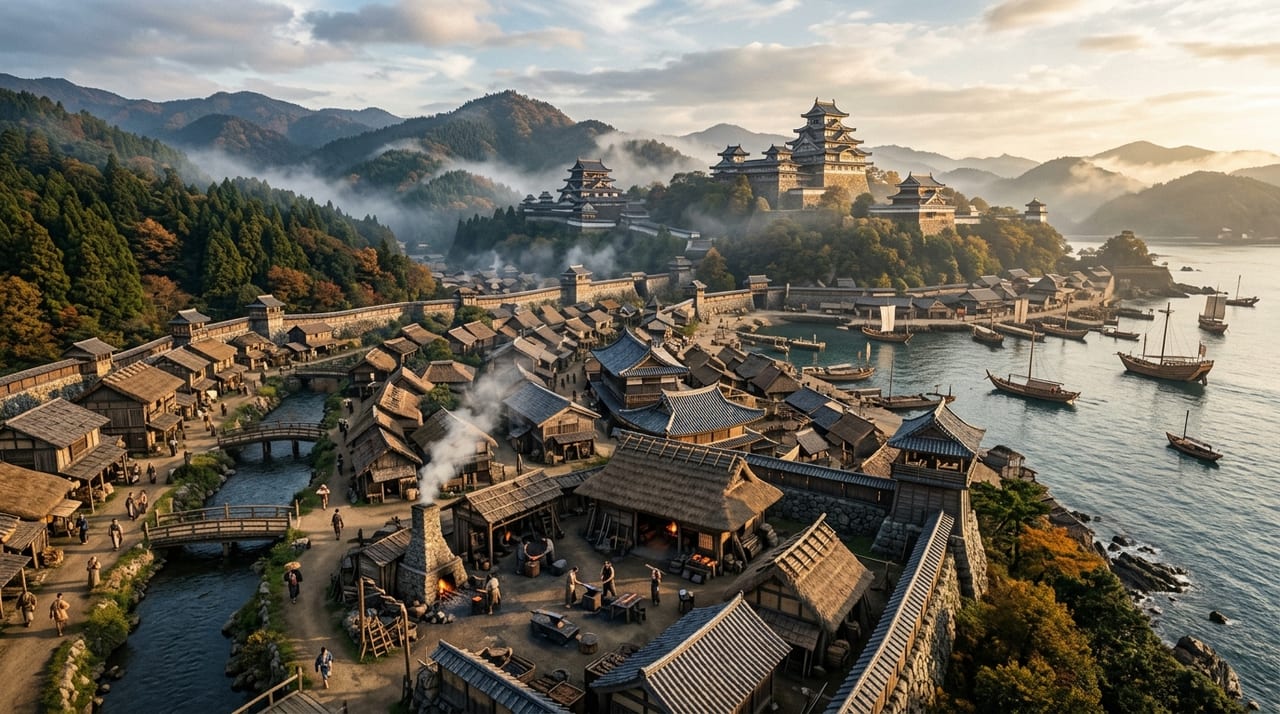
 * Image is for illustrative purposes only.
Bunshō Era
文正(ぶんしょう)
Bunshō (1466-1467) was an extremely short mid-Muromachi era name, falling in the year immediately before the outbreak of the Ōnin War. Amid intensifying factional strife such as the Hatakeyama succession dispute, it stands at the threshold of the late-Muromachi shift from tachi to uchigatana driven by the wars that followed.
Description
Bunshō (1466-1467) was an era name used for a very short period in the middle of the Muromachi period, from the 1st year of Bunshō (1466) to the 3rd month of the 2nd year of Bunshō (1467). Rivalries within the bakufu deepened, triggered by events such as the Bunshō Political Incident in the 9th month of Bunshō 1, when Ise Sadachika, a close aide of Shogun Ashikaga Yoshimasa, fell from power due to opposition from the daimyō. In the 12th month of that year, Hatakeyama Yoshihiro led a large force into Kyoto. In the 1st month of Bunshō 2 (Ōnin 1, 1467), the struggle over the succession of the Hatakeyama clan erupted into armed conflict, and the Ōnin War broke out between the Eastern Army, led by Hosokawa Katsumoto, and the Western Army, led by Yamana Sōzen. Bunshō was precisely the year of the political struggles that became the fuse of this great war. From the perspective of sword history, in the early Muromachi period, against a backdrop of peace, tachi that emphasized artistic quality (such as the Ōei-Bizen of the Ōei era) flourished. However, with the Ōnin War as a dividing point, the mode of combat shifted from mounted to foot-centered, and the uchigatana, worn thrust through the belt, became mainstream. The Bunshō years fall just before this turning point. Within the Osafune school of Bizen Province, swordsmiths of the generation later called the Sue-Bizen were active, including Katsumitsu, Tadamitsu, and Munemitsu (the second son of Sukemitsu), and they are known to have been active around the time of the Ōnin War. Their style, while rooted in the Bizen tradition that had continued since their forebears, would gradually change in response to the practical demands of the Sengoku period, when warfare became full-scale. Although Bunshō was an era of barely more than one year, it is a period of significance in sword history as a juncture dividing the art sword culture of the peaceful early Muromachi period from the practical sword culture of the Sengoku period.
Characteristics of This Era
- An extremely short mid-Muromachi era name, from Bunshō 1 (1466) to the 3rd month of Bunshō 2 (1467)
- A period of intensifying shogunate infighting, including the Hatakeyama succession dispute
- Falls immediately before the outbreak of the Ōnin War the following year (Ōnin 1 / 1467)
- The Ōnin War marked a shift in combat style from mounted to foot-soldier warfare
- A turning point from tachi toward the more portable uchigatana as the mainstream sword
- Sue-Bizen-generation smiths Katsumitsu, Munemitsu, and Tadamitsu active in Bizen's Osafune school
- A hinge between the peaceful early-Muromachi art-sword culture and the Sengoku-era battle-sword culture