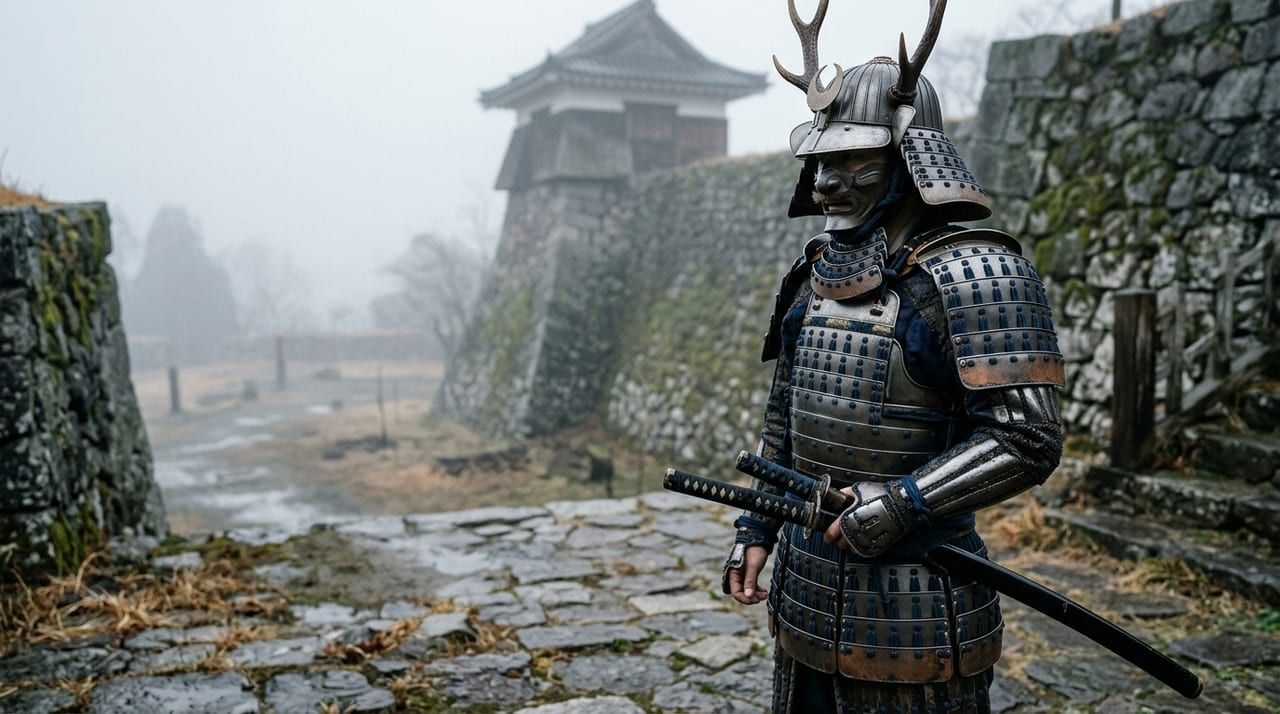
 * Image is for illustrative purposes only.
Yagyū Jūbei
柳生十兵衛
The One-Eyed Swordsman — Heir to Yagyū Shinkage-ryū and Japan's Most Mysterious Swordmaster
Description
A Swordsman Wrapped in Mystery
Yagyū Mitsuyoshi, known as Jūbei, was the eldest son of Yagyū Munenori and was born in Yagyū-no-shō in Yamato Province in Keichō 12 (1607). He is one of the most legendary swordsmen of the Edo period. Most of his life remains shrouded in mystery. In particular, his "period of disappearance," lasting about twelve years from around the age of twenty, has continued to supply countless stories to later writers and historians. While his father Munenori wielded great power as martial arts instructor to the Tokugawa shogunate, Jūbei is a figure of many mysteries. It is said that he wandered the provinces in a carefree manner, and it is also said that he engaged in secret operations for the shogunate.
Inheritance of the Yagyū Shinkage-ryū
The Yagyū Shinkage-ryū, which Jūbei inherited and deepened over his lifetime, is the school that his grandfather Yagyū Sekishūsai Muneyoshi independently developed from the Shinkage-ryū founded by Kamiizumi Ise-no-kami Nobutsuna. Its core is the philosophy of "katsujinken (the sword that gives life)." It valued not merely the technique of defeating an enemy but spiritual training and the formation of character through the sword. Jūbei further deepened this philosophy and pursued the state of "kenzen ichinyo." At the age of thirteen he became a koshō to Tokugawa Iemitsu. It is said that he accompanied his father in attending Iemitsu's practice sessions and received deep favor from him.
The Mystery of the One Eye
Jūbei is widely known for his image as a man who lost an eye, the one-eyed swordsman. Accounts include one that his father Munenori's wooden sword struck his eye during practice, and another that a pebble thrown by Munenori to gauge his skill hit his eye. However, the portrait said to depict him shows both eyes, and no contemporary documents or records state that Jūbei was one-eyed. Like Date Masamune's epithet "One-Eyed Dragon," this legend of the one eye came to symbolize Jūbei's mystique and strength. It became the core of his image in later literature, performance, and film.
Travels Through the Provinces and the Tsuki no Shō
The Tsuki no Shō, said to have been written by Jūbei, is an important swordsmanship treatise that records the techniques and spirit of the Yagyū Shinkage-ryū. His father's Heihō Kadensho has the character of a political and philosophical work for those in power. The Tsuki no Shō, by contrast, is said to have more practical and technical content. Jūbei himself wrote that while he was away from Edo, he secluded himself in his home village of Yagyū and devoted himself to studying the oral transmissions (kuden) and scrolls of transmission (mokuroku) left by his grandfather and father. Yet legends also arose that he traveled the provinces on a warrior pilgrimage (musha shugyō). In later novels and films, this legend of travel was linked to secret missions as a covert agent, and it forms the core of the Jūbei legend.
Jūbei's Swords
Among Jūbei's worn swords, his long sword is said to have been a Miike Denta Mitsuyo, but few pieces with clear provenance survive. In the Yagyū Shinkage-ryū, mutō-dori (the technique of seizing an opponent's sword without using a sword) was an important skill. The paradoxical idea that "not holding a sword is also swordsmanship" was a characteristic of the school. The sword Jūbei mastered is thought to have been a handy, sharp-edged uchigatana, suited to the Shinkage-ryū's quick footwork and keen blade handling.
A Life of Forty-Four Years and Undying Legend
In Keian 3 (1650), Jūbei died suddenly while on a falconry outing, at a place in what is now Minamiyamashiro village, Sōraku District, Kyoto Prefecture. He was 44 years old. Even the post-mortem examination by the Nara magistrate did not clarify the cause of death. Various speculations arose, including a theory that it was revenge by the retainers of his younger half-brother Tomonori. This enigmatic end also became part of the Jūbei legend. From the Edo period to the present, it has served as the subject of countless novels, films, and games. The figure of Yagyū Jūbei, beyond the real historical person, has come to embody the very archetype of the Japanese swordsman. Many writers, including Gomi Kōsuke and Yamada Fūtarō, have written works with Jūbei as protagonist, and his legend, in which fact and fiction are intertwined, still shines today.
Notable Swords
- Miike Denta Mitsuyo (said to have been Jūbei's long sword)