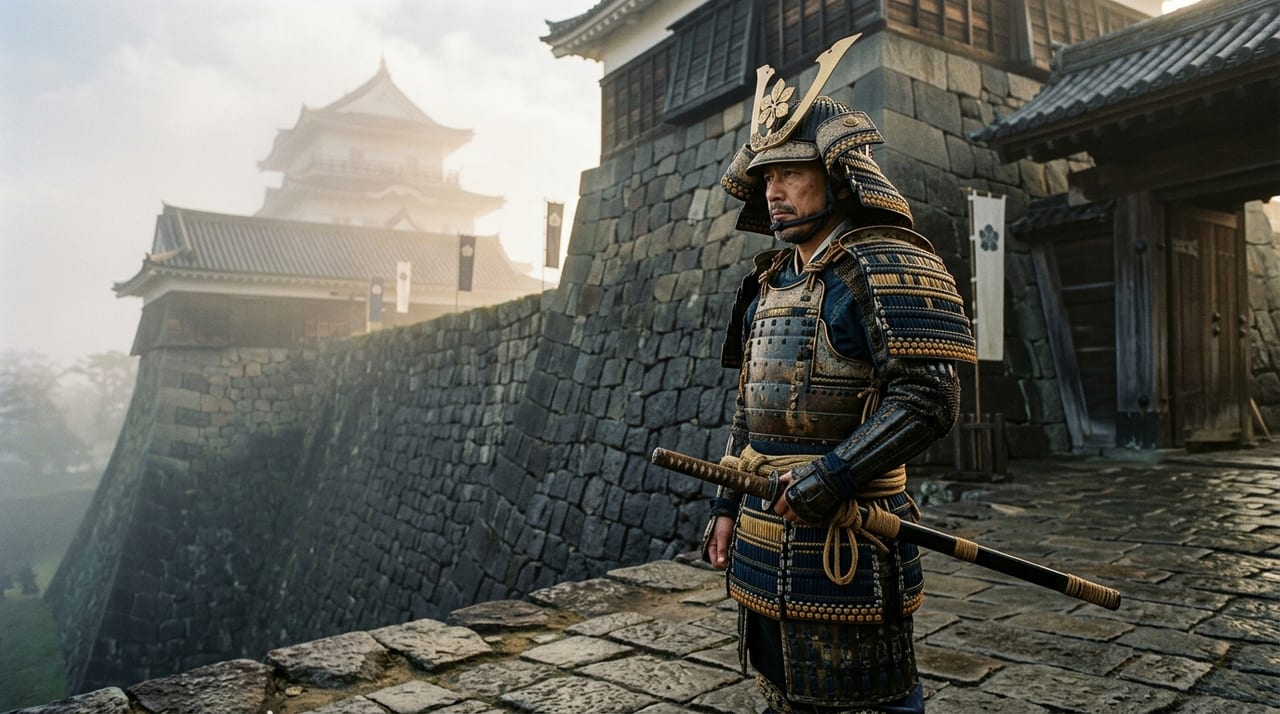
 * Image is for illustrative purposes only.
Wife of Tomita Nobutaka
富田信高の妻
The Woman Warrior Who Saved Her Husband at the Siege of Anotsu Castle
Description
Tomita Nobutaka, lord of Anotsu Castle in Ise Province, is recorded as having had both a principal wife and a secondary wife (keishitsu). The secondary wife was a daughter of Ukita Tadaie, younger brother of Ukita Naoie, making her a cousin of Ukita Hideie, one of the Five Great Elders (Go-Tairō); she reportedly became Hideie's adopted daughter before marrying Nobutaka. No personal name for her survives in the sources — most records refer to her only by honorific titles such as "Kita no Kata" — so this entry is titled simply "Wife of Tomita Nobutaka." That she was related by blood to Ukita Hideie, a central figure of the Western Army, while her own husband fought for the Eastern Army, makes her a striking symbol of the tangled kinship ties that crisscrossed the eve of Sekigahara.
On the 24th day of the 8th month of Keichō 5 (October 1, 1600), the Siege of Anotsu Castle broke out as a prelude skirmish to the Battle of Sekigahara. Facing tens of thousands of Western Army troops led chiefly by the Mōri, Nobutaka's side is said to have held the castle with only a small garrison, and when Nobutaka himself found himself trapped and in grave danger amid the enemy ranks, his wife is said to have donned full armor and ridden out alone from the castle to rescue him. The Edo-period collection of samurai anecdotes "Bukō Zakki" preserves a vivid description of her appearance in that moment: clad in scarlet-laced armor with a two-tiered black-leather lacing, her helmet cord fastened beneath a crescent-moon crest, wielding a single-hooked hand spear (kata-kama-yari) as she charged into the enemy. She has been remembered ever since as the woman warrior who broke into hostile lines in brilliant scarlet armor and a crescent-crested helmet, described in the record as "beautiful yet martial," her striking figure said to have drawn the gaze of friend and foe alike.
It should be noted that this episode is drawn primarily from Edo-period samurai anecdote collections such as "Bukō Zakki," and the full course of the engagement is not corroborated by contemporary first-hand sources from the year 1600 itself. Even so, the image of a woman donning armor and taking up a weapon to ride into the main battle line was considered extraordinary even by the standards of the time, and the episode became one of the few widely retold tales of female valor from the eve of Sekigahara, later depicted repeatedly in paintings and popular literature. Anotsu Castle surrendered shortly afterward, but Nobutaka himself went on to survive as a daimyo, and his conduct in the battle — including his wife's intervention — is said to have later been favorably recognized by the Tokugawa side.
Notable Swords
- Kata-kama-yari (single-hooked hand spear said to have been wielded when she rode out to rescue her husband at the Siege of Anotsu Castle)