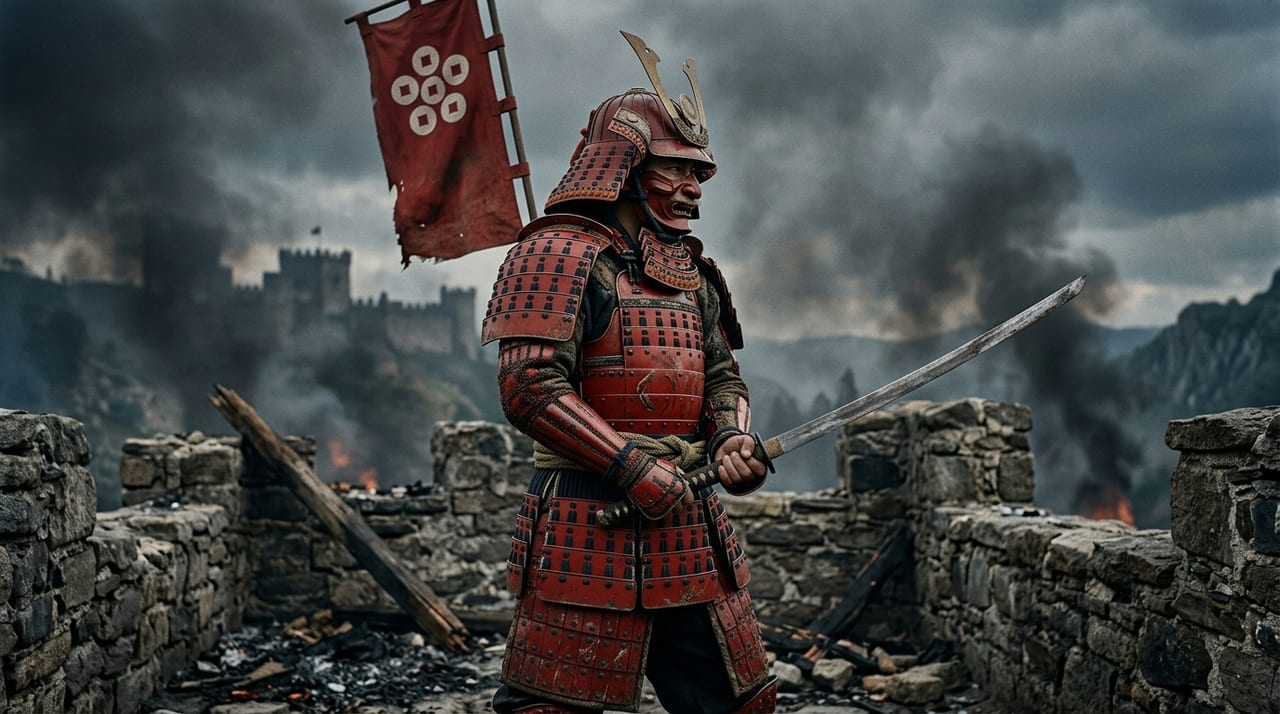
 * Image is for illustrative purposes only.
Mōri Hidemoto
毛利秀元
The Mōri clan elder remembered for the "Saishō-dono's Empty Lunchbox" episode at Sekigahara, and first lord of Chōfu Domain
Description
Mōri Hidemoto (1579-1650) was a military commander and daimyo active from the Azuchi-Momoyama through the early Edo period. The son of Hoida Motokiyo, Mōri Motonari's fourth son, he was raised as the adopted heir of clan head Mōri Terumoto and is remembered for the "Saishō-dono's Empty Lunchbox" episode at the Battle of Sekigahara.
Origins and Adoption by Terumoto
Hidemoto was born in 1579, the son of Hoida Motokiyo. After his elder brother's early death he became Motokiyo's heir, and in 1585, because clan head Mōri Terumoto had no biological son, Hidemoto was adopted as his heir (though contemporary documentation for this is limited, and much of the account rests on the later-compiled "Mōri Hidemoto-ki"). In 1592, meeting Toyotomi Hideyoshi in Hiroshima, Hidemoto was granted the character "Hide" from Hideyoshi's own name.
Military Service in the Invasions of Korea
During the first invasion of Korea, Hidemoto crossed to the peninsula in 1593 and served as a lead commander in the assault on Jinju Castle, reporting large numbers of enemy heads taken to Hideyoshi, and also oversaw construction of Busan Castle. In the second invasion he crossed again as overall commander of a 30,000-strong Mōri force, taking part in the fall of Hwangseoksan Fortress, repelling Ming forces at Jiksan, and relieving Ulsan Castle.
The Battle of Sekigahara and the "Empty Lunchbox"
At Sekigahara in 1600, Hidemoto deployed on Mount Nangū, positioned as part of the Western Army's main force. However, his cousin Kikkawa Hiroie had secretly negotiated with the Eastern Army's Tokugawa Ieyasu, and Hiroie blocked Hidemoto's line of advance with his own troops, so that Hidemoto — despite knowing the battle had begun — was never able to engage. When messengers pressed him to advance, Hidemoto is said to have replied that his troops were "just now eating their lunch," an excuse that later became known as the "Saishō-dono's Empty Lunchbox."
Rule as First Lord of Chōfu Domain
After Sekigahara, the main Mōri house was drastically reduced to the two provinces of Suō and Nagato, but Hidemoto was allotted 60,000 koku at Chōfu in Nagato and became the domain's first lord. During the Kan'ei era he conducted land surveys that effectively raised the domain's assessed yield, introduced a paper monopoly system, promoted new-field development, and paid off the domain's debts. Friction arose with the main-house lord Mōri Hidenari over the regency, deepening around 1630 into an attempt at independence that did not materialize; the shogunate mediated a reconciliation in 1636. After learning of Hiroie's collusion at Sekigahara, a long-standing rift is said to have persisted between the Chōfu Mōri and the Iwakuni Kikkawa families.
Connection to Swords
Hidemoto is said to have received the wakizashi "Washi-no-su Yukimitsu" (attributed to Miyoshi Nagayasu) and the tachi "Atsu Tōshirō" from Hideyoshi at their 1592 meeting. Hideyoshi's favored blade "Mitsutada" is also said to have passed to Hidemoto, and these blades were preserved as treasures of the Mōri house. The tachi "Bizen Saburō Kunimune" was presented by Hidemoto to shogun Tokugawa Iemitsu in 1640.
Legacy
Hidemoto was also a man of culture who studied the tea ceremony under Furuta Oribe, and spent his final years in Edo as a companion (otogishū) to shogun Tokugawa Iemitsu. While he served as a senior figure of the Mōri clan in war, governance and culture alike, the "empty lunchbox" episode remains widely retold today as an emblem of the Mōri clan's inaction at Sekigahara.
Notable Swords
- Atsu Tōshirō (a tachi by Tōshirō, received from Toyotomi Hideyoshi)
- Washi-no-su Yukimitsu (a wakizashi by Yukimitsu, said to have belonged to Miyoshi Nagayasu, received from Hideyoshi)
- Mitsutada (a katana by Mitsutada favored by Hideyoshi, said to have been passed to Hidemoto)
- Bizen Saburō Kunimune (a tachi presented to shogun Tokugawa Iemitsu in 1640)