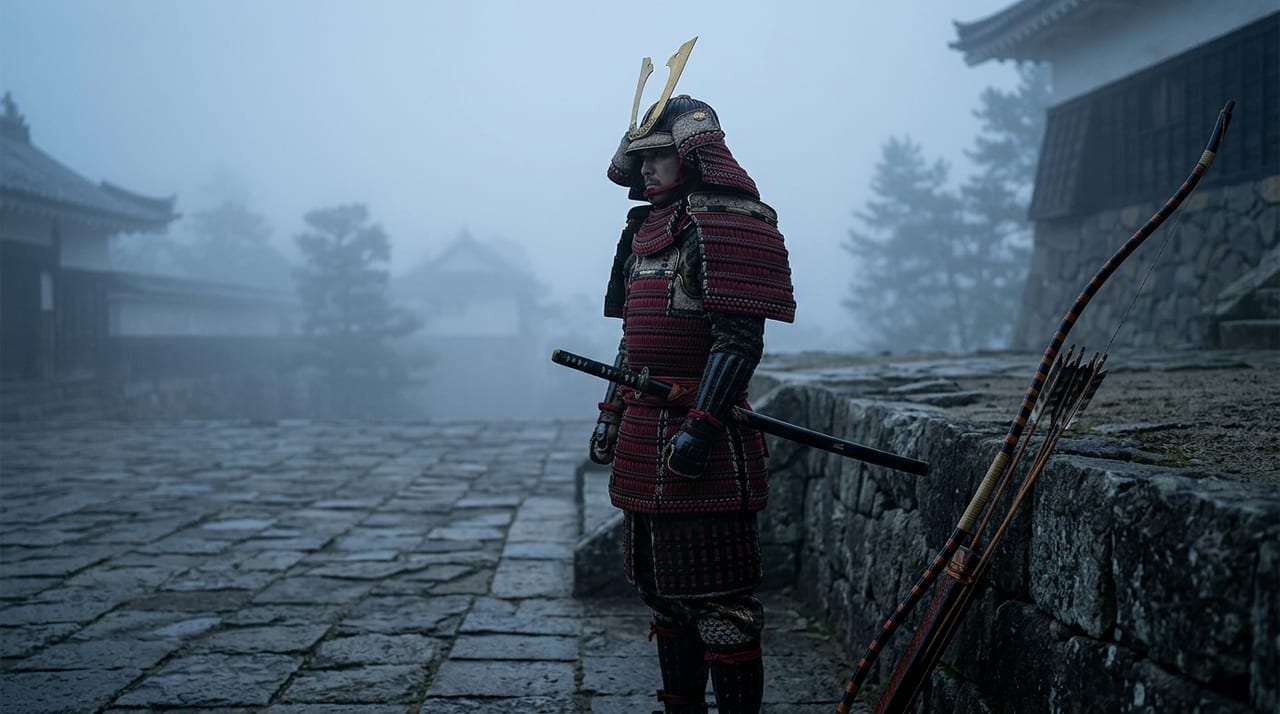
 * Image is for illustrative purposes only.
Minamoto no Yoriie
源頼家
The Second Shogun — heir to Kamakura who died by conspiracy before he could find his footing
Description
Born as the Heir of the Shogunal House
Minamoto no Yoriie was born in Juei 1 (1182), the eldest son of Minamoto no Yoritomo and Hōjō Masako. Destined to succeed the founder of the Kamakura shogunate, Yoriie was, from early childhood, a boy skilled in the martial arts, and those around him placed their hopes in him. Yoritomo chose the wet nurse for his eldest son from among the Hiki clan, and he personally appointed the attendants and guardians around the boy. Yoriie is said to have excelled at kemari and archery and to have shown outstanding skill in both. In particular, Rokudai Shōjiki describes his archery as “skilled in the art of hitting every mark,” and when the twelve-year-old Yoriie first brought down a deer during the great hunt at Mount Fuji in Kenkyū 4 (1193), his father Yoritomo is said to have been overjoyed.
Taking Office and the Council of Thirteen
When Yoritomo died suddenly in Kenkyū 10 (1199), Yoriie, then eighteen, succeeded to the headship of the family. However, real power over the Kamakura shogunate had already passed into the hands of the gokenin vassals, centered on the Hōjō clan, and the senior figures of the shogunate established the Council of Thirteen to prevent Yoriie from acting unilaterally. This system restricted the shogun’s authority through deliberation among thirteen powerful gokenin, and for Yoriie it meant the effective hollowing out of his shogunal power. Surrounded by the schemes of senior retainers, including his grandfather Hōjō Tokimasa, the young shogun grew increasingly isolated, and each time he tried to assert his own will, he created friction with those around him.
Bow and Kemari: Yoriie’s Two Faces
Records of Yoriie convey both his outstanding aptitude for the martial arts and his cultural refinement. Assessments of him as a master archer appear in many sources. Jien’s Gukanshō also records that his reputation as a martial artist, unrivaled past or present, was no secret. At the same time, his devotion to kemari drew criticism as “unbecoming of a warrior,” but this shows that Yoriie also had a deep interest in court culture.
The Hiki Yoshikazu Incident and Confinement at Shuzen-ji
In Kennin 3 (1203), when Yoriie fell ill, Hōjō Tokimasa seized the opportunity and acted. He assassinated Hiki Yoshikazu, Yoriie’s maternal relative (the Hiki Yoshikazu Incident), and destroyed the Hiki clan. Yoriie recovered and, upon learning of the destruction of the Hiki clan by the Hōjō, flew into a rage and ordered Tokimasa’s destruction, but his forces fell short. The Hōjō clan deposed Yoriie as shogun and installed his younger brother Senman (later Minamoto no Sanetomo) as the third shogun. Yoriie was confined at Shuzen-ji in Izu Province. The following year, in the 7th month of Genkyū 1 (1204), Yoriie was assassinated at Shuzen-ji. He was only twenty-three years old.
The Tragedy at Shuzen-ji and Later Assessments
Yoriie’s death was widely retold in later ages as a casualty of the struggle for power. His tragedy also became a subject for literature and the performing arts. Okamoto Kidō’s play Shuzenji Monogatari (Meiji 44 (1911)), a representative work of shin-kabuki, depicts the mask carver Yashaō of Shuzen-ji in Izu against the backdrop of Yoriie’s death, and it continues to be performed today. Sympathy for Yoriie, who was swallowed up young by the whirlpool of power and was never given the chance to fully display his talents, continues to resonate with people across the ages. A shogun who wore a sword yet held no real power: that contradiction lies at the core of Yoriie’s tragedy.