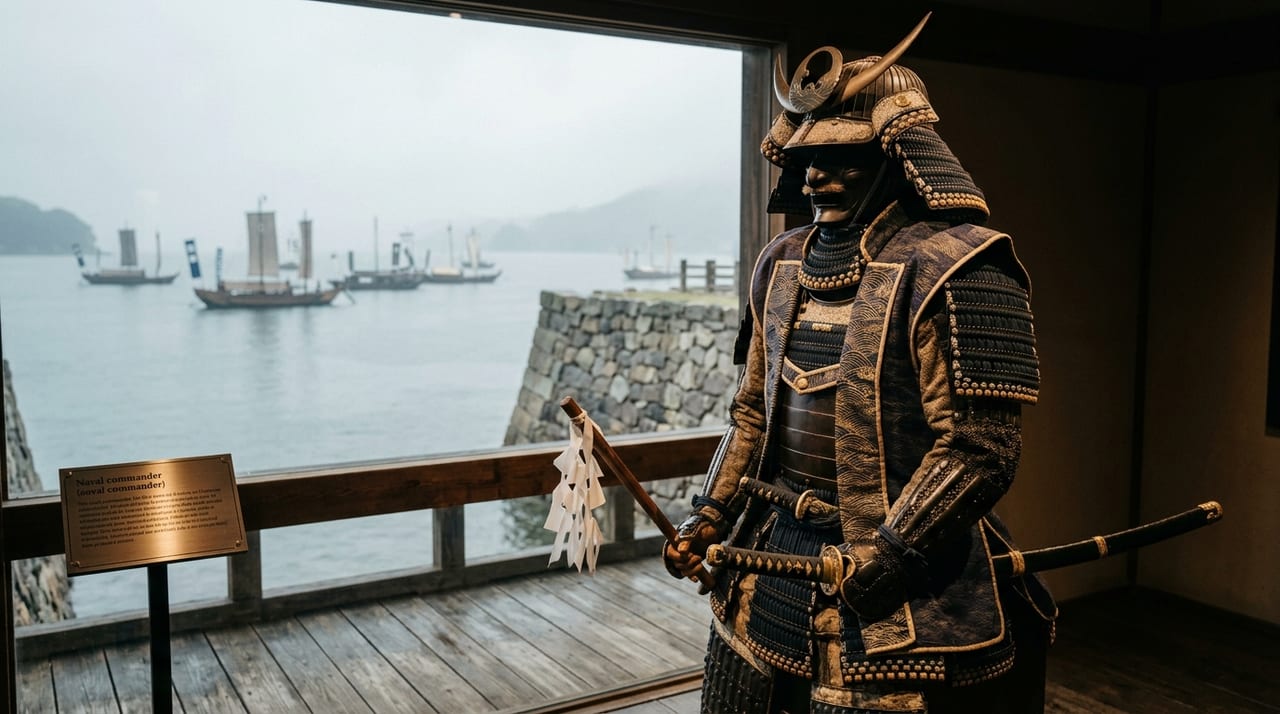
 * Image is for illustrative purposes only.
Kurushima Michifusa
来島通総
Chief of the Kurushima Navy, a Pirate Band of the Seto Inland Sea: The Toyotomi Naval General Who Fell in the Korean Campaigns
Description
Chief of the Kurushima Navy, Master of the Seto Inland Sea
Kurushima Michifusa, born in Eiroku 4 (1561), was the chief of the Kurushima navy, whose base was on Kurushima island offshore of present-day Imabari, Ehime Prefecture, in Iyo Province. The Kurushima navy was a branch of the Murakami navy. Among the three Murakami houses of Kurushima, Noshima and Innoshima, it held the westernmost stronghold, and for generations it had been under the influence of the Kōno clan of Iyo. Michifusa drew on the advantages of that terrain and his well-trained naval warriors, and maintained an independent maritime power even under the Oda and Toyotomi regimes.
As a Naval General of the Toyotomi Regime
In Tenshō 10 (1582), Michifusa, on the invitation of Hashiba (Toyotomi) Hideyoshi, defected to the Oda side. Attacked by the Mōri and Kōno clans, he was for a time driven from his base, but after Hideyoshi and the Mōri made peace, he returned to his former domain. Hideyoshi valued Michifusa, who had sided with him early, and called him “Kurushima, Kurushima”; as a result, it is said, Michifusa changed his family name from Murakami to Kurushima. In Tenshō 13 (1585), in the Shikoku campaign, he served as vanguard, and for that merit he was granted 14,000 koku in Kazahaya District, Iyo Province, and became a daimyō. In the Bunroku campaign (first invasion of Korea, 1592), he initially fought on land, and later was reorganized into the naval forces and fought the Korean navy.
A Valiant End in the Korean Campaigns
In the Keichō campaign (second invasion of Korea), in Keichō 2 (1597), Michifusa led his navy to Korea. In the Battle of Myeongnyang in the 9th month of that year, he charged into the strait as vanguard, but was counterattacked by the Korean navy under Yi Sun-sin and died in battle. He died aged 37 (by East Asian reckoning). As one of the few daimyō who died in battle during the Korean campaigns, his renown for valor was handed down to posterity.