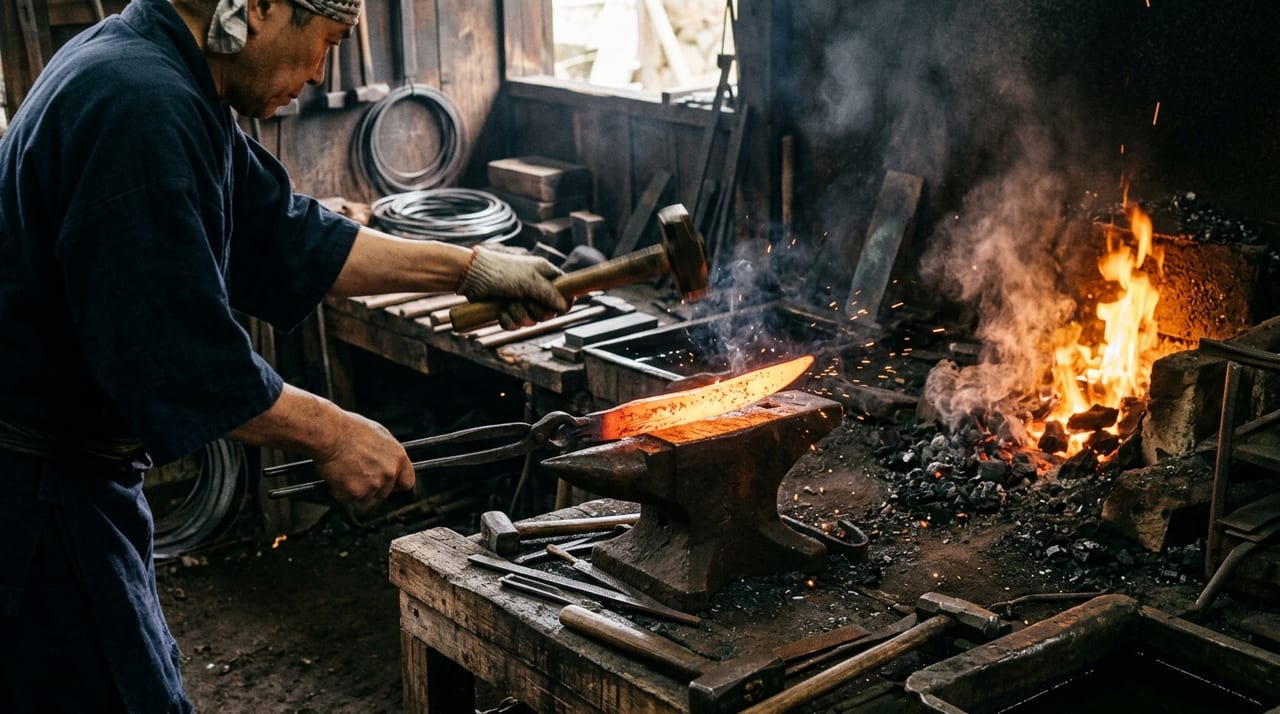
 * Image is for illustrative purposes only.
Yokoyama Sukenaga
横山祐永
Description
Yokoyama Sukenaga was a swordsmith active in Osafune, Bizen Province (present-day Osafune, Setouchi City, Okayama Prefecture) from the Tenpō era of the late Edo period through the Meiji period. A member of the Yokoyama school, which carried the Bizen tradition into the Shinshintō (new-new sword) era, he is regarded as one of the most highly esteemed smiths of that school.
Lineage and School
The Yokoyama school preserved the Osafune Bizen tradition into the early modern period. Sukenaga is recorded as the son of Yokoyama Sukehira and inherited headship of the family. He was permitted to sign his blades as the "56th-generation descendant of Tomonari," a mark of prestige tracing back to the founder of the Osafune tradition, and was also permitted to carve a chrysanthemum crest on the tang.
Style
Sukenaga specialized in flamboyant gunome-chōji (interlocking clove-shaped) blade patterns, and his signature "kikuka-chōji" (chrysanthemum-clove) work — a continuous run of small, tightly-formed chōji — is considered representative of the finest Yokoyama-school craftsmanship. His steel shows a tight itame grain, and the bright, clear temper line exemplifies the Shinshintō-era revival of the Bizen tradition.
Extant Works
Swords and wakizashi bearing dated signatures from the Tenpō era (1830s) through the Kaei and Ansei eras survive today, held by institutions including the Kurashiki Token Museum and various sword dealers.
Reputation
Sukenaga is regarded as one of the most highly rated swordsmiths of the Shinshintō-era Yokoyama school, and his work stands as evidence that the Bizen tradition remained alive through the end of the Edo period.