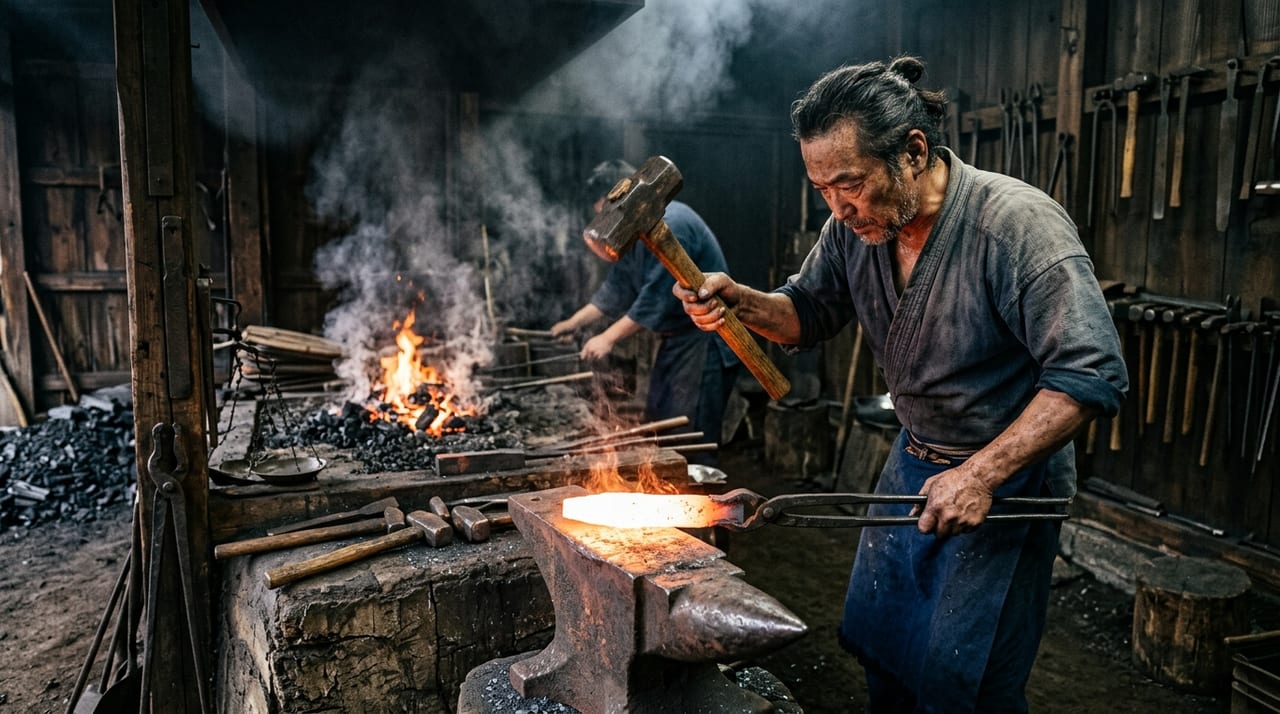
 * Image is for illustrative purposes only.
Miyairi Kozaemon Akihira
宮入小左衛門昭平
Description
Miyairi Akihira and the Pinnacle of Modern Swordmaking
Miyairi Akihira (later known as Yukihira, 1913–1977) was the defining swordsmith of the Shōwa era and one of the most important figures in modern Japanese sword history, recognized as a holder of Important Intangible Cultural Properties (Living National Treasure). Born in Sakaki, Nagano Prefecture, even as the tradition of Japanese swordmaking faced the threat of extinction during and after the war, he never abandoned his passion for the craft, ultimately pioneering a unique path that integrated rigorous study of ancient blades with contemporary swordmaking techniques.
Akihira's swordmaking was not passive preservation of tradition but an active answer to the fundamental question—"What is the Japanese sword?"—asked anew within modern production conditions. At a time when electric furnaces and mechanical tools had become prevalent, he deliberately preserved the charcoal-fired, hand-forged traditional process while integrating modern scientific knowledge.
Forging Technique and Commitment to Tamahagane
The most distinctive commitment in Akihira's swordmaking was his rigorous dedication to tamahagane—steel produced by the traditional Japanese tatara iron-smelting method, fundamentally different in composition and microstructure from modern industrial steel. Even in the postwar period of material scarcity, Akihira insisted on obtaining tamahagane and was among those who advocated for its revival and stable supply.
The jigane produced from tamahagane under Akihira's hands displays refined small-itame with even ji-nie and transparent, lustrous clarity. This quality is achieved only through repeated folding and forging and precise control of fire—the crystallization of decades of training.
Hamon Aesthetics: Reverence for Kotō and Contemporary Reinterpretation
Akihira's hamon took ancient blades as models without falling into simple imitation, reinterpreting them within a contemporary context. He was proficient in both the straight-edge lineage of the Yamashiro and Yamato traditions and the chōji lineage of the Bizen tradition, selecting the appropriate hamon style for each commission and purpose.
The nie is fine and even, the nioi deep, the edge finish shows no inferior comparison to first-rate ancient works. With abundant activity within the blade—kinsuji and sunagashi—he possessed the skill to create a sense of living movement in still steel, standing out among modern smiths.
Miyairi Akihira and the Cultural Redefinition of the Japanese Sword
The Shōwa era in which Miyairi Akihira lived was precisely the period when the Japanese sword completed its transition from weapon to art object and cultural property, seeking new value in its transformed identity. In response to the demands of this age, Akihira positioned swordmaking as "production of the soul"—redefining the swordsmith's work not as mere manufacture of objects but as a practice of spiritual discipline.
This approach was transmitted to his disciples. In his later years, Akihira himself changed his name from Akihira to Yukihira. His younger son, Miyairi Satoshi, later assumed the name Miyairi Kozaemon Yukihira and became a leading figure in contemporary swordmaking. The Miyairi family has become a symbolic presence in modern swordmaking, embodying the transmission and development of Japanese sword culture in the present age.
TOUKENZA and Miyairi Akihira
TOUKENZA presents Miyairi Akihira to demonstrate that the Japanese sword tradition continues as a living art in the present day. The works of the ancient masters and Akihira's contemporary pieces are in dialogue across time through the shared medium of the Japanese sword. The refined jigane and deep hamon of Akihira's blades prove that technical transmission is not merely preservation of form but transmission of spirit.
Famous Works
- 太刀(文化庁買上げ)
- 刀(重要無形文化財保持者作品展出品作)