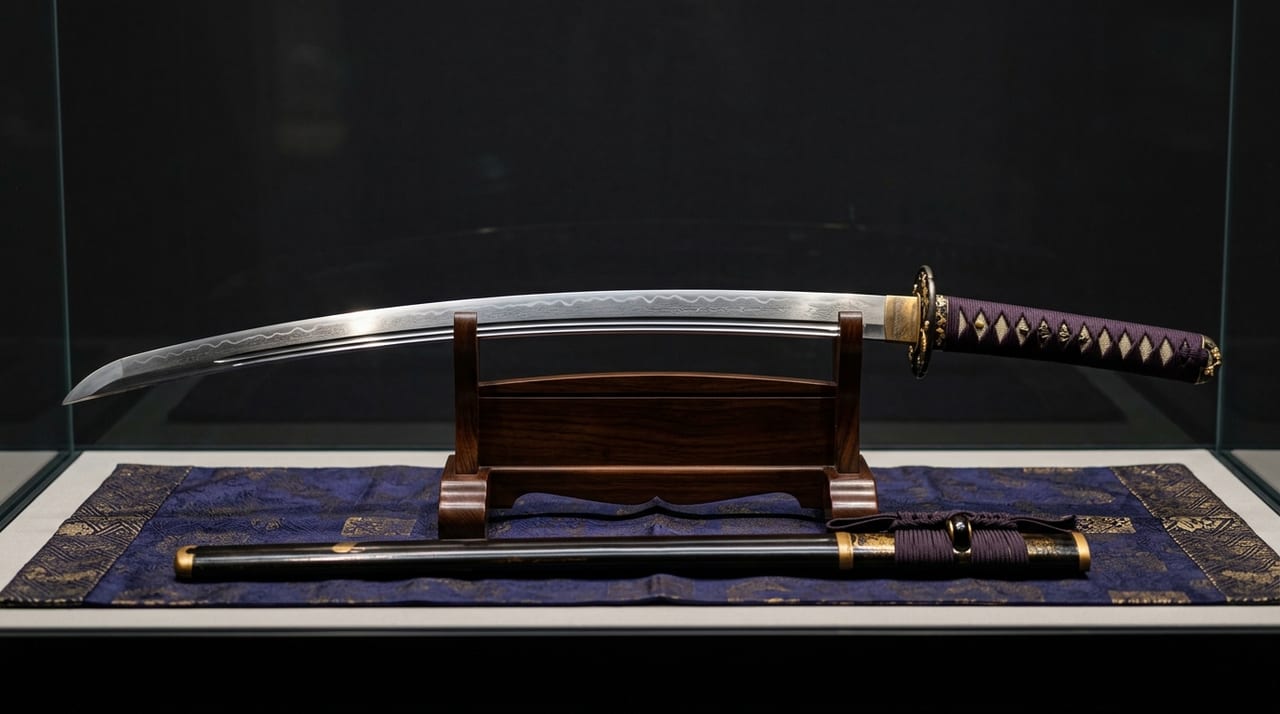
 * Image is for illustrative purposes only.
Tanto signed Rai Kunimitsu (Meibutsu Uraku Rai Kunimitsu)
短刀 銘 来国光(名物 有楽来国光)
Also known as: Uraku Rai Kunimitsu — listed in the Kyoho Meibutsucho, short sword owned by Oda Urakusai, National Treasure, Nagoya Token Museum
- Smith
- Rai Kunimitsu (Yamashiro Province)
- Era
- End of the Kamakura period (first half of the 14th century)
- Type
- Tanto
- Designation
- National Treasure
- Location
- Nagoya Token Museum (Token World Foundation), Nagoya City, Aichi Prefecture
Description
Rai Kunimitsu and the Rai School
Rai Kunimitsu was a master smith of the Rai school (Rai-ichiha), active in Yamashiro Province (present-day southern Kyoto Prefecture) from the late Kamakura period into the Nanboku-chō period. He is said to have been the grandson of Rai Kuniyuki, regarded as the de facto founder of the Rai school. While inheriting the style of his father, Rai Kunitoshi, he left behind many tanto and tachi with an elegant character of his own. Several of Rai Kunimitsu's works have been designated National Treasures or Important Cultural Properties, and he is especially regarded as one of the foremost smiths of his era in the quality of his tanto.
Overview of “Uraku Rai Kunimitsu”
“Uraku Rai Kunimitsu” is a tanto forged by Rai Kunimitsu in the late Kamakura period, designated a National Treasure in 1955. Its blade length is 27.7 centimeters, it has no curvature (sori), its body width (mihaba) is broad, and its kasane is thick. The jigane is ko-itame-hada, and the hamon is ō-chōji midare mixed with gunome, with ashi entering, deep nioi, and ko-nie. It displays the spirited quality representative of Rai Kunimitsu's work, and beyond the fullness of its tanto construction, it has the dignified sheen of the Rai school's characteristic jigane.
Provenance: From Toyotomi Hideyori to Oda Uraku-sai
This tanto has been prized as a meibutsu since before the Edo period. Its provenance is first known as ownership by Toyotomi Hideyori, son of Toyotomi Hideyoshi. Hideyori gave it to Oda Uraku-sai (Oda Nagamasu, 1547–1621). Uraku-sai was a younger brother of Oda Nobunaga and a warrior-tea master known as a master of the tea ceremony; he was also the founder of the Uraku school. His go, “Uraku,” is the reason the name was attached to this sword. It was later passed down for a long time in the Maeda family (Kaga domain), and ultimately came into the collection of the Token World Foundation (Tōken Corporation).
Listing in the Kyōhō Meibutsuchō
By order of the eighth Tokugawa shogun, Yoshimune, the Hon'ami family compiled the sword catalogue Kyōhō Meibutsuchō, in which it is recorded as “Uraku Rai Kunimitsu.” It is also said to have later been bought and sold at a price of 5,000 kan, and it was rated highly as a top-class meibutsu of its time.
Present Ownership and Display
It is currently held by the Nagoya Token Museum (Token World Foundation) in Nagoya City, Aichi Prefecture, where it is displayed and exhibited as one of the core National Treasure swords of the museum's collection. As the pinnacle of tanto made by Rai Kunimitsu, it continues to draw keen attention from sword enthusiasts and researchers today.
Legends & Stories
A tanto bearing the name of Oda Uraku-sai (Oda Nagamasu), the tea master and younger brother of Oda Nobunaga, who received it from Toyotomi Hideyori. It is recorded in the Kyōhō Meibutsuchō as “Uraku Rai Kunimitsu,” and from the Edo period onward it earned renown as a supreme meibutsu.