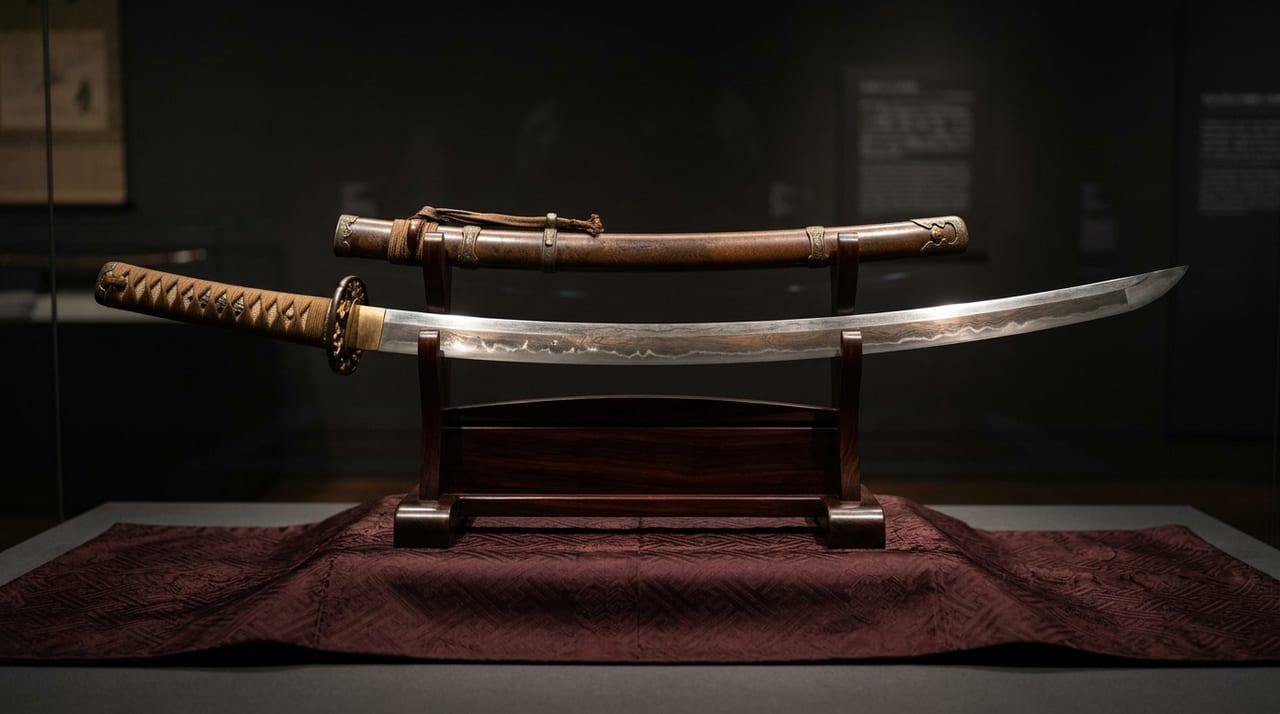
 * Image is for illustrative purposes only.
Tokuzenin Sadamune (Unsigned Sadamune)
徳善院貞宗(無銘貞宗)
Also known as: Tokuzenin Sadamune — National Treasure unsigned Sadamune tanto, Maeda Gen'i provenance, Mitsui Memorial Museum
Description
Sadamune (active early 14th century) worked in Sagami Province (modern Kanagawa) and is traditionally ranked as the foremost of the "Masamune jittetsu" (ten great disciples of Masamune). He inherited the deep, tempestuous nie of his master Masamune but refined it into a more composed, aristocratic style. His tanto in particular are renowned for hamon closely resembling Masamune's work, graceful looping boshi, and superb steel quality.
This unsigned (mumei) tanto takes its name from Maeda Gen'i (1539–1602), one of the "Five Commissioners" (Go-bugyo) of the Toyotomi administration, who held the Buddhist title "Tokuzenin." The blade originally belonged to Toyotomi Hideyoshi and is said to have been given to Maeda Gen'i as a keepsake at Hideyoshi's death in 1598, subsequently passing through the Tokugawa shogunal house, the Kishu Tokugawa branch, and the Saijo Matsudaira clan.
The blade carries relief carvings of sankosho (vajra-hilted sword), incense burners, and Sanskrit characters on both faces. The steel is a tightly packed ko-itame with rich nie, and the hamon with its elegant boshi (tip temper line) reflects the refinement Sadamune developed from Masamune's model. Though unsigned, the blade has been authenticated by the Honami family as a masterwork of Sadamune.
Designated a National Treasure on November 22, 1952, the sword is now held at the Mitsui Memorial Museum in Chuo Ward, Tokyo, where it is exhibited at special exhibitions. It stands as an essential reference piece for understanding the Soshu tradition and Sadamune's place in Japanese sword history.
Legends & Stories
Named after Maeda Gen'i ('Tokuzenin'), one of Toyotomi Hideyoshi's senior commissioners, who owned and prized this blade. Originally Hideyoshi's own sword, it was given to Gen'i as a keepsake at Hideyoshi's death, then became a Tokugawa shogunal treasure.