 * Image is for illustrative purposes only.
Todaijiyama Kofun Nakahira-Inscribed Ring-Pommel Tachi
東大寺山古墳出土 中平銘花形飾環頭大刀
Also known as: Chuping-Inscribed Iron Sword
Description
Overview
The Chuping-inscribed ring-pommel tachi from the Todaijiyama Kofun in Tenri, Nara Prefecture, is an iron sword whose gold-inlaid inscription is among the oldest inscribed blades ever excavated in Japan. It was designated a National Treasure on 15 September 2017 as part of the Todaijiyama Kofun excavated artifacts and is now kept at the Tokyo National Museum.
The Inscription and Its Date
The blade back is thought to have carried a 24-character gold-inlaid inscription, read as "In the fifth month, bingwu day, of the Zhongping era, this sword was made, a hundred-times-forged blade, in accord with the stars above and warding off misfortune below." Zhongping (184-189 CE) is a reign name of Emperor Ling of the Later Han. The blade itself is Chinese, while the tomb dates to the fourth century, so a long interval separates its making and its burial.
Form and Construction
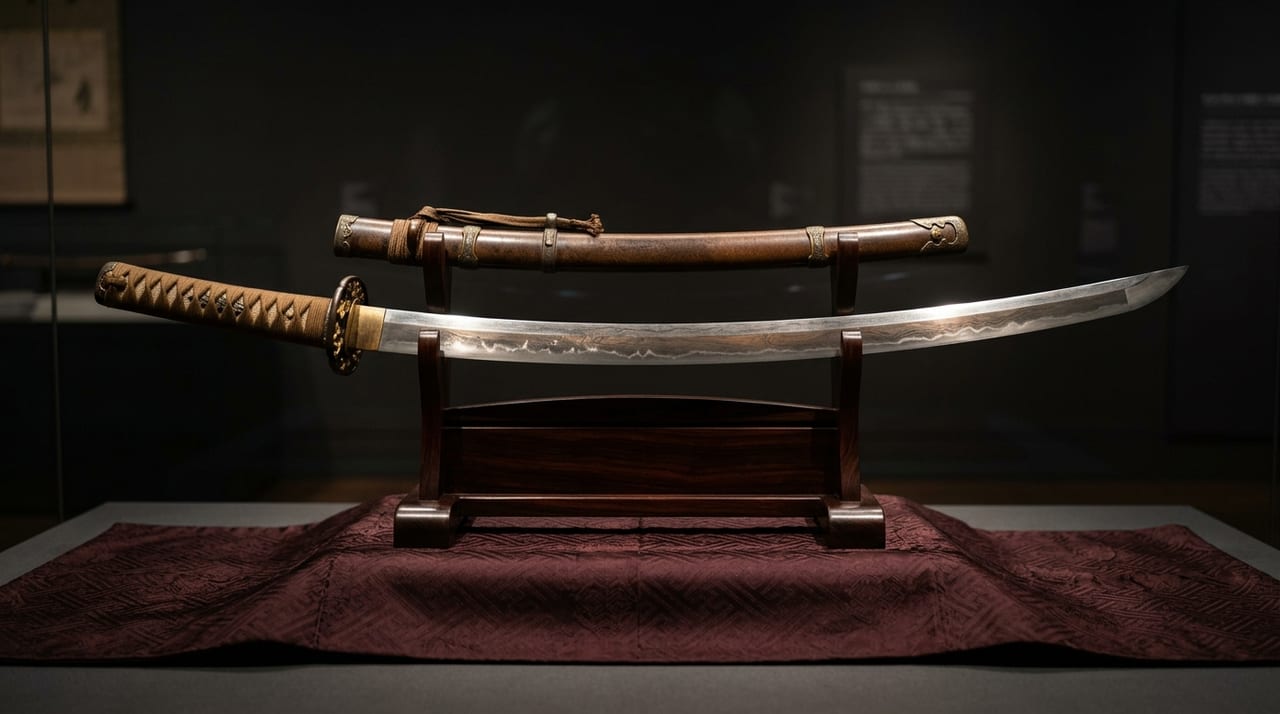
The sword is about 110 cm long with a slight inward curve. It is explained as originally having a plain ring pommel that was replaced in Japan with a bronze flower-shaped ring pommel. The iron blade reflects the advanced Chinese forging of its time, as the phrase "hundred-times-refined" boasts.
Historical Significance
The Zhongping years coincide with the upheaval in Wa described in Chinese histories such as the Book of the Later Han. The sword is therefore thought to have been granted by the Han court after that turmoil, and it is valued as evidence that local powers in Yamato had contact with China. No record directly documents the gift, so this remains a leading interpretation rather than established fact.
Excavation and Display
The Todaijiyama Kofun sits on a ridge on the eastern side of the Nara Basin. This sword was among many iron weapons found in the burial pit east of the clay chamber. It is often on permanent display on the first floor of the Heiseikan at the Tokyo National Museum.
Legends & Stories
The blade bearing the Later Han reign name Zhongping is thought to have been sent from the Han court to Wa after the period of unrest, and later buried in a Yamato tomb.