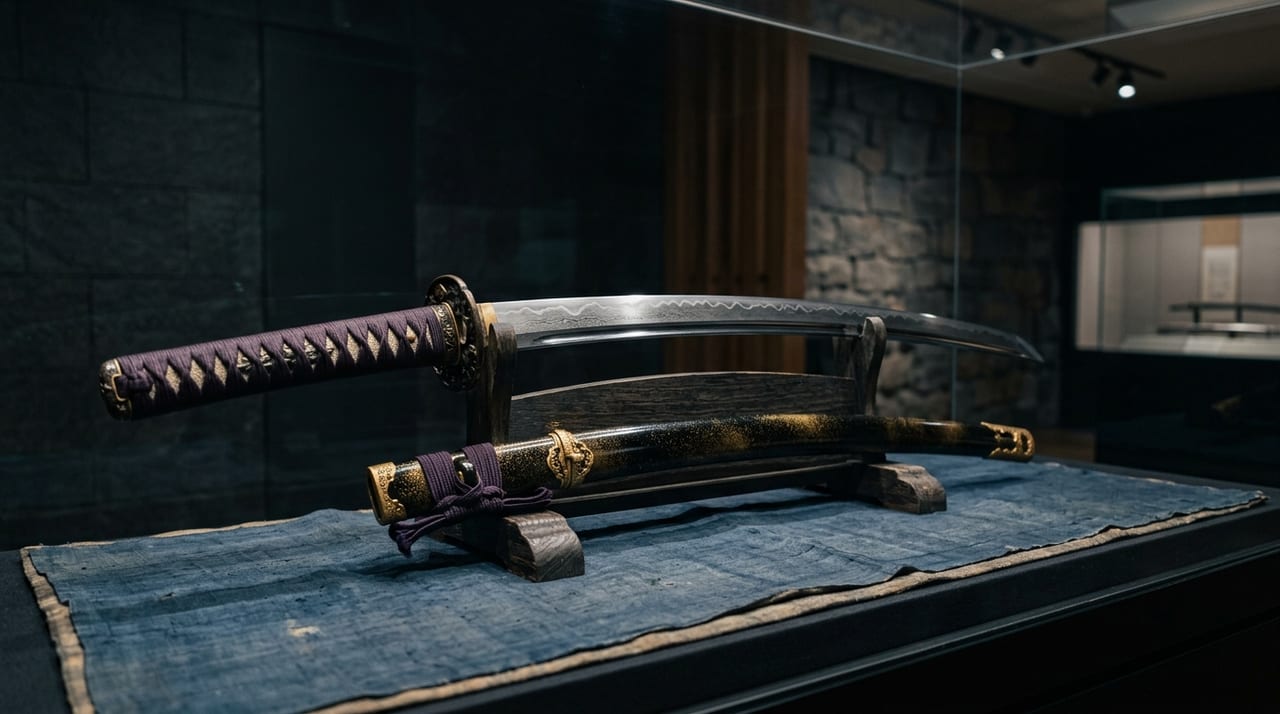
 * Image is for illustrative purposes only.
Sukekane
助包
Also known as: Tachi signed Sukekane; Ko-Bizen Sukekane; sword of Shinonome Shrine
Description
A Surviving Work of the Ko-Bizen School
Sukekane was a smith of the Ko-Bizen ("Old Bizen") school, active in Bizen Province (present-day eastern Okayama) from the late Heian into the early Kamakura period. This tachi, signed "Sukekane," is one of his few surviving works and was designated an Important Cultural Property (craft work) on 4 April 1928.
Craftsmanship
The blade measures 72.8 cm in length with a curvature of 2.5 cm. It is of shinogi-zukuri construction with an iori ridge, presenting a form with pronounced curvature and a sturdy build. The steel shows itame mixed with mokume grain and well-developed ji-nie, while the temper line is a small midare pattern in nie-deki with choji utsuri (a reflected choji pattern). The tang has been shortened from its original length and bears four mekugi holes; the two-character signature "Sukekane" is carved into it.
Provenance
According to tradition, the blade was granted by Toyotomi Hideyoshi to Yamamoto Yoshizumi, a retainer of the Matsuyama domain. His descendant Yamamoto Yoshihiro dedicated it to Shinonome Shrine in Matsuyama in 1881 (Meiji 14), and it has remained the shrine's property ever since. It is now kept and exhibited at the Ehime Prefectural Museum of Art in Horinouchi, Matsuyama.
Significance
The Ko-Bizen school is regarded as one of the earliest branches of the Bizen tradition, itself considered a wellspring of Japanese swordsmithing, yet firmly signed surviving examples are scarce. Only a handful of signed Sukekane blades are known, including this Important Cultural Property, making it a valuable witness to the style of Bizen swordsmithing at the turn of the Kamakura period.
Related Famous Swords
太刀 銘 国行(当麻)
National TreasureTachi Signed Kuniyuki (Taima)
Kuniyuki (founder of the Taima school)
伏見貞宗
National TreasureFushimi Sadamune
Sadamune (Sōshū Sadamune)
太刀 銘 大和則長作
Important Cultural PropertyTachi Signed Yamato Norinaga saku
Norinaga (Yamato Shikkake school)
沃懸地酢漿平文兵庫鎖太刀
National TreasureIkakeji Katabami Hyōmon Hyōgogusari Tachi
Unknown (unsigned)