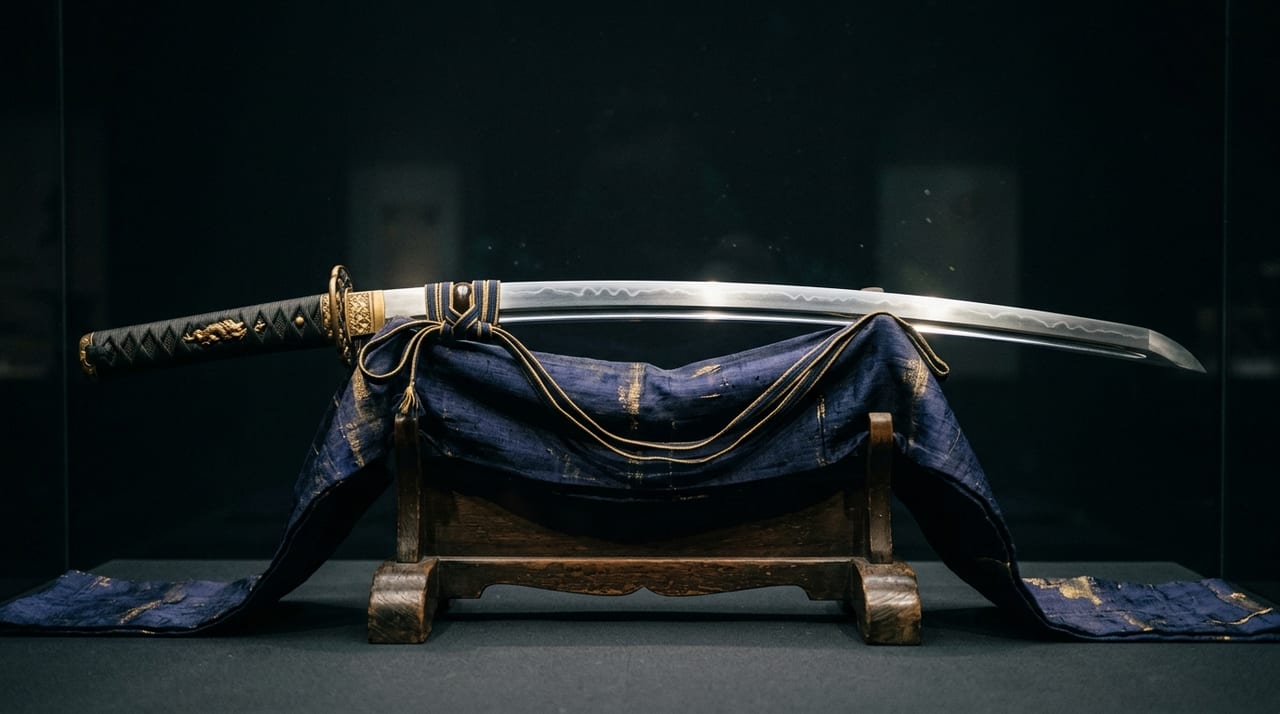
 * Image is for illustrative purposes only.
Tanto signed Rai Kunimitsu (Meibutsu Shiokawa Rai Kunimitsu)
短刀 銘 来国光(名物塩川来国光)
Also known as: Shiokawa Rai Kunimitsu — listed in the Kyoho Meibutsucho, Honda family transmission
Description
Rai Kunimitsu and the Rai School
Rai Kunimitsu is a swordsmith said to have been the legitimate eldest son of Rai Kunitoshi, and the master of the Rai school who made swords over the longest period. Active from the late Kamakura period into the early Nanboku-chō period in Yamashiro Province (present-day Kyoto Prefecture), he inherited his father Kunitoshi's style and left behind numerous masterpieces of tantō.
Overview of the Tantō
This tantō has a blade length of 25.6 centimeters and takes the form of a straight hira-zukuri without curvature (sori). Its highlights are Rai Kunimitsu's accomplished workmanship in the tantō form and the dignified jigane (steel texture) characteristic of the Rai school.
Provenance from the Shiokawa Family to the Honda Family
The Kyōhō Meibutsu-chō records it as: “Valued at 100 gold pieces (daikin hyakumai). In the time of Oda Nobunaga, held by Shiokawa-dono of Ōmi.” Because it was owned by the Shiokawa family in Nobunaga's era, it received the name “Shiokawa Rai Kunimitsu.” (This Shiokawa family is said by some to be the Shiokawa family of Ōmi, and by others to be Shiokawa Hōki-no-kami Kunimitsu, lord of Yamashita Castle in Settsu.) It then passed into the hands of Honda Mino-no-kami Tadamasa and was handed down for a long time within the Honda family of the Himeji domain in Harima Province (present-day Himeji, Hyōgo Prefecture).
Designation and Current Ownership
It has been designated an Important Cultural Property. Since the Edo period it has been highly valued as a meibutsu listed in the Kyōhō Meibutsu-chō. It is currently held by the Token World Foundation (Token Corporation).
Legends & Stories
A celebrated tantō named “Shiokawa Rai Kunimitsu” after the Shiokawa family, which owned it in the time of Oda Nobunaga. Recorded in the Kyōhō Meibutsu-chō with a value of 100 gold pieces, it was later passed down to the Honda family of the Himeji domain in Harima Province.