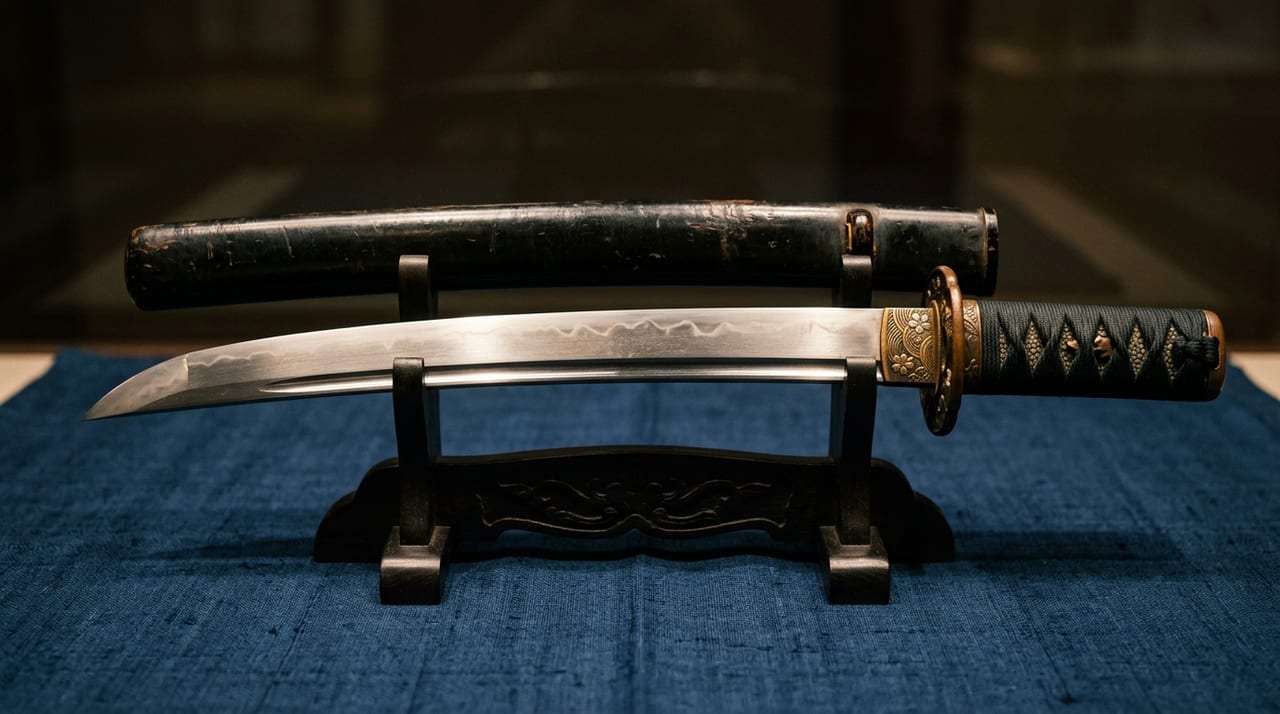
 * Image is for illustrative purposes only.
Tachi signed Kunimune (Shimazu Family Heirloom)
太刀 銘 国宗(島津家伝来)
Also known as: Shimazu Kunimune — National Treasure tachi by Bizen Saburō Kunimune, Shimazu family heirloom, Terukuni Shrine
Description
About Bizen Saburō Kunimune
Bizen Saburō Kunimune was a renowned swordsmith active in Bizen Province (present-day Okayama Prefecture) during the Kamakura period (13th century). The name 'Saburō' is said to derive from his being the third son of Kunizane, and he is also said to have later moved to Kamakura in Sagami Province, where he was involved in the establishment of the Sōshū-den tradition, making him one of the leading master smiths of Bizen blades in the Kamakura period. Many of Kunimune's works have been designated National Treasures or Important Cultural Properties, and his signed works have been especially prized.
Provenance and History of the Shimazu Family
This tachi was a family heirloom passed down through generations of the Shimazu clan; it is currently held by Terukuni Shrine in Kagoshima City and is designated as a National Treasure. The Shimazu clan was a powerful samurai daimyo family that ruled southern Kyushu; with a long history dating back to the Kamakura period, it held the three provinces of Satsuma, Ōsumi, and Hyūga. Through a turbulent history, including the Sengoku-period push to unify Kyushu under the brothers Shimazu Yoshihisa and Shimazu Yoshihiro and the family's survival as the Satsuma domain after the Battle of Sekigahara, the clan collected and preserved many famous swords. This work was donated to Terukuni Shrine by the Shimazu family in Shōwa 2 (1927). After World War II it was confiscated by the General Headquarters of the Allied Powers (GHQ) and its whereabouts remained unknown for a long time, but through the kindness of American sword enthusiast Walter Compton, it was returned to the shrine in Shōwa 38 (1963), and the following year, Shōwa 39 (1964), it was designated a National Treasure. It is currently on deposit at the Reimeikan, Kagoshima Prefectural Center for Historical Material.
Characteristics of the Sword
The blade length is approximately 81.3 centimeters. The blade is wide in width, with a high koshizori (curvature) and strong fumbari (sturdy base), giving it a dignified form, and the nakago (tang) is ubu (unshortened). The jigane (ground steel) shows itame-hada (flowing grain) with slight hada-tatsu (raised grain), with thick ji-nie (ground hardening) across it, and overall midare-utsuri (irregular reflections) stands out. The hamon (temper line) is a deep nioi chōji-midare mixed with gunome, with well-developed ashi (lines) that give it variety, and kinsuji (golden lines) appear here and there.
Significance as a Cultural Property
As a signed tachi by Bizen Saburō Kunimune, it is a valuable surviving work that conveys Kamakura-period swordmaking to the present day, and with the addition of its provenance through the historic Shimazu daimyo house, it holds high documentary value in both sword history and samurai history.
Legends & Stories
Handed down through the Shimazu family for generations as a "treasured sword," it has been regarded as a famed blade that symbolizes the spirit and pride of the Satsuma samurai. As a blade that has witnessed the long history of the Shimazu clan, the lords of southern Kyushu, it has been passed down at Terukuni Shrine and is deposited at Reimeikan, Kagoshima Prefectural Center for Historical Material.