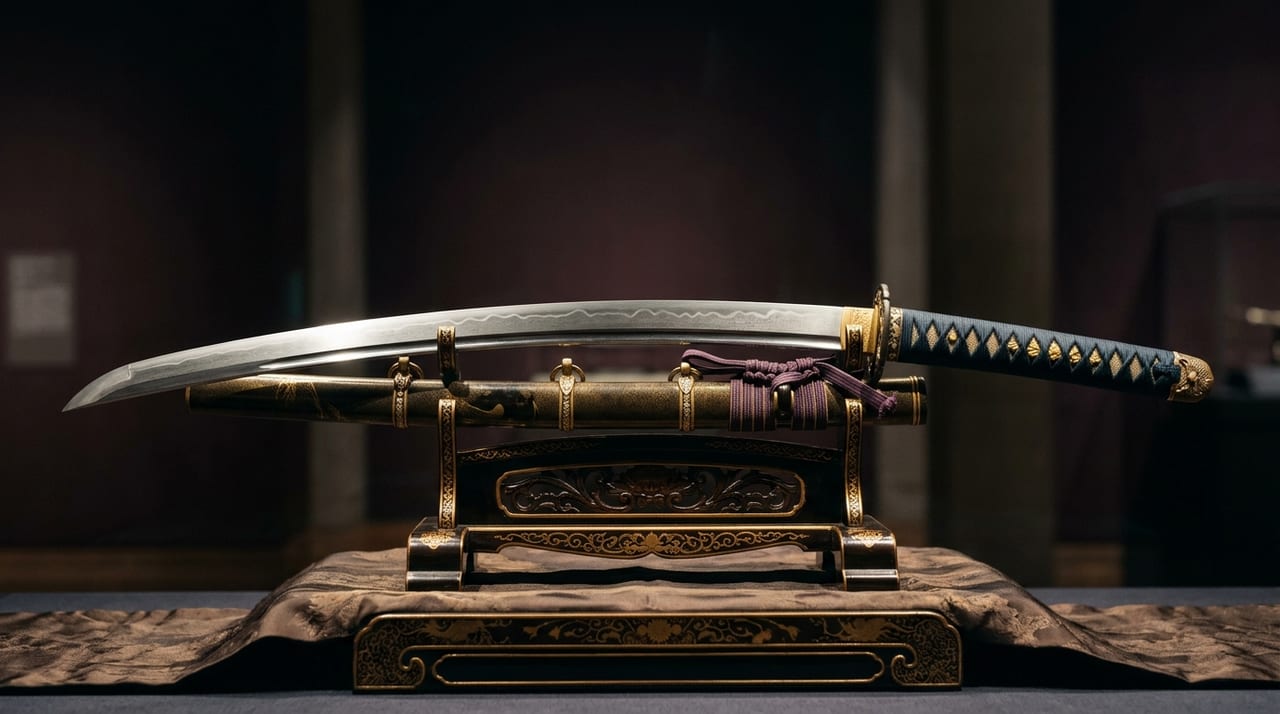
 * Image is for illustrative purposes only.
Ōdachi inscribed Teiji 5th Year, Senjuin Nagayoshi
大太刀 銘 貞治五年丙午千手院長吉
Also known as: Senjuin Nagayoshi odachi 1366, National Treasure dedicated by Emperor Gomurakami, Oyamazumi Shrine
Description
Senjuin Nagayoshi and the Yamato Senjuin School
Senjuin Nagayoshi was a swordsmith of the Nanboku-chō period based at Senjuin (the Senjuin-dani valley of Tōdai-ji) in Yamato Province (present-day Nara Prefecture). He is one of the outstanding master smiths representing the Yamato Senjuin school. The Senjuin school is said to have arisen in the late Heian period and is the oldest group of swordsmiths in Yamato; it is traditionally said to have forged swords for the warrior monks (sōhei) of Tōdai-ji. Nagayoshi came to the fore during the turbulent Nanboku-chō period and displayed outstanding skill in the field of ōdachi and nodachi.
Oyamazumi Shrine and Its Treasury of Arms
Oyamazumi Shrine is located in Ōmishima-chō, Imabari City, Ehime Prefecture, and enshrines Ōyamazumi-no-kami. It is an ancient shrine regarded as the supreme guardian shrine of mountains and seas throughout Japan. Venerated as a deity of arms, the shrine has received many armors and swords as offerings since ancient times. As cultural properties including its shrine buildings and its arms and armor, it holds 8 National Treasures and 76 Important Cultural Properties; about 40% of the armor across Japan designated as National Treasures or Important Cultural Properties is concentrated here, and the shrine is known as a “treasure house of arms.”
Overview of the Ōdachi and Its Provenance
This ōdachi is a nodachi forged by Yamato Senjuin Nagayoshi in Teiji 5 (1366). It has an enormous build, with a blade length of 135.7 cm and a sori (curvature) of 4.8 cm, and it is regarded as a representative masterpiece of the ōdachi (nodachi) style that was popular in the Nanboku-chō period. It is said that Emperor Go-Murakami (1328–1368) offered it to Oyamazumi Shrine, and on 31 March 1953 it was designated a National Treasure.
Features of the Blade and Forging Technique
The technical achievement of soundly forging a blade of over 135 cm in length is worthy of special note. Works of the Senjuin school are said to be characterized by a jigane (steel structure) in which flowing masame is mixed with itame, and by a narrow-width suguha-style hamon (temper line) with small midare mixed in. This work is a masterpiece of the Yamato Senjuin school that conveys the imposing blade form of the Nanboku-chō period.
Cultural Property Value
A secure inscribed date (Teiji 5) is carved on the blade, which makes it an example of Nagayoshi's work, and it is also considered an important standard work (kijunsaku) for chronological study of the style of the Yamato Senjuin school. It is housed and displayed at the Oyamazumi Shrine Treasure Hall, and enthusiasts of Japanese swords and armor visit from across Japan.
Legends & Stories
It is said that Emperor Go-Murakami of the Nanboku-chō period offered this blade to Oyamazumi Shrine. It records one episode in history, in which many powerful figures, from warrior households to the imperial family, offered famous swords to the shrine as offerings to Ōyamazumi Daimyōjin, the deity of war.