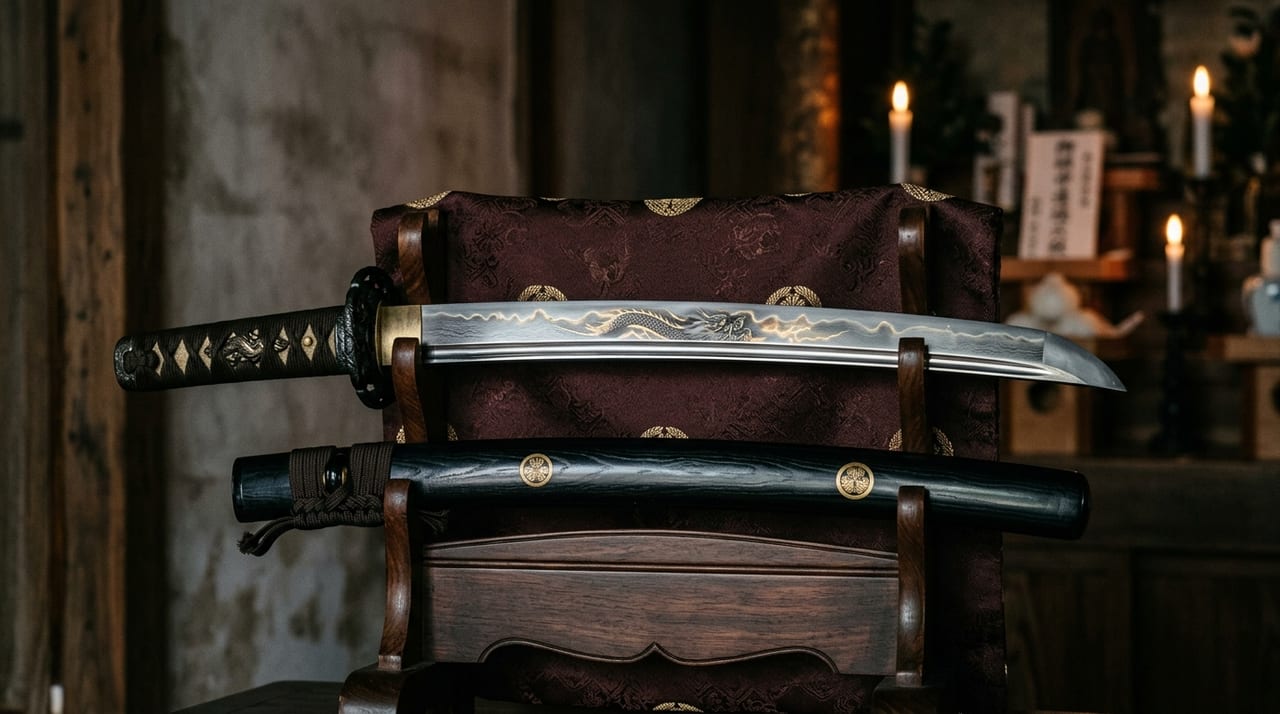
 * Image is for illustrative purposes only.
Rai Magotarō-saku
来孫太郎作
Also known as: Tachi signed Rai Magotarō-saku (with kaō), dated Shōō 5 (1292); tachi of the Tokugawa Art Museum
Description
Rai Kunitoshi's Only Signature as "Magotarō"
This tachi was signed "Rai Magotarō-saku," together with a kaō (personal seal), by Rai Kunitoshi, a swordsmith of Yamashiro Province (present-day Kyoto) active in the late Kamakura period. It bears the date the thirteenth day of the eighth month of Shōō 5 (1292). The sword treatise Shokoku Kaji Shidai records him as "Kunitoshi, Kyoto, Rai Magotarō, in the reign of Emperor Fushimi," and this is the only known example in which Kunitoshi used the alternate name "Magotarō" in his signature. It was designated an Important Cultural Property on 14 November 1953 and elevated to National Treasure on 20 March 1954.
Craftsmanship
The blade measures 77.3 cm in length, with a curvature of 3.0 cm and a tang of 20.9 cm. It shows a pronounced koshizori curve and strong build typical of late-Kamakura tachi form. The steel is finely wrought, and the temper is a dignified, straight suguha pattern. Bearing both a precise date and a kaō, the blade is of especially high documentary value among Rai Kunitoshi's signed works, since it fixes the year of production beyond doubt.
Provenance
The sword is said to have been used by Tokugawa Ieyasu and was subsequently handed down within the Owari Tokugawa family. It is now held by the Tokugawa Art Museum in Nagoya, where it is exhibited as one of the museum's representative tachi.
Significance
Rai Kunitoshi was a leading master of the Yamashiro Rai school and left numerous works designated National Treasure or Important Cultural Property in both tachi and tantō form. Yet no other work bearing his alternate signature "Magotarō" has been confirmed, making this blade a singular and invaluable benchmark in the study of his career.
Related Famous Swords
太刀 銘 国行(当麻)
National TreasureTachi Signed Kuniyuki (Taima)
Kuniyuki (founder of the Taima school)
伏見貞宗
National TreasureFushimi Sadamune
Sadamune (Sōshū Sadamune)
太刀 銘 大和則長作
Important Cultural PropertyTachi Signed Yamato Norinaga saku
Norinaga (Yamato Shikkake school)
沃懸地酢漿平文兵庫鎖太刀
National TreasureIkakeji Katabami Hyōmon Hyōgogusari Tachi
Unknown (unsigned)