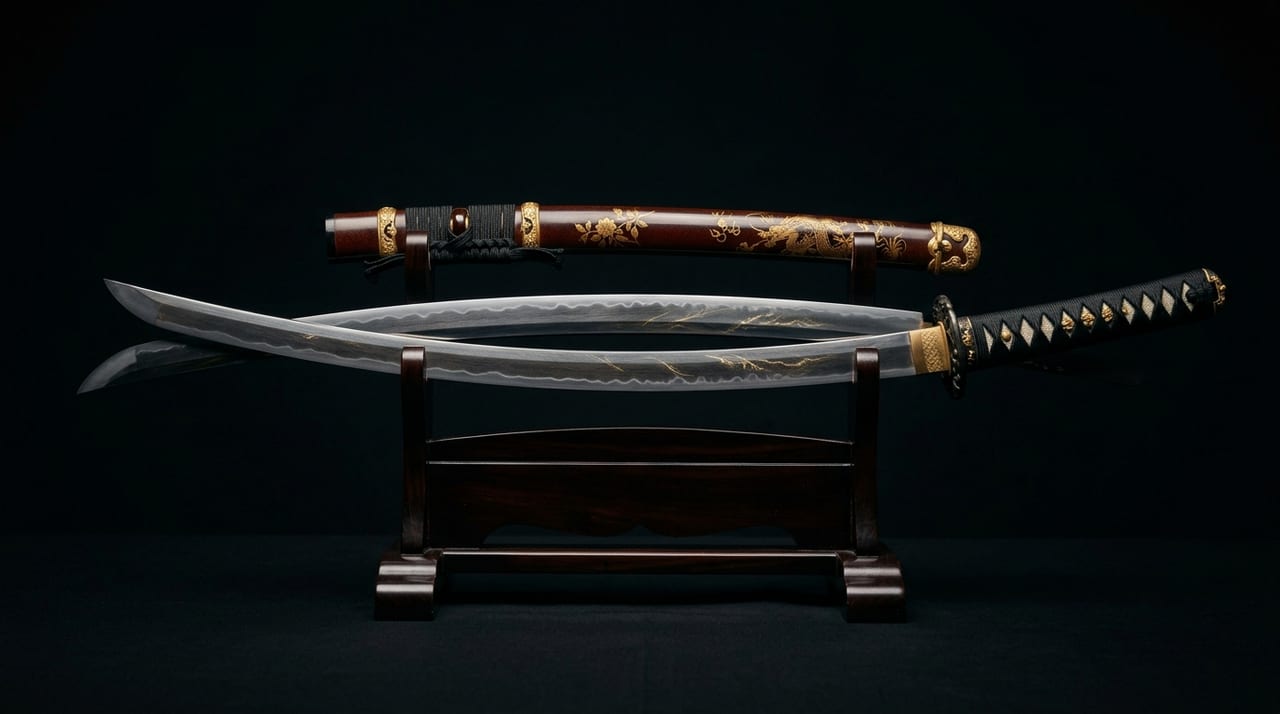
 * Image is for illustrative purposes only.
Katana, unsigned, attributed to Sadamune (Owari Tokugawa family transmission)
刀 無銘 貞宗(尾張徳川家伝来)
Also known as: Owari Tokugawa Sadamune — a large-shortened (o-suriage) Nanbokucho-style Soshu blade
Description
Sadamune and the Sōshū Tradition
Sadamune, commonly known as Hikoshirō, was a swordsmith active in Sagami Province (present-day Kanagawa Prefecture) from the late Kamakura period into the early Nanboku-chō period. He is said to have been either a son or an adopted son of Masamune, the perfecter of the Sōshū tradition, and he was appointed Sahyōe-no-jō. While inheriting Masamune's style, he left works characterized by a lucid jigane and a hamon full of spirit.
Overview of the Sword
This is an unsigned blade with a blade length of 69.1 centimeters and a curvature of 2.4 centimeters. It was shortened by ō-suriage, and it conveys the broad-bodied, imposing form of the Nanboku-chō style. The jigane is ko-itame with chikei, and the hamon is notare with dense ashi, with kinsuji and sunagashi appearing frequently. Ji-nie is thickly present, giving the blade the appearance of fine snow quietly settling on its surface.
Provenance in the Owari Tokugawa Family
This sword was handed down in the Owari Tokugawa family and is counted among the many famous swords that family held. Although it is unsigned, it has been attested as a genuine work of Sadamune. The ō-suriage removed the area of the signature, so the inscription is lost, but based on the quality of the jigane and hamon it is evaluated as a work from the mature period of Sadamune's later years.
Designation and Current Ownership
It is designated as an Important Cultural Property. After passing down from the Owari Tokugawa family, it is now owned by the Token World Foundation (Token Corporation).
Legends & Stories
A katana attributed to Sadamune, transmitted through the Owari Tokugawa family. Though unsigned due to later shortening, its steel and hamon confirm it as a genuine Sadamune work, designated an Important Cultural Property as a representative Nanbokucho-era Soshu blade.