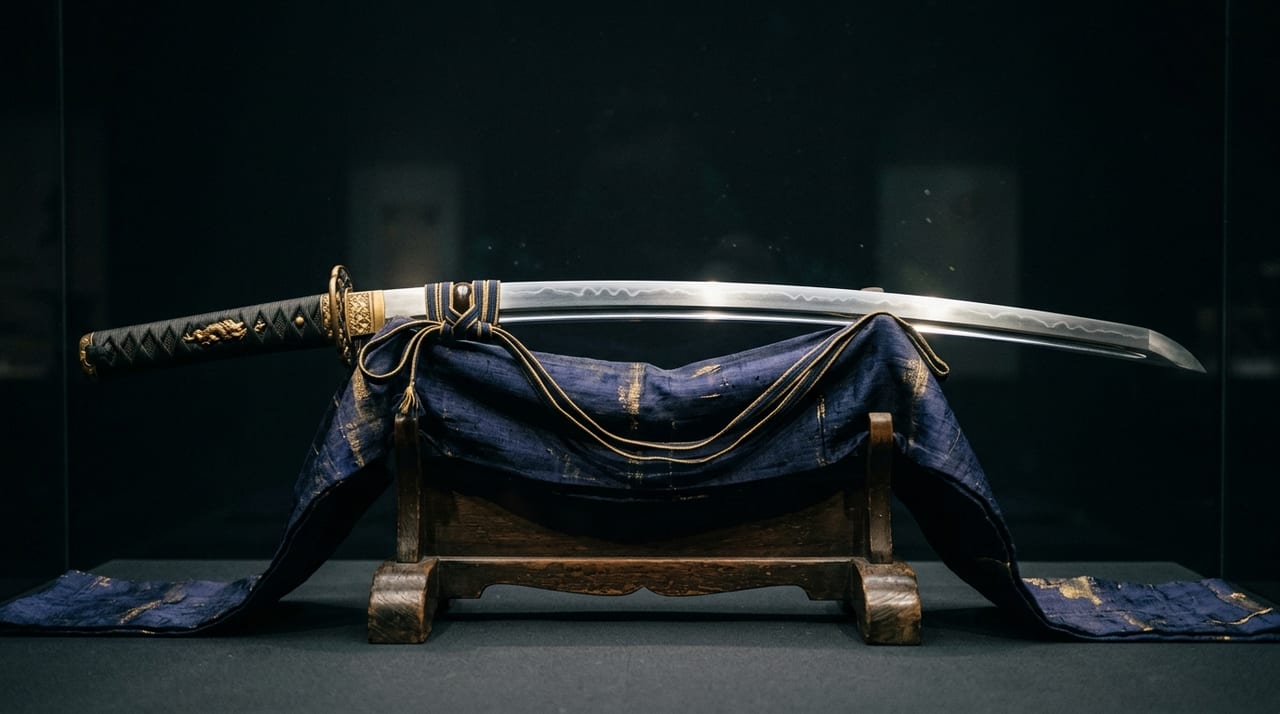
 * Image is for illustrative purposes only.
Tachi signed Norikuni (Awataguchi Norikuni)
太刀 銘 則国(粟田口則国)
Also known as: Awataguchi Norikuni tachi — National Treasure, Tottori Ikeda clan provenance, Kyoto National Museum
- Smith
- Awataguchi Norikuni (Yamashiro Province)
- Era
- Early Kamakura period (13th century)
- Type
- Tachi
- Designation
- National Treasure
- Location
- Kyoto National Museum, Higashiyama Ward, Kyoto
Description
About Awataguchi Norikuni
Awataguchi Norikuni was a master smith active in Awataguchi, Yamashiro Province (present-day Higashiyama Ward, Kyoto City), in the early Kamakura period (13th century), and is an important member of the Awataguchi school. The Awataguchi school was the foremost swordsmith group in Yamashiro, producing many master smiths such as Kunitomo, Hisakuni, Kuniyasu, and Yoshimitsu from the late Heian period through the Kamakura period, and it is known for an elegant style that fuses the culture of the Kyoto court nobility with the beauty of the sword. Norikuni is said to have been a son (or grandson) of Kunitomo, and is one of the representative swordsmiths of the Awataguchi school, alongside Hisakuni, Kuniyasu, Kunitsuna, and Yoshimitsu.
Characteristics of the Sword
Blade length 74.7 cm, curvature 2.1 cm. The signature 'Norikuni' is a two-character signature, inscribed near the tip of the shortened tang (nakago) on the omote side of the blade (hakiomote). It shows the typical configuration of an old tachi from the early Kamakura period, with a slender form, a small kissaki, and an elegant appearance in which the point looks slightly drooping.
The jigane (ground steel) shows tight ko-itame grain, with fine ji-nie (ground hardening), and displays a clear, bright steel surface. The hamon is based on a narrow straight temper (hosu-sugu-ha), and a dignified hardened edge (yakiba) extends across the whole blade with slight variations. The bōshi returns in a small round shape, and the blade maintains a well-balanced form from the machi to the tip. An elegant air characteristic of Kyoto swordsmiths pervades the whole, showing a serene realm of beauty that differs from the splendor of Bizen works.
Provenance and Designation as Cultural Property
This tachi is known as a sword that was handed down through generations of the Ikeda family of the Tottori domain, and it was designated an Important Cultural Property in Shōwa 9 (1934) and a National Treasure in Shōwa 29 (1954). It is currently held by the Kyoto National Museum.
Significance in the History of Japanese Swords
Extant tachi bearing the signature 'Norikuni' are extremely few, and this tachi, together with the signed Norikuni tachi held by Atsuta Shrine, is valued by sword researchers as a standard example (kijun sakurei) of Norikuni's work. It is an essential reference when discussing the lineage of the Awataguchi school and the formal characteristics of the Yamashiro tradition, and when it is exhibited it receives high praise as a masterpiece embodying the elegant beauty of the Japanese sword.
Legends & Stories
A rare surviving testament to the Awataguchi school's golden age, when the Kyoto smiths served the aesthetic demands of both the courtly capital and the new warrior class. National Treasure Norikuni blades are extraordinarily rare, making this tachi at the Kyoto National Museum among the most treasured examples of classical Yamashiro swordsmanship.