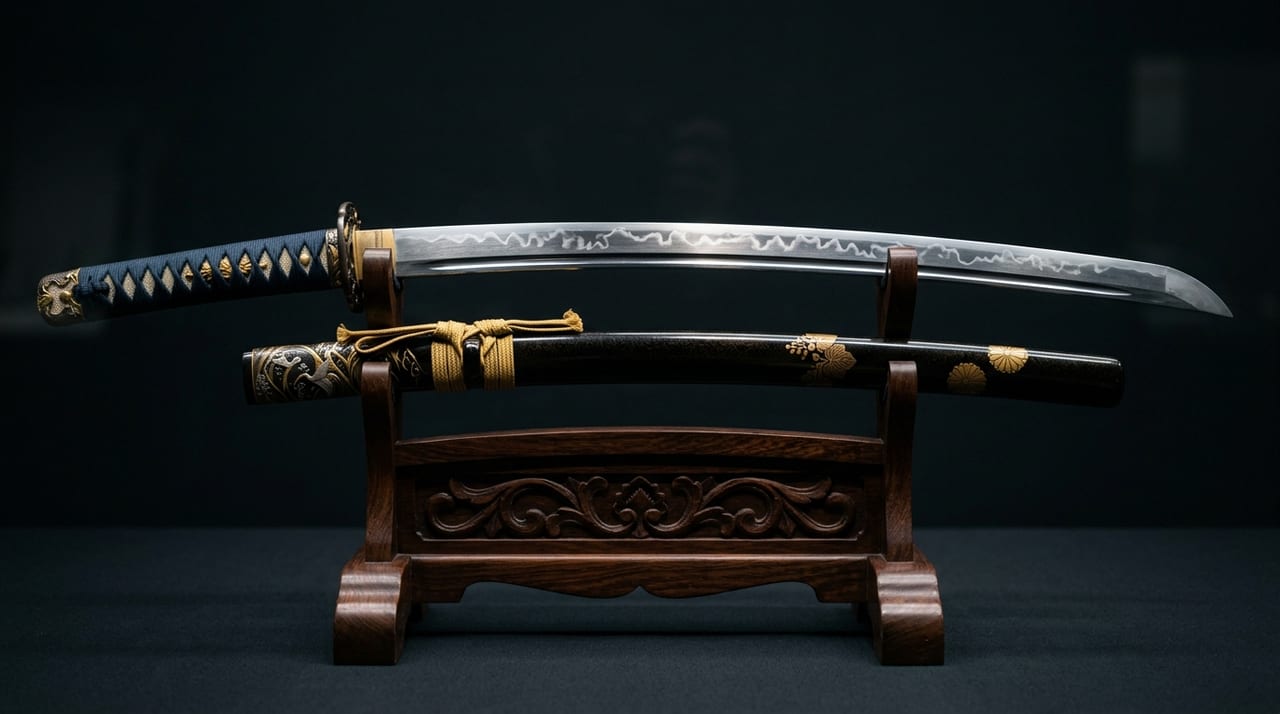
 * Image is for illustrative purposes only.
Nami-yu Kanemitsu (Wave-Swimming Kanemitsu)
波游ぎ兼光
Also known as: Nami-yu Kanemitsu — Wave-Swimming Kanemitsu, sword used to behead Toyotomi Hidetsugu, Kyoho Meibutsucho, Recognized Art Object
Description
Nami-yu Kanemitsu (Wave-Swimming Kanemitsu) is a uchigatana forged during the Nanbokucho period by Osafune Kanemitsu, the fourth-generation head of the Osafune school in Bizen Province. Kanemitsu synthesized the Bizen tradition with the Soshu style of Masamune, establishing the distinctive "Soden Bizen" approach — combining Bizen choji-midare with the deep, turbulent nie and vigorous activity of the Soshu school.
The sword's striking name derives from a grim legend at a Kuwana ferry crossing in Ise Province: at low tide, passengers waded or swam across; during a dispute a man was slashed with this blade, swam to the far bank, stepped ashore, and his body split cleanly in two. Such terrifying sharpness earned the epithet "wave-swimming."
In 1595, the sword was used by retainer Suzumebe Shigemasa to behead the regent Toyotomi Hidetsugu at Mt. Koya, on orders from his uncle Toyotomi Hideyoshi. The blade subsequently passed to Hideyoshi himself and was presented to Kobayakawa Hideaki in 1597 for the Korean campaign. It is listed in the Kyoho Meibutsucho (the definitive Edo-period catalog of famous swords, compiled 1719) under the name of Tachibana Hida-no-kami.
Now designated a Recognized Art Object (Juyo Bijutsuhin), the sword is held by Breast Seeb Co., Ltd. in Osaka.
Legends & Stories
At a Kuwana ferry crossing in Ise Province, a traveler who was slashed while swimming managed to reach the far shore before his body split cleanly in two — testament to the blade's supernatural sharpness and the origin of its name "wave-swimming."