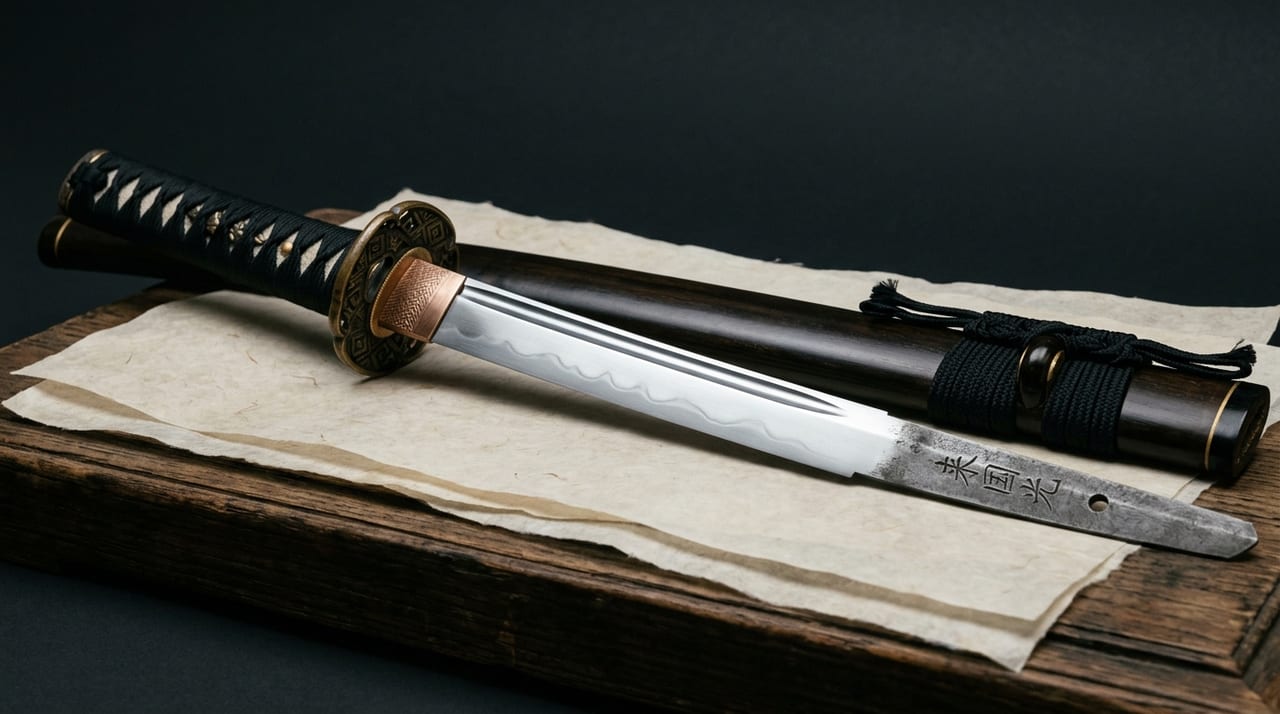
 * Image is for illustrative purposes only.
Tachi signed Sanetsune
太刀 銘 真恒
Also known as: Sanetsune — Kunozan Toshogu Museum
Description
Sanetsune and the Ko-Bizen School
Sanetsune was a swordsmith active in Bizen Province (eastern present-day Okayama Prefecture) during the Heian period. He is regarded as a master positioned within the orbit of the Ko-Bizen school, said to be the oldest lineage in the history of Japanese swords. Together with Masatsune and Tomonari, he preserves to this day the dignified style of Heian-period tachi.
Overview of the Tachi
This tachi measures 89.4 cm in blade length, 3.9 cm in curvature, 3.5 cm in width at the base, 2.2 cm in width at the tip, and 3.5 cm in length of the kissaki (point). It displays an imposing form, with a thick back and a broad blade body. For a tachi of the late Heian period it is large, and it boasts a stately workmanship that is praised alongside the famous blade Ō-Kanehira of the same era.
Offering to Kunōzan Tōshōgū
After the death of Tokugawa Ieyasu, a Tōshōgū was founded at Kunōzan (present-day Shizuoka City, Shizuoka Prefecture) in accordance with his last wishes. It is said that the second shogun, Tokugawa Hidetada, offered this tachi to the Tōshōgū at the enshrinement ceremony of Genna 3 (1617). It is considered one of the earliest swords offered among the blades transmitted at Kunōzan Tōshōgū, and it forms the core of the shrine's treasures.
Designation and Evaluation
It was designated a National Treasure on June 9, 1951 (Shōwa 26). Together with the Important Cultural Property Sohaya no Tsurugi, it is one of the representative swords transmitted at Kunōzan Tōshōgū.
Current Collection
It is currently owned by Kunōzan Tōshōgū and is displayed at the Kunōzan Tōshōgū Museum, rotating with other shrine treasures. The accompanying itomaki-no-tachi koshirae is a luxurious mounting: a scabbard of gold nashiji lacquer with paulownia crests in maki-e, fitted with full metal mounts of shakudō nanako ground decorated with scattered gold-painted paulownia crests.
Legends & Stories
A tachi said to have been offered by the second shogun Tokugawa Hidetada at the Tōshōgū enshrinement ceremony of Genna 3 (1617), after the death of Tokugawa Ieyasu. Of imposing workmanship, it is regarded, together with Ō-Kanehira, as a representative tachi of the late Heian period.