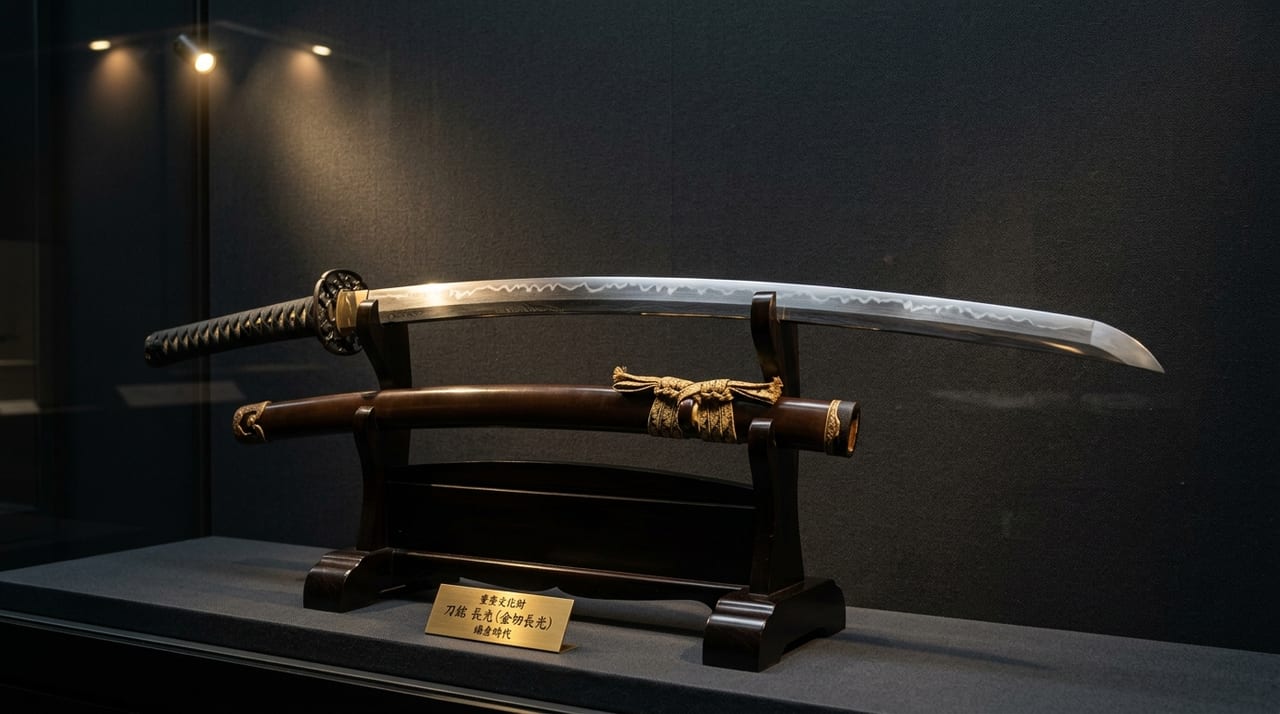
 * Image is for illustrative purposes only.
Kumokirimaru
蜘蛛切丸
Also known as: Wakizashi signed Yoshimitsu, Kameomaru
Description
Overview
Kumokirimaru is a Kamakura-period wakizashi signed Yoshimitsu of the Awataguchi school, with the reverse inscription "Kameomaru". It is said to have been dedicated to Atsuta Shrine by Oda Nobunaga in 1560, the year of the Battle of Okehazama, as a prayer for victory. It is an Aichi Prefecture designated cultural property kept at Atsuta Shrine.
The Smith and the Blade
Yoshimitsu of the Awataguchi school in Yamashiro Province, known as Toshiro, was renowned for his tanto and counted in the Edo period among the Three Great Smiths with Masamune and Go Yoshihiro. The blade is about 32.6 cm long and without curvature, and is described as having a long, imposing form for its width.
Origin of the Name
Kumokiri means "spider-cutter". According to legend, when its owner slept beneath a cedar tree and was attacked by a venomous spider, the wakizashi leapt from its scabbard on its own and cut the spider down. Similar tales are attached to other swords; it should not be confused with Hizamaru, the Minamoto family sword also nicknamed Kumokiri.
Nobunaga and Atsuta Shrine
Tradition holds that in 1560, on his way to Okehazama, Nobunaga stopped at Atsuta Shrine to pray for victory. Another sword associated with this offering is the Azamaru, also kept at the shrine, and the two have been exhibited together at the Atsuta Shrine Treasure Hall as Nobunaga-related blades.
Today
Atsuta Shrine, home of the Kusanagi sword, exhibits swords at its Treasure Hall. Kumokirimaru is known there both as a Nobunaga offering and as a wakizashi by Yoshimitsu.
Legends & Stories
Legend says the wakizashi drew itself from its scabbard to cut down a venomous spider attacking its sleeping owner; Nobunaga is said to have dedicated it at Atsuta Shrine before Okehazama.