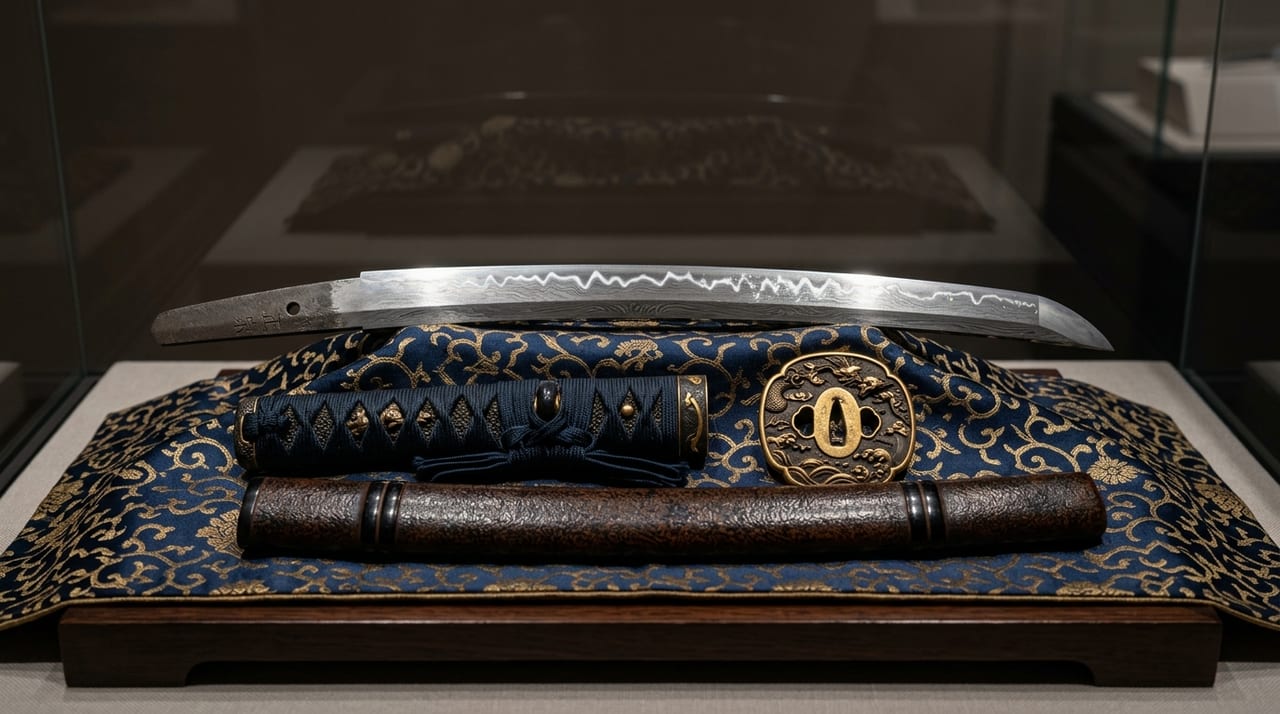
 * Image is for illustrative purposes only.
Kumano Sansho Gongen Nagamitsu
熊野三所権現長光
Also known as: Kumano Sansho Gongen Nagamitsu — National Treasure tachi by Osafune Nagamitsu, dedicated to Kumano
Description
Osafune Nagamitsu and the Bizen Osafune School
Osafune Nagamitsu was a master smith who worked in Osafune in Bizen Province (present-day Osafune-chō, Setouchi City, Okayama Prefecture) in the middle Kamakura period (late 13th century). He was the son of Mitsutada, regarded as the de facto founder of the Osafune school. He inherited his father's style and developed it further, leaving many masterpieces in a wide range of forms, including tachi, tantō and naginata. Many of Nagamitsu's works are designated as National Treasures or Important Cultural Properties, and tachi signed “Nagamitsu” have long been valued in the history of Japanese swords as the most reliable standard of Bizen Kamakura blades.
Kumano Sansho Gongen Nagamitsu: Overview
Kumano Sansho Gongen Nagamitsu is a tachi whose tang (nakago) is inscribed “Kumano Sansho Gongen Nagamitsu,” and it is designated a National Treasure. It is said to have been made for goma fire rituals, in which the imperial court prayed for the repulse of the Yuan forces during the Mongol invasions (Genkō), and later to have been dedicated to Kumano. “Kumano Sansho Gongen” collectively refers to the deities of the three shrines, Kumano Hongū Taisha, Kumano Hayatama Taisha and Kumano Nachi Taisha (Ketsumiko-no-Ōkami, Hayatama-no-Ōkami and Musumi-no-Ōkami). It was originally transmitted as a sacred sword of Kumano. In the Sengoku period, however, it passed into the hands of the Kuki clan, who led the Kumano naval forces. From then on it left the shrine's possession and passed among samurai houses and daimyō families.
Kumano Faith and the Dedication of Sacred Swords
The Kumano Sanzan (Hongū, Hayatama and Nachi) were syncretic sacred sites of Shinto and Buddhism. They drew so many pilgrims that they were said to be like “the pilgrimage of ants to Kumano” (Ari no Kumano-mōde). They received wide veneration, from the imperial family and regent houses (sekkan-ke) to samurai and common people. In particular, successive emperors made many pilgrimages (gokō), including the cloistered sovereign (hōō) Go-Shirakawa and the retired emperor (jōkō) Go-Toba. Samurai too had the custom of dedicating famous swords at this site. This sword is believed to have been transmitted to Kumano as one of these dedicated swords.
Characteristics of the Blade
True to Nagamitsu's tachi, the blade shows a hamon based on chōji-midare, developing a splendid and varied pattern. The jigane is finely forged with ko-itame-hada, and the midare-utsuri characteristic of Bizen works stands out clearly. Nagamitsu's distinctive bright, clear nioiguchi and the balanced action of nie and nioi convey the essence of Kamakura Bizen beauty to the present day.
Preservation and Designation as Cultural Property
After leaving Kumano, the sword passed through the hands of the Kuki family, then came into the possession of Oda Nobunaga, and later was held by Toyotomi Hideyoshi, who gave it to Uesugi Kagekatsu. After the Battle of Sekigahara it was presented from the Uesugi family to the Tokugawa shogunate. In Kyōhō 2 (1717) it was granted to Kutsuki Tanemoto, lord of Fukuchiyama Domain, and it has been handed down in the Kutsuki family since then. From the Meiji period onward it passed through the hands of the Hosokawa family and the sword researcher Satō Kanzan, among others, and it is now owned by an individual (or corporation). It was designated in 1931 under the former National Treasure Preservation Act (Kyū Kokuhō Hozonhō). On 22 November 1952 (Shōwa 27) it was newly designated a National Treasure under the Cultural Properties Protection Act (Bunkazai Hogohō). Although it has had a long transmission since leaving the shrine, it is highly valued as a representative work of Bizen Nagamitsu and as a sword that illustrates the relationship between Kumano faith and samurai society.
Legends & Stories
Said to have been dedicated to the three deities of Kumano (Hongu, Hayatama, and Nachi shrines). Kumano was so famous a pilgrimage site that it was said crowds came "like ants," and warriors customarily dedicated fine swords here.