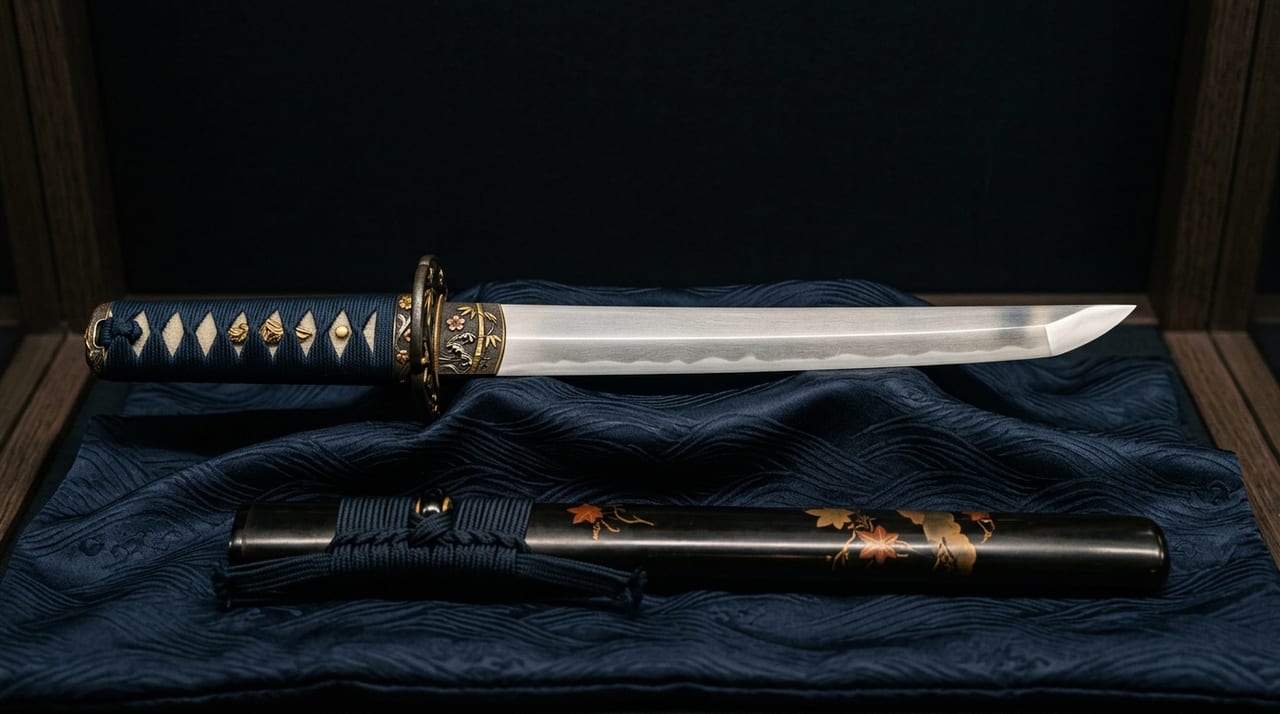
 * Image is for illustrative purposes only.
Kokin Denju no Tachi
古今伝授の太刀
Also known as: Kokin Denju no Tachi — National Treasure tachi by Bungo Yukihira, gifted by Hosokawa Yusai
Description
The Kokin Denju no Tachi is a tachi forged by Yukihira, a smith active in Bungo Province from the late Heian into the early Kamakura period. Its formal designation is "Tachi signed Bungo-no-kuni Yukihira saku," and it is designated a National Treasure together with its leather-wrapped scabbard mounting. It is held by the Eisei Bunko in Bunkyo, Tokyo. Yukihira is known as one of the earliest smiths to execute complex carvings on curved blades, and his work has long been highly esteemed.
The sword takes its name from the Kokin Denju, the most secret transmission of the art of waka poetry — the esoteric interpretation of the Kokin Wakashu, conveyed only from master to chosen disciple. In 1600, amid the upheaval preceding the Battle of Sekigahara, the warrior-scholar Hosokawa Yusai (Fujitaka) was besieged at Tanabe Castle. Because Yusai was then the sole living holder of the Kokin Denju, his death would have severed the tradition. By imperial command of Emperor Go-Yozei a truce was arranged and Yusai surrendered the castle. He then presented this tachi to the court noble Karasumaru Mitsuhiro as a token of the transmission he had bestowed — hence the sword's name.
It remained with the Karasumaru family through the Edo period, passed to Marquis Nakayama Takamaro in 1894, and was repurchased in 1929 by Hosokawa Moritatsu, returning it to the Hosokawa house connected to Yukihira's Bungo homeland. It was designated a National Treasure in 1951.
Yukihira's tachi shows an elegant, dignified shape with a finely packed ko-itame jihada and nie; the hamon is a suguha-based ko-midare with varied activity, and the blade often bears carvings such as kurikara dragons and Sanskrit characters, reflecting his pioneering role in curved-blade engraving. Beyond its merit as a weapon, it stands as a witness to a defining episode in Japanese cultural history.
Legends & Stories
On the eve of Sekigahara, the besieged Hosokawa Yusai's death would have ended the Kokin Denju, so Emperor Go-Yozei ordered a truce by imperial command. As he surrendered the castle, Yusai gave this tachi to his disciple Karasumaru Mitsuhiro as thanks for the transmission — remembered as "the sword that saved the way of poetry."