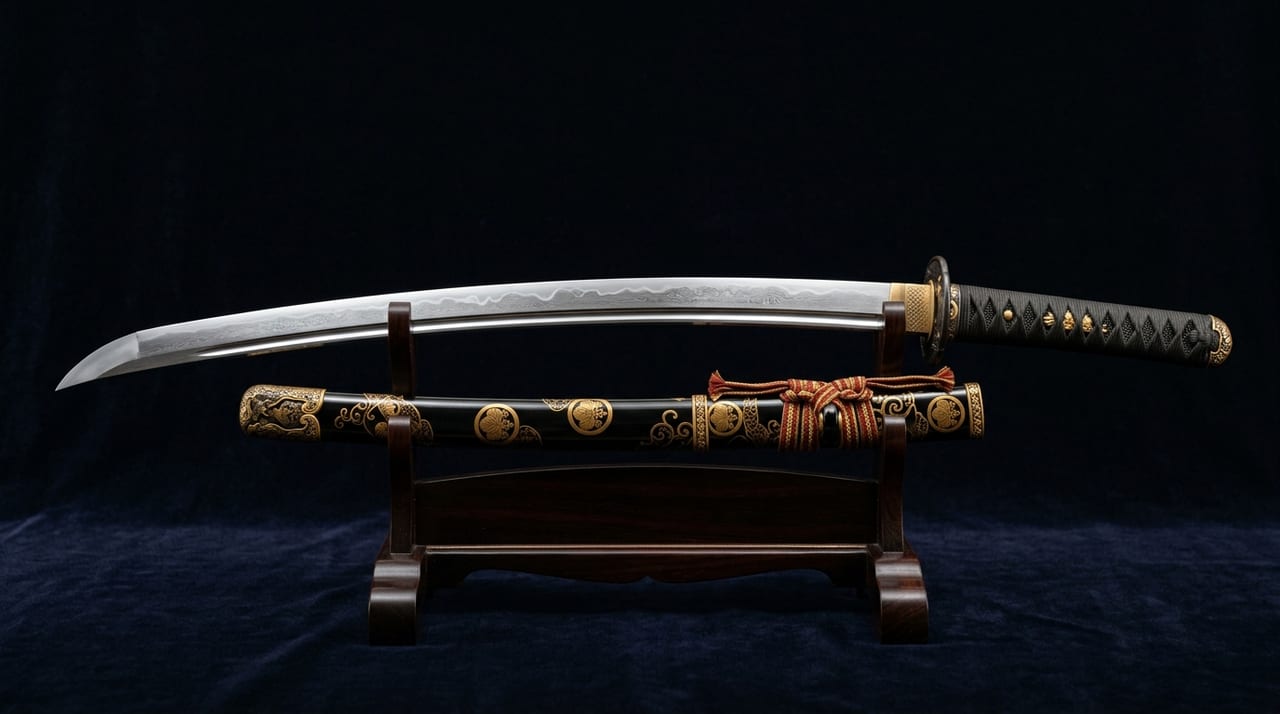
 * Image is for illustrative purposes only.
Kodetegashiwa Kanenaga
児手柏包永
Also known as: Kodetegashiwa, Konotegashiwa Kanenaga
Description
Overview — a blade with two faces
Kodetegashiwa Kanenaga is a sword by Kanenaga, a Kamakura-period smith of the Tegai school of Yamato Province. It passed from Hosokawa Yūsai to Tokugawa Ieyasu and was thereafter handed down in the Mito Tokugawa family. Its defining feature is a hamon (temper pattern) that differs completely between the outward-facing (omote) side and the reverse (ura) side of the blade, and this very quality gave rise to the sword's name, Kodetegashiwa. Sources classify it differently: Cultural Heritage Online lists it as a kodachi, while The Tokugawa Museum records it as a tachi.
Workmanship — two hamon on one blade
The blade's greatest highlight is that within a single sword the hamon differs between the two faces: the outward-facing side is midare (irregular), while the reverse is suguha (straight). Japanese blades are normally tempered with broadly matching patterns on both faces, so this "two-sided" quality has drawn attention since early times as a character unmatched by any other. The Tegai school to which Kanenaga belonged was one of the five schools of the Yamato tradition, based near the Tegaimon (Tegai Gate) of Tōdai-ji in Nara, and known for the strength of its jigane (base steel), a hallmark of Yamato blades.
Signature
On the outward-facing side of the tang (nakago), toward its tip, the original two-character signature "Kanenaga" remains. In addition, an added inscription by Hosokawa Yūsai, "Hyōbu-no-tayū Fujitaka suriage kore, thirteenth day of the third month, Tenshō 2," has been cut, recording that Yūsai shortened the blade (suriage) on 4 April 1574 (Tenshō 2, 3rd month, 13th day). The coexistence of the smith's signature and a later owner's own record of alteration on a single tang makes this a work rich in clues for reading its transmission.
Provenance — from Hosokawa Yūsai to the Mito Tokugawa
After leaving Hosokawa Yūsai's possession, the sword came into the hands of Tokugawa Ieyasu, who passed it to his eleventh son, Tokugawa Yorifusa. Yorifusa became the founder of the Mito Tokugawa family, and from then on the blade was handed down through the generations as a treasure of the Mito Tokugawa. It is currently the personal collection of Tokugawa Narimasa, the fifteenth head of the Mito Tokugawa family.
The Great Kantō Earthquake and survival
During the Great Kantō Earthquake of 1 September 1923 (Taishō 12), the sword was affected at the Mito Tokugawa residence in Honjo Shin-Koume-chō. For a long time it was believed to have been lost in a fire, but in fact, although it had survived in a fire-damaged (shōshin) state, the Mito Tokugawa family continued to keep it, and its survival was confirmed in 2015 (Heisei 27). It is currently preserved at The Tokugawa Museum in Mito, Ibaraki Prefecture.
Legends & Stories
The origin of the name "Kodetegashiwa"
The name is said to have been given by Hosokawa Yūsai. He likened the blade's two contrasting faces — a midare hamon on one side, suguha on the other — to the Man'yōshū verse "on Nara hill, the kodetegashiwa, two-faced." The kodetegashiwa (Chinese arborvitae) bears foliage that stands without a distinct front or back, and was long invoked in poetry as a figure for two-facedness. Where most sword sobriquets derive from an owner's name or an anecdote, this one takes the workmanship itself as its source and expresses it through classical verse — a fitting choice for Yūsai, who was celebrated as a poet.
What survives in a burned blade
The Great Kantō Earthquake left the sword shōshin — fire-damaged, its hamon and the activity of its steel impaired. Such blades lose much of their standing as art objects and are often written off as lost, and this one was indeed presumed destroyed for decades. Yet the Mito Tokugawa family never parted with it, and its survival was confirmed in 2015. Still bearing its descent from Ieyasu and the inscription Yūsai had cut into its tang, the sword stands as a reminder that a blade carries more than the beauty of its temper line.