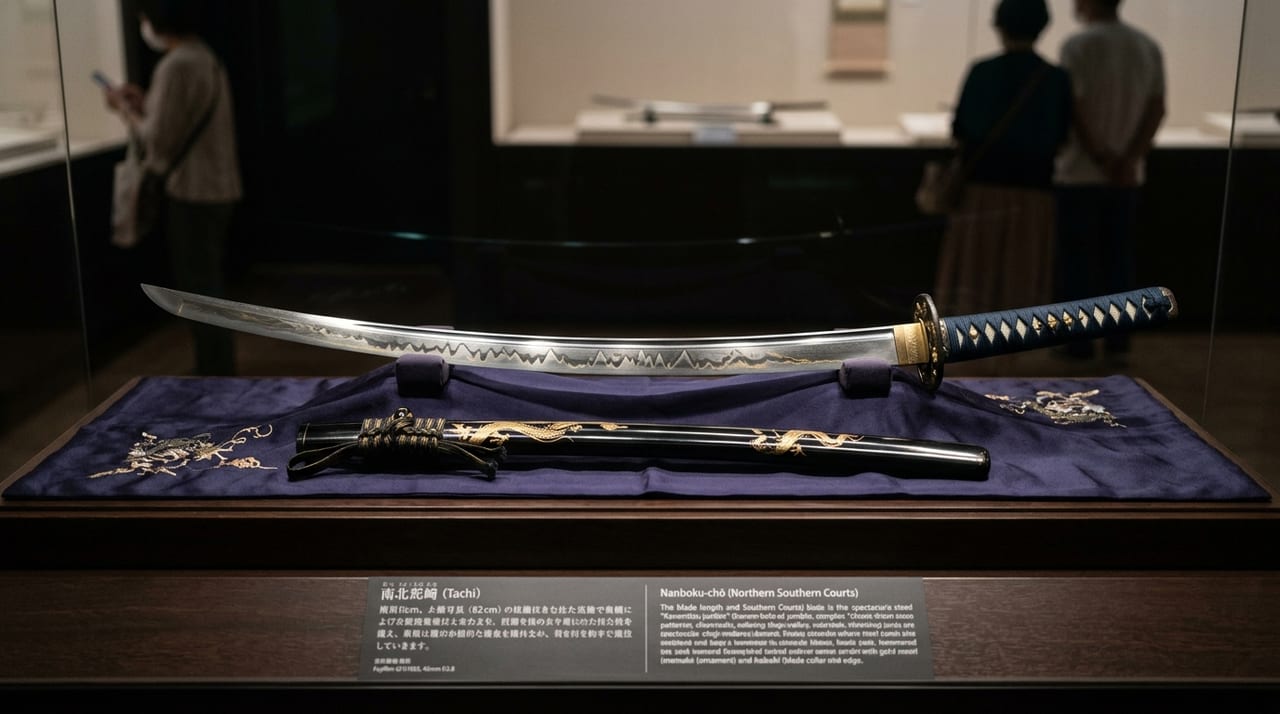
 * Image is for illustrative purposes only.
Tachi Signed Yasutsugu
太刀 銘 康次
Also known as: Ko-Aoe Yasutsugu; heirloom of the Shimazu clan; held at the Hikaru Museum
Description
A Tachi by Yasutsugu of the Aoe School
Tachi Signed Yasutsugu is a work by the swordsmith Yasutsugu, who was active in Bitchū Province (the western part of present-day Okayama Prefecture) during the Kamakura period. It is classified as a "Ko-Aoe" (early Aoe) work, representing the earliest phase of the Aoe school's output. The blade is a National Treasure held by the Hikaru Museum in Takayama, Gifu Prefecture, operated by the religious corporation Sūkyō Mahikari, and was designated a National Treasure on 2 February 1955. The Bitchū Aoe school was active from the Kamakura through the Nanboku-chō periods and produced numerous works later designated National Treasures and Important Cultural Properties.
Style
Among surviving Aoe-school works, this blade is counted among the longest and widest, presenting a bold, grand form. The hamon shows a splendid pattern blending large and small motifs, combined with the calm, restrained ji-gane texture characteristic of the Ko-Aoe school, making it one of the representative Kamakura-period works of the Bitchū tradition.
Provenance
The blade is said to have been presented by the 15th Ashikaga shogun, Yoshiaki, to Shimazu Yoshihisa, the sengoku-period daimyo of Satsuma Province, and was subsequently passed down within the Satsuma Shimazu clan for a long period. In the modern era it came into the possession of the religious corporation Sūkyō Mahikari and is now held at its Hikaru Museum.
Designation and Present Location
The blade is designated a craft-work National Treasure and is located at the Hikaru Museum in Nakayama-chō, Takayama City, Gifu Prefecture. For conservation reasons, it is not on permanent year-round display.
Legends & Stories
The blade is said to have been a gift from the 15th Ashikaga shogun, Yoshiaki, to Shimazu Yoshihisa, the sengoku-period daimyo of Satsuma — an episode reflecting the bond between the shogunate and a powerful outer domain. It remained a treasured heirloom of the Shimazu family for centuries thereafter.
Related Famous Swords
太刀 銘 国行(当麻)
National TreasureTachi Signed Kuniyuki (Taima)
Kuniyuki (founder of the Taima school)
伏見貞宗
National TreasureFushimi Sadamune
Sadamune (Sōshū Sadamune)
太刀 銘 大和則長作
Important Cultural PropertyTachi Signed Yamato Norinaga saku
Norinaga (Yamato Shikkake school)
沃懸地酢漿平文兵庫鎖太刀
National TreasureIkakeji Katabami Hyōmon Hyōgogusari Tachi
Unknown (unsigned)