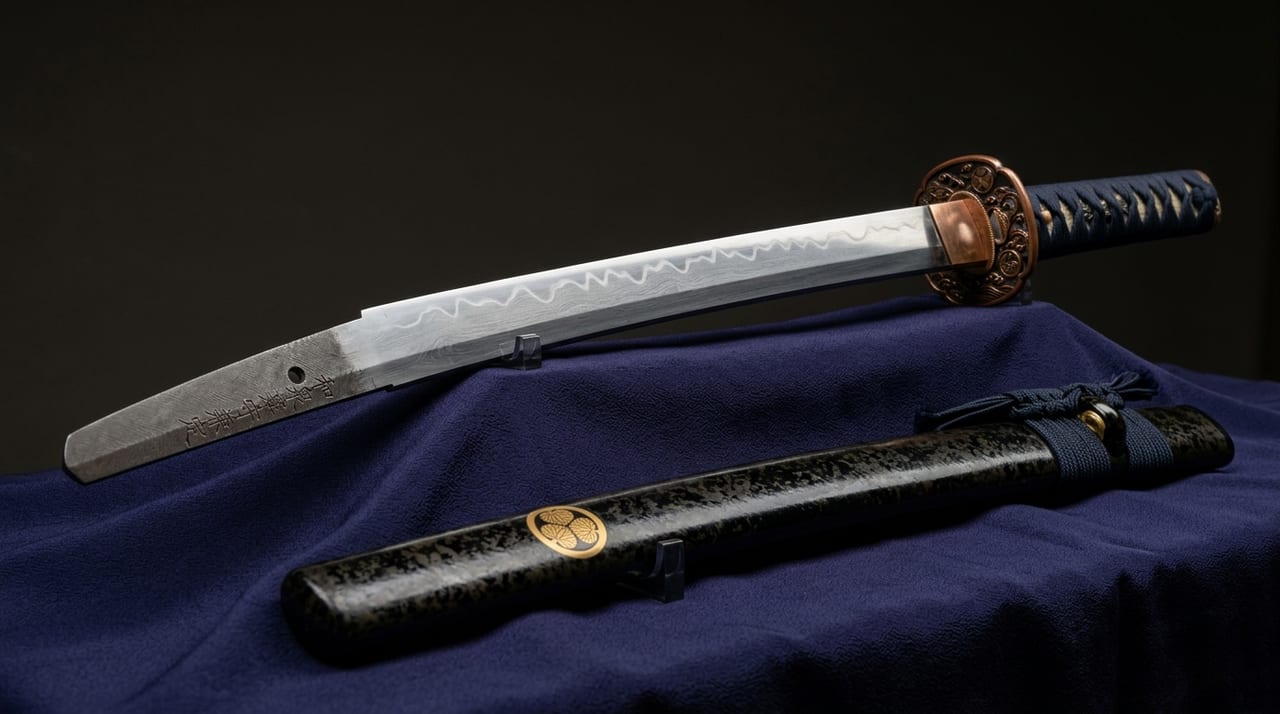
 * Image is for illustrative purposes only.
Karakashiwa
唐柏
Also known as: One of Kagekatsu's Thirty-Five Selected Swords
Description
Overview
Karakashiwa is a tachi made by Hasebe Kuninobu, a swordsmith of the Nanbokucho period. It is certified as an Important Art Object and is held in a private collection.
Maker
The Hasebe school was active in Yamashiro Province from the Nanbokucho into the Muromachi period; its founder Hasebe Kunishige, one of the ten great pupils of Masamune, showed the Soshu tradition. Kuninobu was Kunishige's younger brother, with a similar style, though his tanto tend to be somewhat larger and are characterized by very thin kasane.
Name and Provenance
The name is said to come from the resemblance of its hitatsura hamon to the form of the karagoma (karakashiwa). The sword scholar Sato Kanzan called it an elegant name. It was one of the thirty-five swords personally selected by Uesugi Kagekatsu from several hundred, known as "Kagekatsu-ko Oten-sen Sanjugo-yo", and was passed down in the Yonezawa Uesugi family. It was designated an Important Art Object on 10 May 1938 in the name of Count Uesugi Noriaki, but went missing when it was confiscated by GHQ after the war; it was later found to have gone to the United States and has returned to Japan in recent years.
Form
The blade is 79.4 cm long, with a curvature of 3.57 cm, a kissaki length of 4.1 cm and a tang of 22.0 cm. It is shinogi-zukuri with an iori-mune, with itame mixed with flowing masame-tinged hada and beautiful ji-nie. The tang is extremely beveled on its cutting edge side, a form also seen in Kuninobu's tachi at the Tokyo National Museum, and thought to be his own device. It came with an uchigatana mounting thought to date from Uesugi Kenshin's time, which was certified as an Important Art Object together with the blade.
Legends & Stories
Named for a hitatsura hamon resembling the karagoma, one of the thirty-five swords chosen by Uesugi Kagekatsu.