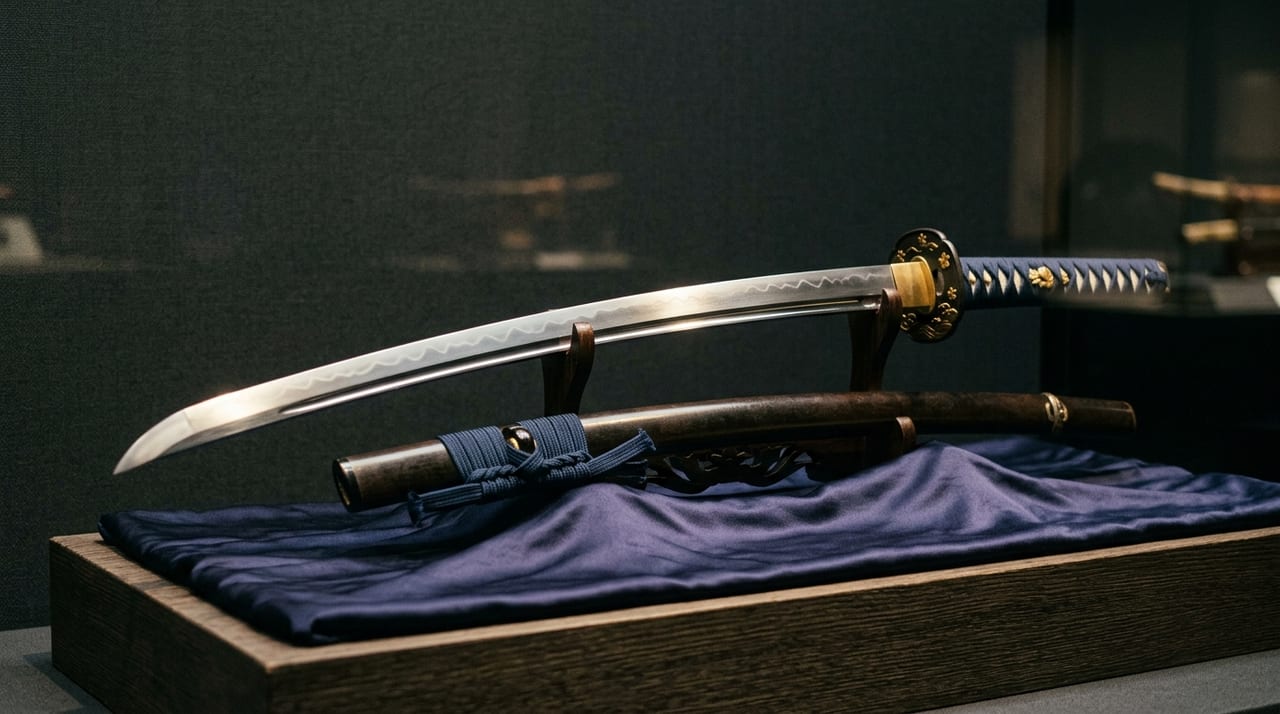
 * Image is for illustrative purposes only.
Kambe Taima
上部当麻
Also known as: Kambe Taima — Taima tanto owned by Kambe Sadanaga, Kyoho Meibutsucho meibutsu
Description
What Kambe Taima Is
Kambe Taima is a tantō certified as a work of the Taima school of Yamato Province (present-day Nara Prefecture). It is a meibutsu recorded in the Kyōhō Meibutsuchō, compiled in Kyōhō 4 (1719). It is unsigned (mumei) and bears an attribution inscription (kiwamemei) reading "Taima" applied by the Hon'ami family, accompanied by the Hon'ami family's kaō (monogram). The blade length is 8 sun 7 bu (approximately 26.4 cm). The front is carved with a ken (sword carving) and the back with a shōbu-hi.
The Taima school, the maker, is one of the Yamato Goha (Five Yamato schools), a group of smiths that arose around Taima-dera in Nara. It is known for its strong masame-hada in the jigane and its suguha-style hamon, and for the refined, elegant style characteristic of Yamato smiths who were attached to temples and shrines.
Origin of the Name
The sword's name "Kambe" derives from its first owner, Kambe Etchū-no-kami Sadanaga. Combining the school name "Taima" with the owner's name "Kambe," it is called "Kambe Taima."
Provenance and Anecdotes
According to the Kyōhō Meibutsuchō, Kambe Taima was held by Kambe Etchū Sadanaga of Ise and then passed through several hands. Another account holds that Jō Izumi-no-kami obtained it from an oshi of Ise, and it is therefore also called "Jō Izumi Taima." It passed through the hands of Matsudaira Shimōsa-no-kami and Matsudaira Dewa-no-kami and was presented to the fourth shogun, Tokugawa Ietsuna, as a bequest. Later, during the Jōkyō era, when Tsuruhime, daughter of the fifth shogun Tokugawa Tsunayoshi, married into the Kishū Tokugawa family, the shumei was added, and the Kishū Tokugawa family received it.
An anecdote associated with this tantō holds that it was originally to be bought for one piece of gold. However, because a second piece of gold was found by chance along the way, it was effectively obtained for "practically nothing." The Kyōhō Meibutsuchō values it at 5,000 kan.
Evaluation
Kambe Taima is an excellent tantō that displays the refined style of the Yamato Taima school. It is a prestigious meibutsu with attribution by the Hon'ami family and a provenance passing through shogunal and daimyo households. Among the Yamato Goha, it has long been cherished by sword enthusiasts as a fine standard piece for studying the style of the Taima school.
Legends & Stories
A tradition is told that it had been agreed to buy it for one piece of gold. However, because a second piece of gold was found by chance along the way, it was effectively obtained for "practically nothing." The Kyōhō Meibutsuchō values it at 5,000 kan.