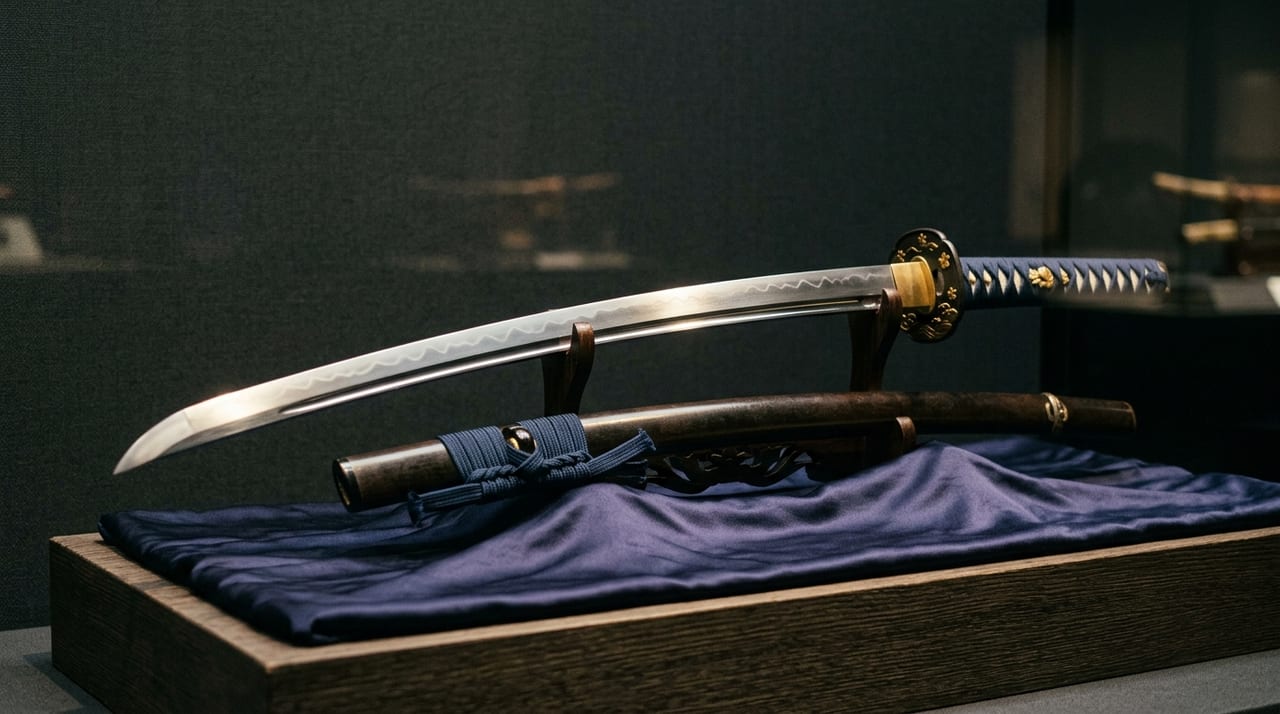
 * Image is for illustrative purposes only.
Ishidoro-giri Kotetsu
石灯籠切虎徹
Also known as: Toro-giri Kotetsu
Description
Overview
Ishidoro-giri Kotetsu is an uchigatana made in the Edo period by Nagasone Okisato (Kotetsu). It bears no date, but from its signature style it is attributed to around autumn of Kanbun 9 (1669) or about Kanbun 12. It is regarded as the most famous of all Kotetsu blades, and its straight, almost curvature-free shape, apparently a special order, is unlike any other.
Origin of the Name
The name comes from an anecdote in which Kotetsu, to prove the cutting power of the blade to the hatamoto who ordered it, cut at a pine branch and, with force to spare, cut into a stone lantern standing beside it. The tang carries the signature "Nagasone Okisato Nyudo Kotetsu" followed by an inlaid-cut inscription "Ishidoro-giri". Many texts name the client as Kugai Inaba-no-kami (Kugai Masakata), but accounts differ between books; some do not identify the hatamoto, and the location of the lantern is variously given, including Yushima Tenjin. The sword scholar Fukunaga Suiken has even suggested, from the timing of the tang's shortening, that Kotetsu may not have been the one who cut the lantern.
Form
According to the Dai Nihon Token-shi the blade length is 2 shaku 1 sun 2.5 bu (about 64.4 cm), in shinogi-zukuri with a small kissaki and almost no curvature, with a wide notare hamon mixed with gunome. It was reportedly 2 shaku 4 sun originally and shortened twice, and it has been pointed out that the added inscription was cut after the shortening.
Provenance
In 1935 it was shown at the Takashimaya famous-sword exhibition as the possession of Viscount Hosokawa Toshibumi. Its whereabouts were then unknown for a long time until it was exhibited by a Tokyo sword dealer at the 2021 Tobi Special Exhibition, where it was appraised Tokubetsu Hozon Token.
Legends & Stories
The most famous Kotetsu, said to have cut through a pine branch and on into a stone lantern beside it.