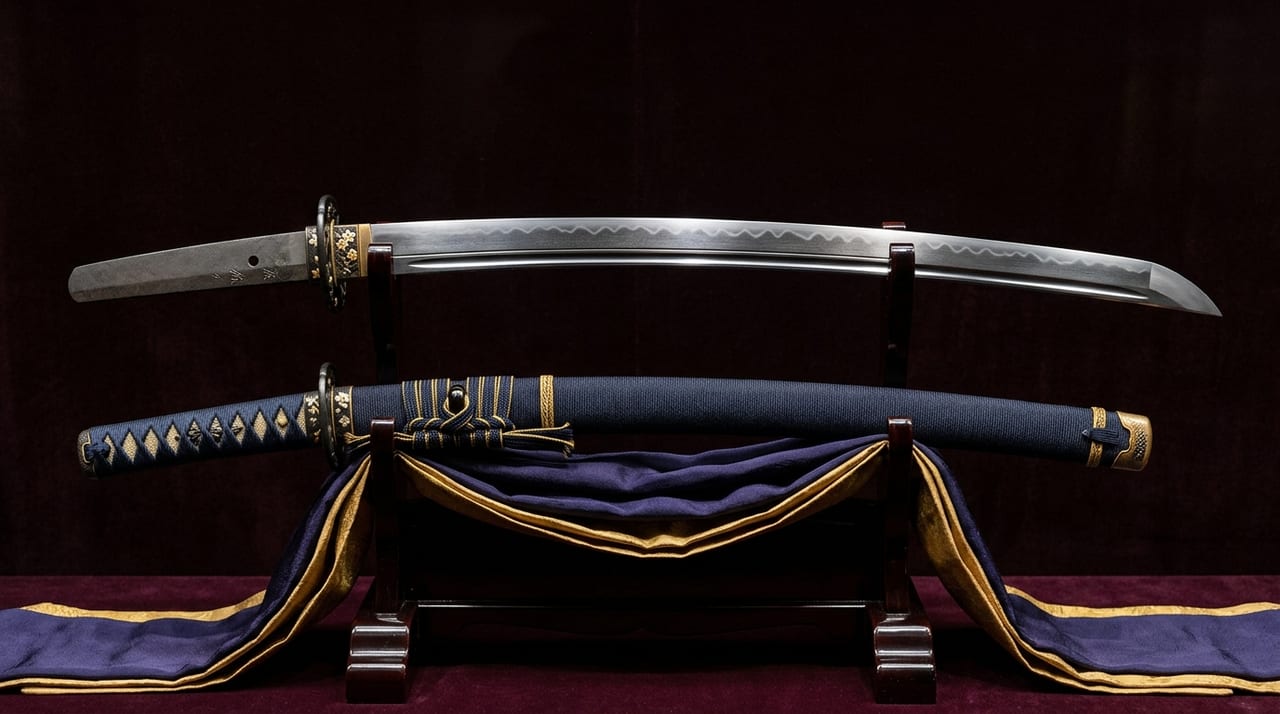
 * Image is for illustrative purposes only.
Hoso Masamune
疱瘡正宗
Also known as: Smallpox Masamune
Description
Overview
Hoso Masamune is an unsigned blade attributed to Soshu Masamune, a celebrated sword of the Tokugawa shogunal house. It gets its name from the custom of a shogun presenting it to his heir to celebrate recovery from smallpox (hoso). Designated an Important Cultural Property in 1961, it is held by the Sano Art Museum.
Origin of the Name
The name is said to originate in 1728, when the eighth shogun Tokugawa Yoshimune gave the sword to his heir Ieshige on recovery from smallpox. It was reportedly presented on the same occasion three more times: Ieshige to Ienari in 1753, Ienari to Ieyoshi in 1820 and Ieyoshi to Iesada in 1840. The name is also said to derive from the inscription on its scabbard.
Form and Style
The blade is 2 shaku 2 sun 5 bu (about 68 cm) long with about 2.6 cm of moderate curvature. The steel combines hard and soft iron, with prominent ji-hada and kinsuji. The hamon is notare mixed with gunome, described as "snow melting in patches" (yuki no muragie).
Provenance
It originally belonged to the Todo family of Tsu Domain in Ise and is said to have been presented to the fifth shogun Tsunayoshi in 1703. It then became a treasure of the shogunal house and was used for the gifts above. It was certified as an Important Art Object on 12 September 1936.
Today
It is held by the Sano Art Museum in Mishima, Shizuoka, and is known as a core piece of the sword collection built by museum founder Sano Ryuichi (1889-1977).
Legends & Stories
A Masamune given by successive shoguns to their heirs on recovery from smallpox, which gave it its name.