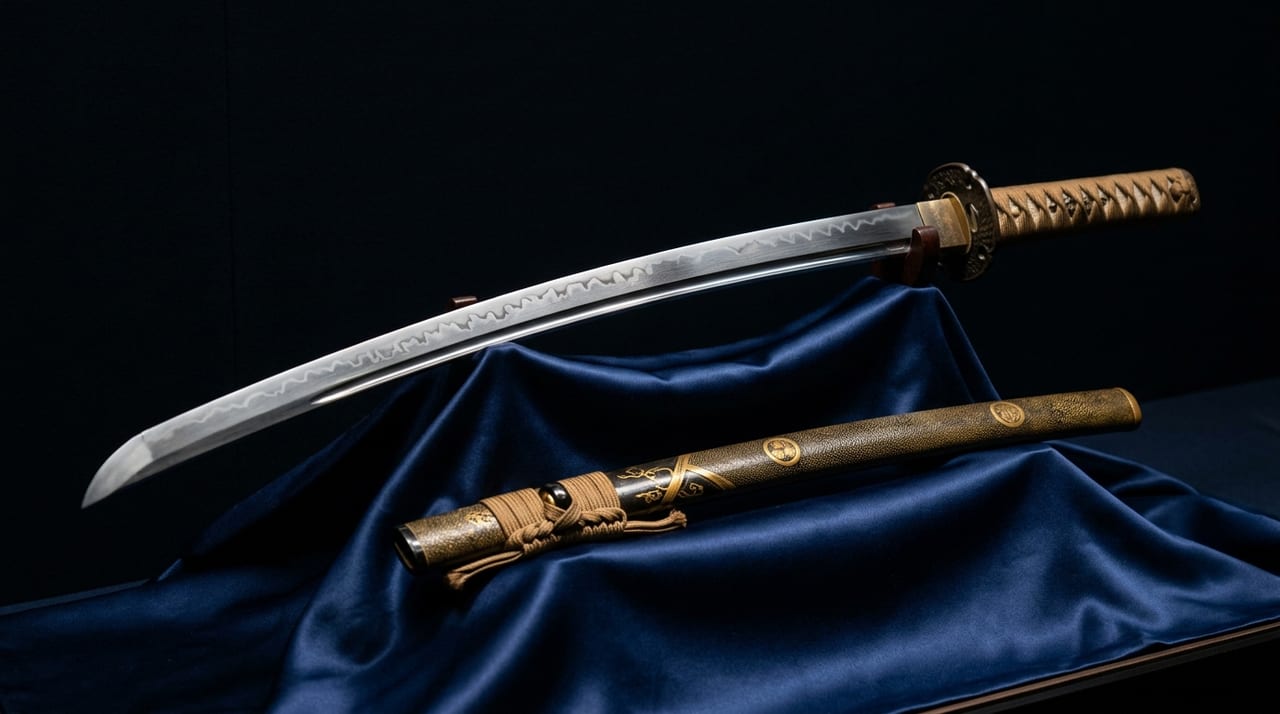
 * Image is for illustrative purposes only.
Katana signed Shinano no Kami Kunihiro (Donated by Toyotomi Hideyori)
刀 銘 信濃守国広(豊臣秀頼寄進)
Also known as: Kunihiro katana donated by Toyotomi Hideyori to Kitano Tenmangu in 1607
Description
Horikawa Kunihiro (c. 1531–1614) is regarded as one of the supreme masters of the shinto (new sword) era and the most influential sword teacher in Japanese history, training an entire generation of Kyoto swordsmiths. Born in Hyuga Province (modern Miyazaki) in a samurai family, he eventually settled in Kyoto's Horikawa district, where he obtained the court title Shinano no Kami in 1585 and thereafter signed as "Shinano no Kami Kunihiro."
In 1607 (Keicho 12), Toyotomi Hideyori (1593–1615) completed the grand reconstruction of Kitano Tenmangu's main hall and worship hall in memory of his father Toyotomi Hideyoshi. To commemorate the occasion, Hideyori commissioned this katana from Kunihiro and dedicated it to the shrine. The long inscription on the tang reads: "When Lord Toyotomi Hideyori undertook the reconstruction of Kitano Tenmangu's divine precinct — Keicho 12, 11th month — made by Shinano no Kami Kunihiro," recording the patronage, date, and craftsman with unusual precision.
The blade displays the vigorous, healthy form characteristic of the finest shinto work: a hamon of deep nie with gunome-midare, flowing itame ji-hada reflecting Kunihiro's powerful technique. It survives in excellent condition.
Designated an Important Cultural Property, the sword is housed in the Kitano Tenmangu treasure hall. As a documented intersection of Toyotomi Hideyori's cultural patronage, Horikawa Kunihiro's peak-period craftsmanship, and Kitano Tenmangu's history as the preeminent Tenman shrine, it stands among the most historically layered signed blades of the Keicho era.
Legends & Stories
Commissioned by Toyotomi Hideyori in memory of his father Hideyoshi and dedicated to Kitano Tenmangu at the completion of the shrine's grand reconstruction. The sword stands as a symbol of the Toyotomi clan's final flourishing before the Osaka campaigns of 1615.