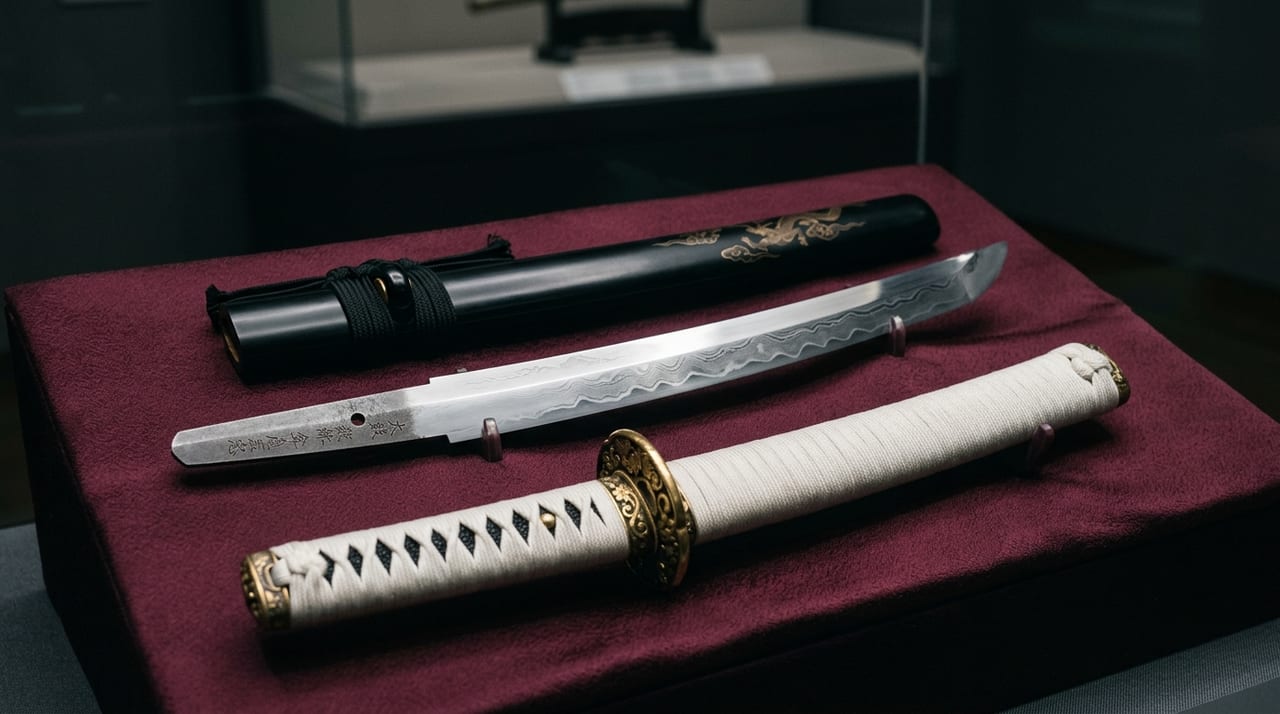
 * Image is for illustrative purposes only.
Tachi signed Masatsune (Hachisuka Masatsune)
太刀 銘 正恒(蜂須賀正恒)
Also known as: Hachisuka Masatsune — regarded as the foremost signed work of Ko-Bizen Masatsune, Fukuyama Museum of Art
Description
Masatsune and the Ko-Bizen School
Masatsune is a representative swordsmith of the Ko-Bizen school who was active in Bizen Province from the late Heian period through the Kamakura period. He is a master smith who is often named alongside Tomonari, and he is known for having the largest number of extant signed works among the Ko-Bizen school.
Overview of the Tachi
This tachi measures 77.6 cm in blade length, 2.6 cm in curvature, 2.9 cm in width at the base, 1.6 cm in width at the tip, and 2.5 cm in kissaki length. The jigane shows a well-packed ko-itame-hada, with ji-nie present and ji-utsuri appearing. The hamon is ko-midare with abundant ashi and yō, the ko-nie is deep, and the bōshi is slightly undulating and returns in a small round. It displays an elegant form with a high koshizori, and among Masatsune's signed works it is considered the most archaic in both inscription style and workmanship and of the highest quality.
Provenance: The Hachisuka Family
It was passed down to the Hachisuka family, daimyō of Awa (present-day Tokushima Prefecture), and left that family in 1933. The designation 'Hachisuka Masatsune' derives from the family's possession of the sword. It later passed through the hands of several owners and came into the collection of Komatsu Yasuhiro, founder of FP Corporation, a food packaging materials manufacturer in Fukuyama City.
Designation and Current Collection
It was designated a National Treasure on March 29, 1952. After Komatsu Yasuhiro's death, his collection was donated to Fukuyama City in 2018, and it is now held by the Fukuyama Museum of Art (Fukuyama, Hiroshima Prefecture).
Legends & Stories
A Ko-Bizen Masatsune tachi that was passed down to the Hachisuka family, lords of the Tokushima domain in Awa, and remained in their possession until 1933. It is regarded as the most archaic and finest of Masatsune's signed works.