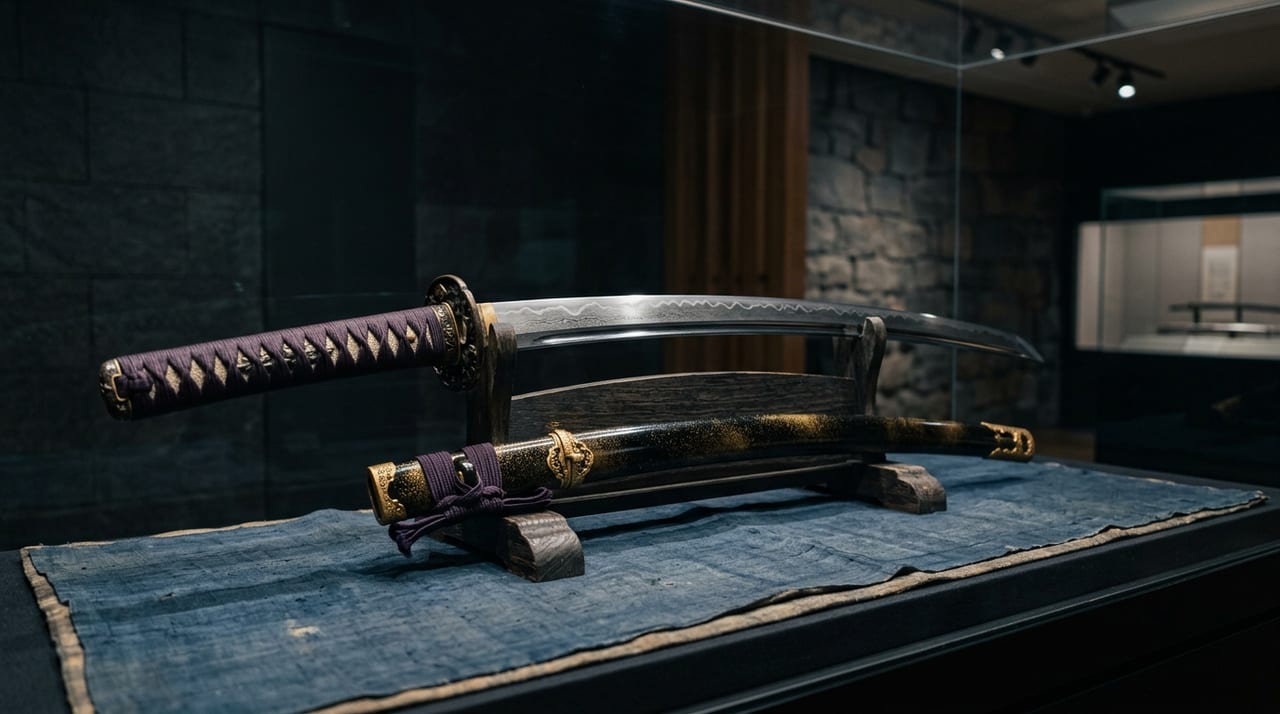
 * Image is for illustrative purposes only.
Tachi by Osafune Kanemitsu (Meibutsu Fukushima Kanemitsu)
太刀 長船兼光(名物 福島兼光)
Also known as: Fukushima Kanemitsu
- Smith
- Osafune Kanemitsu
- Type
- Tachi (Bizen tradition, Osafune school)
- Designation
- Important Cultural Property
- Location
- Tokyo National Museum
Description
Overview
Fukushima Kanemitsu is a tachi made by the smith Kanemitsu of the Bizen Osafune school in the Nanbokucho period (14th century). It is designated an Important Cultural Property and is held by the Tokyo National Museum. The National Cultural Heritage Database of the Agency for Cultural Affairs registers it as "Tachi, inscribed Bishū Osafune jū Kanemitsu (Meibutsu Fukushima Kanemitsu) / Kan'ō □-nen hachigatsu hi."
Smith and Style
The maker, Osafune Kanemitsu, is regarded as an orthodox smith of the Bizen Osafune school, active from the late Kamakura period into the Nanbokucho period. The Tokyo National Museum's commentary highlights two features of this tachi: a well-ordered itame hada with vivid utsuri, and a hamon that combines a chokuba-style edge with small reverse-angled ko-chōji.
Origin of the Name and Provenance
The name derives from the Sengoku-period daimyo Fukushima Masanori, who owned it. It is a meibutsu recorded in the Kyoho Meibutsucho, and it was later passed to the Maeda family of Kaga. The Tokyo National Museum's commentary states that the name arose because Fukushima Masanori obtained the sword from Honkaku-ji temple in Hiroshima.
Today
It is held by the Tokyo National Museum. It is not always on display, so check the museum's exhibition information before visiting.
Legends & Stories
Named for its owner Fukushima Masanori, this Nanbokucho tachi was recorded in the Kyoho Meibutsucho and later passed to the Maeda family of Kaga.